The earliest wars weren't chaotic skirmishes — they were organized, ideological conflicts. Stefan Milo makes this case using evidence from Spanish cave paintings and burial sites that most people have never seen.
The Art of War
Deep in a rock shelter on Spain's Mediterranean coast, a prehistoric painting captures something unmistakable: at least 29 figures on two sides launching arrows at each other. Their legs outstretched, leaping into combat. Someone leaps backward, firing their bow. It's dramatic — perhaps the most dramatic day of their entire lives.
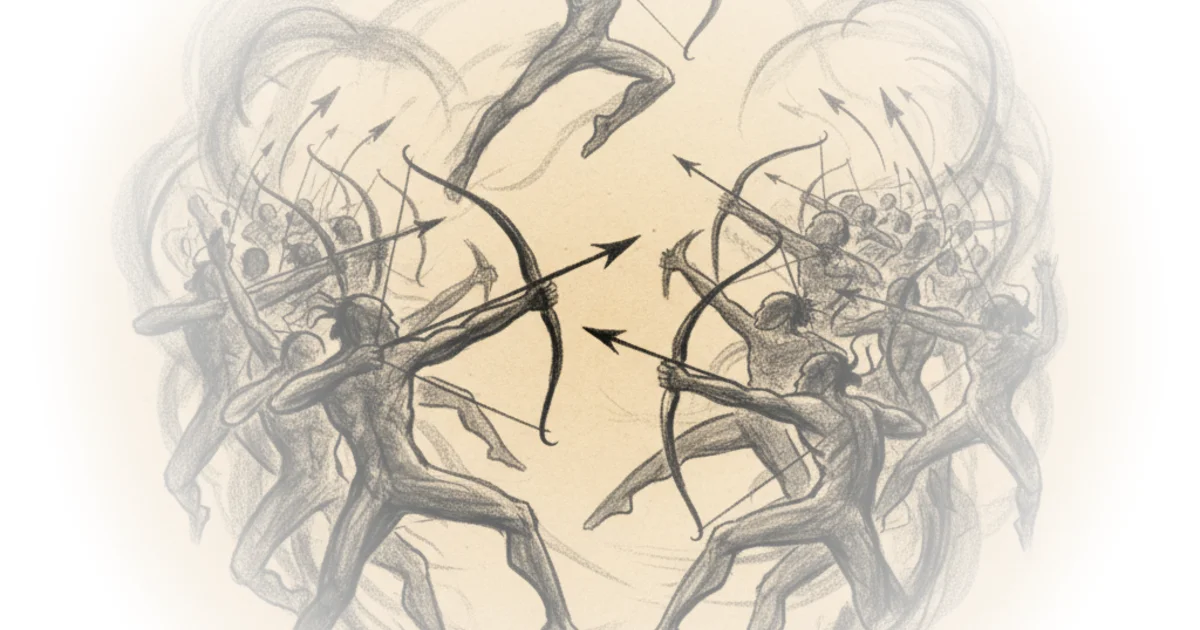
This is Les Dog in the Castillion region of Spain. The paintings were made during the Iberian Neolithic period, roughly 8,000 to 4,500 years ago. They hang beneath a rock overhang high above the valley floor, virtually invisible after thousands of years of exposure to the elements — but still visible today thanks to modern scanning technology.
The artwork from this region is called Levantine art (which simply means "eastern" art). The battle scenes are remarkable. In one painting at Quaver Mela, fighters leap into action with such intensity that archaeologists describe it as feeling like you can see into the past. This scene became so famous it was printed on a Spanish stamp.
Another panel shows what archaeologists interpret as an ambush — smaller figures surrounding larger ones in the middle. A larger figure may represent a chief or big man, similar to how Terra Cotta warriors depicted rank: higher status meant larger depiction.
Most macabre is a painting of 11 people standing with a lone individual on the ground, arrows sticking out of him. What did he do? What taboo did he break? These are questions that can never be answered, but the event clearly demanded commemoration — perhaps marking the final moment of a battle or execution.
Other panels show figures marching together, bows raised, possibly in formation or ceremony. One hunting scene depicts people leaping around a boar with an arrow sticking out of it, another possibly dead on the floor. The composition captures chaos and fear: the boar charging, humans running away.
Bodies in the Cave
The paintings alone would be remarkable. But archaeologists found something far more visceral at San Juan anti-orium latinum — a rock shelter in northern Spain where remains of at least 338 individuals were unearthed, jumbled together so deeply that it's impossible to identify all remains accurately.
Of those that could be identified, 70% were males or young males — the demographic participating in warfare. Among them: 52 flint arrowheads, 64 blades, two polished stone axes, three pebbles, five bones, and personal ornaments. These weren't grave goods; these were weapons that killed people.
The arrowheads all show impact damage. But here's what haunts researchers: 59 of 107 cranial injuries were healed. Many of these people had been in conflict before — this was not their first battle.
"81% of the healed wounds were on male bodies, showing a real gender divide between who is participating in this conflict."
Truly organized war seems to have emerged during the Neolithic period — but wars impact all of society. Among the remains, archaeologists identified at least 34 women and 64 children.
The broader societal impacts are visible in the bones themselves. Thirty-six percent of people showed cribra orbitalia — a condition that becomes porous from trauma, particularly starvation and food insecurity. Of 64 children, 39 had it. This was a community in trouble for a very long time. People lived hard lives.
Weapons of the Neolithic
Archaeologists found remarkably preserved weapons at another site: 6,000-year-old arrows made of reeds and olivewood — lightweight, straight, abundant resources. Arrowheads were tied to shafts using birch tar. Three fragments of twisted fiber believed to be bow strings were found, made from the sinews of goats, deer, and pigs.
No bow was recovered at this site, but one was found in Catalonia: approximately 1 meter long and made of yew — the same wood that English longbows used in the medieval period.
Why War Changes Everything
Why does warfare increase during the Neolithic? The logic isn't difficult. Farming ties people very closely to a specific piece of land. There's no more roaming the landscape freely. You're on a specific piece for at least an entire year, and this encourages people to feel protective of that land — real ownership.
Creating resources in one place also incentivizes raiding. If you don't have enough food, your neighboring village has food too. And with sedentary farming societies, inequality arises easily through unequal access to land, grain, and animals.
This seems to have led to the creation of true wars — organized conflicts driven by ideology rather than just individual squabbles.
Counterpoints
Critics might note that interpreting art as evidence of organized warfare requires assumptions about what the paintings represent. Some archaeologists argue battle scenes could be hunting rituals, ceremonial performances, or symbolic narratives rather than literal documentation. The physical remains at San Juan are ambiguous — 338 people buried together could reflect disease, ritual sacrifice, or conflict, but it's difficult to distinguish between these explanations with certainty.
Bottom Line
The strongest part of Milo's argument is the combination of visual evidence (paintings showing clear battle scenes) and physical evidence (weapons that killed people, skeletal remains showing healed injuries). This suggests organized warfare was real. The biggest vulnerability: the interpretation relies on circumstantial links rather than definitive proof — we cannot confirm these paintings depict actual events or that all the burial sites represent war casualties. But the pattern across both art and archaeology is compelling. If you're interested in how humans became who they are, this is where it started.