Most discussions about space exploration focus on rocketry or orbital mechanics, but Rohin Francis pivots to a far more visceral reality: the terrifying prospect of performing surgery while floating in microgravity. This piece stands out because it moves beyond the sci-fi tropes of bleeding astronauts to dissect the specific physiological and engineering failures that make even a routine knee replacement a potential death sentence in orbit.
The Physiology of Disaster
Francis begins by dismantling the assumption that a doctor on Earth can simply guide a procedure in space. While the International Space Station is close enough for real-time communication, the Moon's "Luna Gateway" presents a unique challenge where a 2.5-second delay makes remote surgery feasible but fraught with risk. However, the true horror lies not in the distance, but in the patient's body itself. Francis explains that astronauts are already in a state of physiological distress before a scalpel ever touches them.
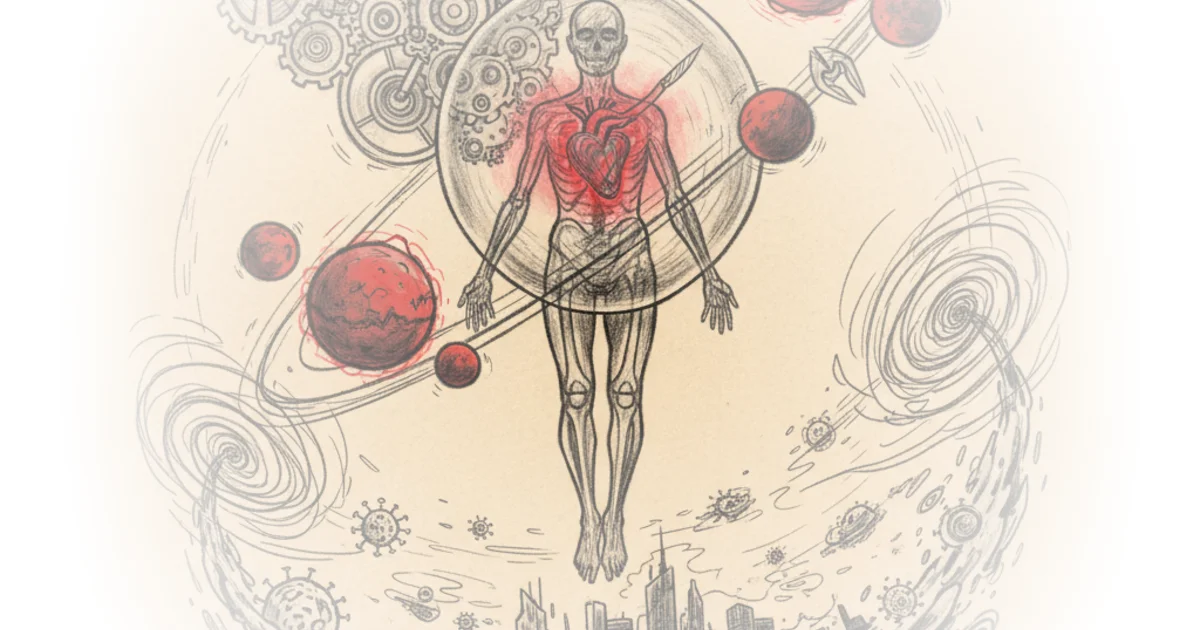
"Without gravity pulling downwards on our bodies fluid redistributes to the center of the body and volume receptors in the blood vessels and the heart interpret this as the body having too much fluid on board so they tell the kidneys to pee it out," Francis writes. This leads to a condition he colorfully terms "puffy face chicken leg syndrome," where astronauts start any potential trauma with up to a third less blood volume than a person on Earth. The argument here is compelling because it reframes the patient not as a healthy explorer, but as someone already operating on the edge of a hemorrhagic shock.
Critics might note that Francis leans heavily on theoretical models and parabolic flight data rather than long-term ISS surgical outcomes, simply because no major surgery has yet been attempted in orbit. Yet, this gap in data is precisely the point: we are sending humans into an environment where our medical protocols are unproven.
"Bacteria have increased virulence in microgravity they can even grow in 3d which could be a huge issue for the rest of the crew."
The Engineering of Containment
The commentary shifts from biology to physics, addressing the nightmare of fluid dynamics in zero gravity. On Earth, gravity pulls blood down; in space, surface tension dominates, turning arterial bleeding into floating droplet streams that can coat every surface. Francis highlights the critical lack of infrastructure to handle this, noting that standard suction devices could contaminate the station's closed-loop air system with bacteria.
"You might get organs that have just covered with a layer of blood that might stop you having the best visualization so you'd need some sort of suction device that may help," Francis paraphrases the consensus among space medics. The proposed solution—a sterile glove-box enclosure—sounds simple but introduces its own complexities regarding sterility and maneuverability. Francis's framing is effective here because it exposes the absurdity of trying to adapt Earth-bound tools to a fundamentally alien physical environment.
As Francis puts it, "we know much more about microgravity than yeah um either lunar or martian gravity." This paradox suggests that our preparation for Mars is actually less advanced than our understanding of the journey there. The distinction between microgravity and partial gravity (like on Mars) is often glossed over, yet Francis insists it is a critical variable for both the surgeon's dexterity and the patient's recovery.
The Digital Frontier
In a surprising pivot, Francis suggests that video game technology may hold the key to solving these medical crises. He details a collaboration with Level X, a company creating high-fidelity cloud-based surgical simulators that allow two users to operate in real-time from opposite ends of the planet. This isn't just a gimmick; it represents the only viable path to training for procedures that cannot be practiced on Earth.
"In comparison to the simulation software we get in medicine normally which makes minecraft look like red dead redemption 2 the graphics are way better," Francis writes, describing the immersive quality of the new tools. The core of the argument is that the gaming industry's investment in physics engines and haptic feedback has outpaced traditional medical simulation. By testing these systems now, we can potentially bridge the gap between a surgeon in Chicago and an astronaut on the Moon.
Bottom Line
Francis's strongest move is grounding the abstract terror of space surgery in the concrete physics of fluid dynamics and bacterial growth, proving that the human body is the most fragile component of any space mission. The piece's biggest vulnerability is its reliance on simulation data, as the ultimate test—actual surgery in deep space—remains a hypothetical nightmare. As we look toward the Moon and Mars, the reader should watch for how quickly these digital training tools are adopted by actual space agencies, because the window to solve the bleeding problem is closing fast.