Heather Cox Richardson delivers a harrowing account of a nation where the rule of law is being systematically dismantled by the very agency sworn to uphold it. This is not merely a report on political friction; it is a forensic examination of how federal terror is being weaponized to intimidate the electorate and secure political dominance. The piece forces a confrontation with a stark reality: the administration's actions in Minneapolis and Atlanta are not isolated enforcement errors, but calculated moves in a broader strategy to rewrite the social contract.
The Collapse of Institutional Norms
Richardson opens by detailing the violence in Minneapolis, where federal agents have allegedly killed two American citizens, Renée Good and Alex Pretti. She argues that the administration's refusal to investigate these deaths reveals a deeper intent beyond immigration enforcement. "Federal agents continue to rain terror on Minneapolis, Minnesota, and other U.S. cities," she writes, noting that the goal is "to terrorize Americans into accepting the domination of MAGA Republicans." This framing is crucial because it shifts the narrative from policy debate to existential threat. The author suggests that the Department of Justice, under Attorney General Pam Bondi, has been repurposed as a tool for political suppression rather than a guardian of civil rights.
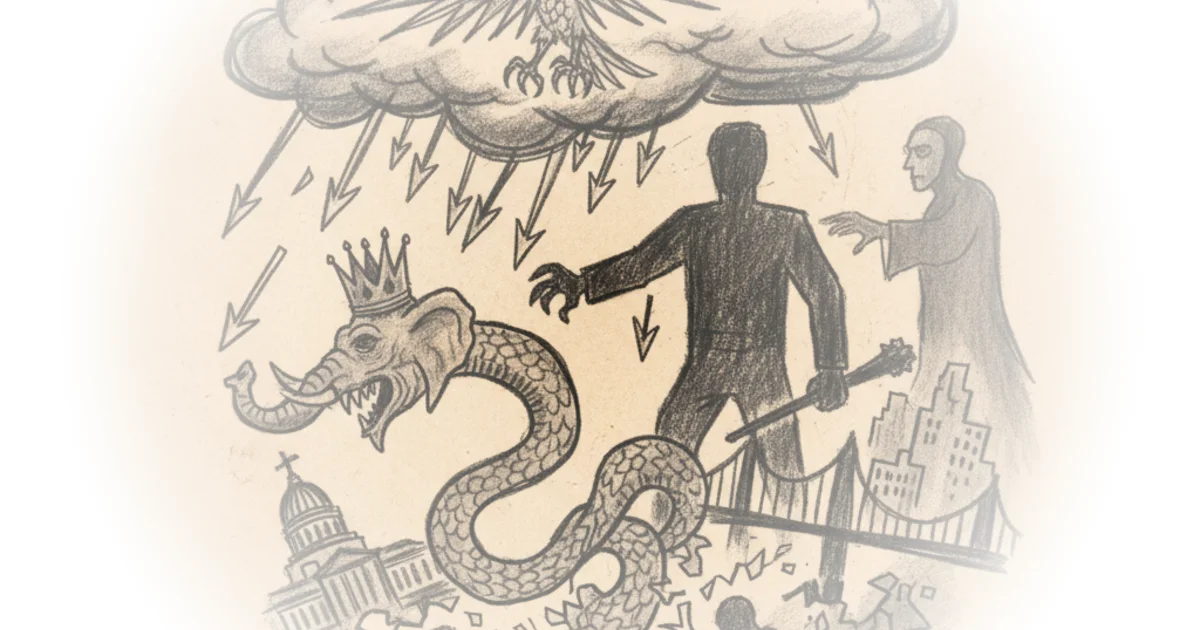
The evidence of this shift is found in the refusal to prosecute. Four Democratic representatives wrote to Bondi, stating that the department "actively obstructed any investigation into these killings" and now "appears to be covering up the most egregious civil rights offenses." Richardson highlights the unprecedented nature of this obstruction, noting that a judge had to order officials not to destroy evidence. This isn't just bureaucratic inertia; it is active concealment. The argument lands with heavy impact because it relies on the words of the lawmakers themselves, who describe a DOJ that has abandoned its 1870 founding mission to enforce civil rights.
"ICE has likely violated more court orders in January 2026 than some federal agencies have violated in their entire existence."
The breakdown of judicial authority is further illustrated by Judge Patrick J. Schiltz, a George W. Bush appointee, who found that Immigration and Customs Enforcement (ICE) had violated 96 court orders in just 74 cases. Richardson uses Schiltz's scathing rebuke to underscore the depth of the crisis: "The extent of ICE's noncompliance is almost certainly substantially understated." When a judge appointed by a Republican president has to threaten contempt proceedings against the acting director of ICE, the institutional decay is undeniable. Critics might argue that immigration enforcement is inherently difficult and that non-compliance is a logistical challenge rather than a moral failing, but Richardson's evidence of systematic disregard for specific court orders suggests a deliberate strategy of defiance.
The Propaganda War and Public Backlash
As the administration attempts to control the narrative, Richardson points to a clumsy and counterproductive propaganda effort. Attorney General Bondi released photos of arrested individuals facing the camera while federal agents stood with their backs turned. Richardson cites journalist Matt Novak, who observed that the images made the "rioters" look like heroes while the agents appeared cowardly. "Bondi thinks she's going to win the propaganda war with this sh*t," Novak wrote, "but it's never been more clear that they're losing." This observation is a sharp critique of the administration's media strategy, which seems to ignore the visual language of the modern era.
The human cost of these policies is driving a measurable shift in public opinion. Richardson cites data from G. Elliott Morris showing that support for the administration's immigration policies has collapsed, dropping 18 points to a net negative. "When Americans hear the word immigration now, they don't think of migrants under an overpass in south Texas, but of an 'ICE officer killing a woman in her car and calling her a 'f*cking bitch'' or a 'regular guy being shot 10 times in the back,'" Morris notes. This pivot in public sentiment is significant because it suggests that the administration's strategy of fear is backfiring, turning the public against the very agency tasked with enforcement. The fact that 46% of Americans now support abolishing ICE indicates a tipping point has been reached.
The Assault on Democracy
The most alarming development, according to Richardson, is the administration's attempt to link immigration enforcement to the integrity of state elections. After the killings in Minneapolis, Bondi demanded access to Minnesota's voter rolls, claiming it was necessary to "guarantee free and fair elections." Richardson dismantles this justification, noting that the federal government has no authority to oversee state election systems. "Here's the bottom line…they're not entitled to that data," Arizona Secretary of State Adrian Fontes told reporters, calling the demand "blackmail" and comparing it to organized crime extortion. "This is not how America is supposed to work," he added.
This demand for voter data is not an isolated incident but part of a broader pattern. Richardson notes that since May 2025, the administration has demanded complete voter rolls from at least 44 states and has sued 24 of them. The connection between violence in Minneapolis and the demand for voter rolls is described as an "ominous sign" that the administration is using chaos as leverage. The stakes were raised even higher when the FBI executed a search warrant at an elections warehouse in Fulton County, Georgia, seizing ballots and voter rolls from the 2020 election. Richardson describes this as a "seismic event," quoting Senator Jon Ossoff who warned, "This should have people across the country absolutely shook. This is a huge deal. This is a shot across the bow at the midterm elections."
The administration's actions suggest a desperate attempt to secure power for the 2026 and 2028 elections. Richardson points out that the former president has admitted to lawmakers that winning the midterms is essential to avoid impeachment. "You gotta win the midterms. Because if we don't win the midterms, it's just gonna be—I mean, they'll find a reason to impeach me," the former president explained. This admission, coupled with the seizure of election materials, paints a picture of an executive branch willing to dismantle democratic safeguards to maintain control.
Bottom Line
Richardson's piece is a powerful indictment of an administration that has weaponized federal power to terrorize citizens and subvert democratic institutions. The strongest part of the argument is the synthesis of disparate events—from the killings in Minneapolis to the seizure of ballots in Georgia—into a coherent narrative of authoritarian consolidation. The biggest vulnerability is the assumption that the public will react with sustained outrage rather than fatigue, but the data on collapsing approval ratings suggests the backlash is already underway. The reader must watch for how the judiciary responds to the administration's continued defiance of court orders, as the courts may soon be the only remaining barrier to unchecked executive overreach.