This piece cuts through the noise of standard educational reform by asking a brutal question that most activists avoid: when the rules are rigged, is "more effort" actually enough? Future Schools doesn't offer a pep talk; instead, it traces a direct line from a 1971 corporate manifesto to the current paralysis of public education, arguing that traditional civic engagement is no longer sufficient against a system designed to be unbeatable. For busy readers trying to navigate a political landscape that feels increasingly hopeless, this analysis provides the sobering context needed to stop blaming themselves for a game that was fixed decades ago.
The Architecture of the 1%
The article's most striking move is its refusal to treat current political stagnation as an accident or a temporary glitch. Instead, Future Schools frames the current crisis as the intended outcome of a specific, decades-long strategy. The piece anchors this argument in the 1971 "Powell Memo," a document written by Lewis F. Powell Jr. before his appointment to the Supreme Court. Future Schools reports that this "pro-capitalist manifesto" explicitly urged the Chamber of Commerce to "invest money and human resources in media, establishing (advocacy) think tanks... [and] drafting academic literature" to advance a capitalist ideology.
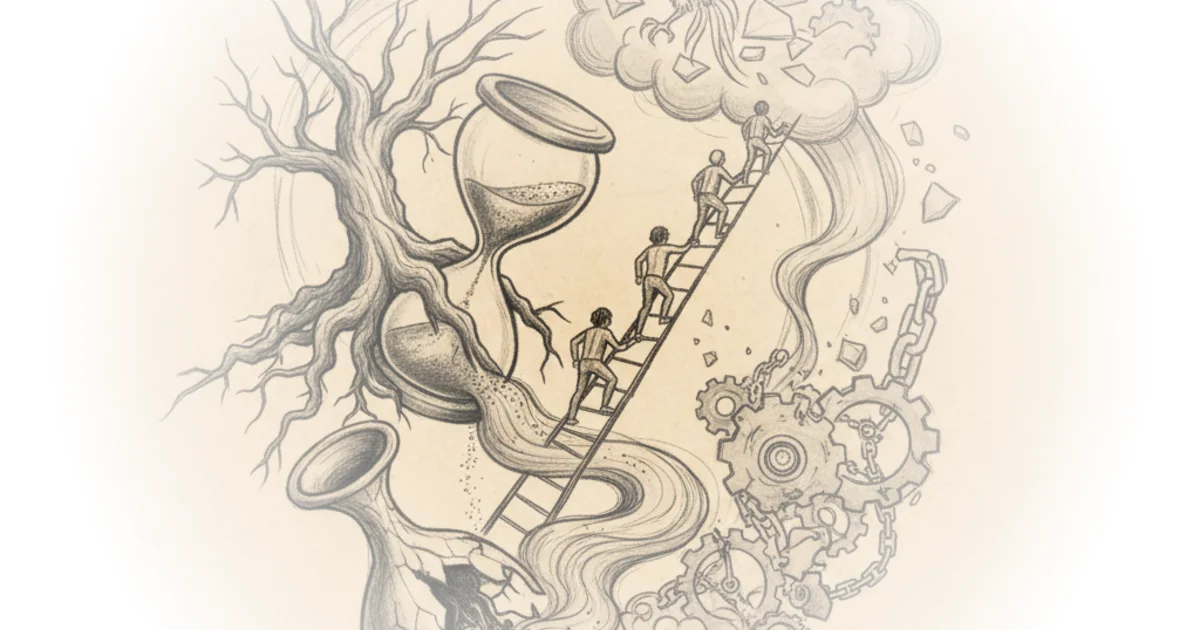
This historical context is crucial because it shifts the blame from general societal drift to a deliberate campaign. The editors note that Powell viewed civil rights activists and educators as "enemies of capitalism" and successfully orchestrated a counter-attack that culminated in legal precedents like Citizens United. The piece argues that "explicit and exorbitant corporate influence over our judicial system and political system was born and codified into law" following these efforts. This is a powerful reframing: the erosion of democracy isn't a failure of the public's will, but a success of a well-funded, long-term corporate strategy.
"Remaining ignorant of the entrenched corporate chokehold over our future, or hoping to take-to-the-streets or vote our way out of this morass, seem to be insufficient approaches in contesting money's influence over politics."
Critics might argue that this analysis is too deterministic, potentially demobilizing citizens by suggesting that resistance is futile. However, the piece anticipates this by distinguishing between "delusion" and "realism." It cites Barbara Ehrenreich to warn that "delusion is no way to confront reality," suggesting that false hope is actually more dangerous than admitting the severity of the situation. By grounding the argument in the specific mechanics of the Powell Memo and the subsequent Citizens United ruling, the article avoids vague pessimism and offers a concrete diagnosis of the problem.
The Failure of Traditional Guardrails
The commentary then pivots to the present day, dismantling the popular belief that voting or standard activism can reverse the current trajectory. Future Schools points to research by Page and Gilens (2012), which concluded that "average citizens and mass-based interest groups" had "virtually zero impact" on policy outcomes compared to wealthy counterparts. The editors use this data to challenge the conventional wisdom that "electing the right people" or getting "engaged" will solve the crisis.
The piece highlights the specific impact on education, noting that for forty years, the system has been "hijacked by the demands of the business community that seeks to optimize efficiency and testing while minimizing opportunities to develop critical thinking." This is not just about curriculum; it is about the structural alignment of schools with corporate interests. The article draws a sharp parallel to the Berlin Conference of the 1880s, where African nations were carved up by external powers without regard for local populations, suggesting that modern urban education reform often follows a similar pattern of external imposition and resource extraction.
"The bulk of our American public seems to be wishing and hoping that the problems that plague our modern demos will work themselves out through the good work of committed activists or traditional guardrails that existed to protect the bulk of Americans from political leaders' worst intentions."
This section is particularly effective because it validates the exhaustion many feel. The editors acknowledge that "activism fatigue is real" and that even those on the "winning side" often experience disillusionment. By admitting that "voting alone is not sufficient," the piece creates space for a more honest conversation about what actually works. It suggests that the "traditional approaches that have been implemented routinely, are woefully insufficient in this moment."
The Camden Case Study
To ground these abstract arguments in reality, the piece turns to the specific experience of Camden, New Jersey. The author, a teacher and former union president in Camden, describes the struggle against "well-resourced and politically connected opposition" during the Chris Christie years. The narrative details how billions in tax incentives were given to multinational corporations with no guarantee of local hiring, and how Community Management Organizations (CMOs) "hijack our District's enrollment and pirate our budget."
Future Schools reports that despite years of "vociferous" fighting by regular people, "the money Big Money has to spend to blunt the efforts of regular people seems endless, and appears ultimately, to be undefeated." This anecdotal evidence serves as a microcosm for the national struggle. The piece argues that the "1% rule" is not a metaphor but a lived reality in cities like Camden, where "no matter how vociferous we regular people fight... the downward trajectory we're on precipitated by the 1% ownership of our government" continues.
"I do however believe openly admitting such, could possibly spur some thoughts from others that could provide a potential blueprint for success - something that's been fleeting for far too long."
The strength of this section lies in its refusal to offer a false solution. The author admits, "I still have no idea of what 'works' in a lasting sense anymore." This vulnerability is rare in political commentary. Instead of selling a silver bullet, the piece invites a collective re-evaluation of strategy. It asks readers to consider when the last time was that "the People winning and beating back corporate power" happened, noting that most responses point to the 1960s or 1970s, implying a long period of stagnation.
Bottom Line
The strongest part of this argument is its unflinching diagnosis of the structural imbalance between corporate power and public will, moving beyond personality-driven politics to analyze the machinery of the "1% rule." Its biggest vulnerability is the lack of a concrete alternative strategy, leaving the reader with a sobering truth but no clear path forward. However, by forcing a confrontation with the reality that "delusion is no way to confront reality," the piece provides the necessary foundation for any future movement to be effective.