Most historical accounts of the third century focus on the chaos of the Crisis of the Third Century, but this piece from Kings and Generals argues that the era's defining narrative is not collapse, but the singular, iron-willed restoration of order by one man. The coverage stands out by reframing the Roman Empire's survival not as a lucky accident, but as the direct result of Aurelian's ruthless pragmatism and military genius. For a busy reader, the value lies in seeing how a leader can dismantle a crumbling system and rebuild it without losing the core of the state.
The Architect of Survival
Kings and Generals opens by situating the reader in a moment of near-total disintegration, noting that "at the height of rome's period of anarchy during the third century... the empire [was] on the very brink of total collapse." This framing is crucial because it establishes the stakes: without intervention, the Western world as we know it might have ended centuries early. The authors argue that Aurelian was the catalyst that prevented this, describing him as a man who "took the roman empire with an iron grip glued together its crumbling domain."
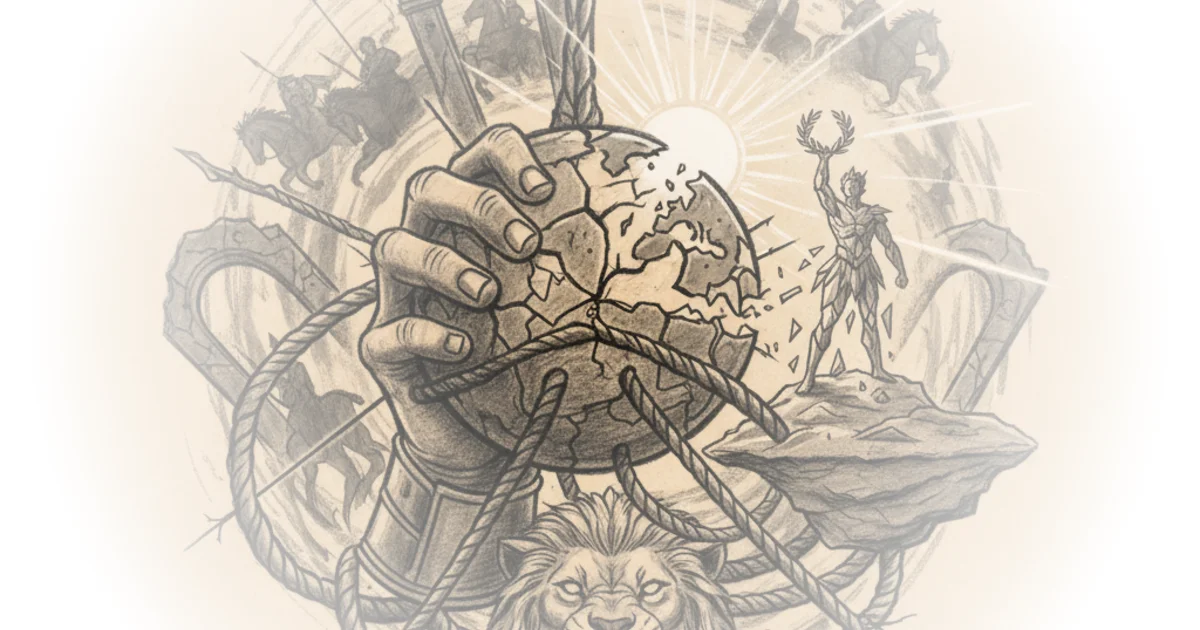
The narrative emphasizes that Aurelian's rise was not merely a matter of luck, but of earned reputation. The text notes he "earned so much renown for bravery and talent that the nickname of manu and pharaoh hand on sword became his." This detail humanizes the military machine, suggesting that his authority stemmed from personal competence rather than just political maneuvering. When the previous emperor, Claudius II, died of plague, the power vacuum threatened to tear the empire apart again. However, the authors point out that "aurelian by far the most respected and feared figure in the empire was simultaneously acclaimed emperor by the legions who were with him." This highlights a critical institutional dynamic: the army's loyalty was to the man who could protect them, not just the title.
"The emperor first waged a war of attrition against them denying them food and supplies then smashed the weakened barbarians in battle."
Kings and Generals uses this description of the Vandal conflict to illustrate Aurelian's strategic shift from reactive defense to proactive attrition. This approach was vital because the traditional Roman legions were no longer sufficient to hold the vast frontiers. The authors correctly identify that Aurelian understood the need for a new kind of warfare, one that prioritized resource denial over mere battlefield glory. Critics might argue that this focus on military prowess overlooks the political fragility of his reign, but the text effectively shows how military success was the only currency that mattered in that specific moment.
The Hard Choices of Reformation
The commentary shifts to the internal challenges Aurelian faced, particularly the corruption that threatened to starve Rome. The authors describe a riot incited by a corrupt financial minister, noting that "up to seven thousand were dead by the time aurelians subdued the city with an iron fist." This is a stark reminder that restoring order often requires brutal, unpopular decisions. The authors argue that Aurelian's response was not just punitive but structural: "aurelian attempted to stabilize the coinage and harshly deal with corruption."
Perhaps the most significant reform highlighted is the relocation of mints. Kings and Generals explains that the strategic move favored locations like Milan and Siscia "where pay could more easily be transported to the armies." This is a brilliant piece of logistical analysis, showing how Aurelian recognized that the old administrative centers were no longer viable for a mobile, defensive empire. The authors also point to the construction of the Aurelian Walls as a symbol of this new reality: "individual cities now needed their own fortifications so the construction of a series of practical non-aesthetic defensive walls began around rome."
"It must have been a big step for the conservative romans to voluntarily and pragmatically admit to this and it is a sign of aurelian's adaptable and charismatic nature."
This observation about the abandonment of the province of Dacia is the piece's most profound insight. By pulling back from a territory that had become a liability, Aurelian demonstrated a level of strategic flexibility that was rare in Roman leadership. The authors argue that this was not a retreat, but a consolidation: "the border was consolidated and shortened on the near side of the river and a deal was negotiated with a tribe of friendly germans to settle in the abandoned area as a buffer." This reframes the loss of territory as a calculated gain in security, a lesson in strategic prioritization that remains relevant today.
The Campaign of Reunification
The final act of the piece details the campaign against the Palmyrene Empire, ruled by the formidable Zenobia. Kings and Generals describes the scale of the operation: "aurelian set about mustering one of the greatest armies of the 3rd century." The authors detail the tactical brilliance at the Battle of Immae, where Aurelian used his lighter cavalry to bait the heavy Palmyrene cataphracts into exhaustion. The text notes, "when the overburdened cataphracts and their horses began to slow down from exhaustion aurelian's cavalry turned and counter-charged them."
The narrative also highlights Aurelian's psychological warfare. After the siege of Tiana, where he initially threatened to spare no one, he chose clemency. The authors recount his witty retort to his soldiers: "i did indeed decree that no dog should be allowed to live well then kill all the dogs." This moment serves as a pivot point in the narrative, showing that Aurelian's power was not just in his sword, but in his ability to command loyalty through wit and mercy. The result was that "no city in asia minor resisted aurelians march," proving that his strategy of combining fear with clemency was effective.
"Still he had much to do upon his arrival in europe aurelian crushed yet another barbarian incursion into misha but was then forced to return to palmyra in early 273."
The authors note that despite his victories, Aurelian's reign was cut short by the very instability he sought to cure, as he had to return to Palmyra to quell a second rebellion. This underscores the fragility of his achievements; the empire was restored, but the underlying tensions remained. The piece concludes by noting his title, "restitutor orbis," or "restorer of the world," a testament to the magnitude of his task.
Bottom Line
Kings and Generals delivers a compelling case that Aurelian was the pivotal figure who prevented the total collapse of the Roman Empire, using a blend of military ruthlessness and strategic pragmatism. The strongest part of the argument is the analysis of his willingness to abandon territory and reform logistics, proving that true leadership requires knowing what to lose. However, the piece slightly underplays the long-term political instability that his death would eventually unleash, leaving the reader with a slightly too-optimistic view of the restoration's permanence.