Tim Mak delivers a harrowing but essential revelation: the winter cold and darkness currently sweeping Ukraine are not just infrastructure failures, but active psychological weapons that re-traumatize former prisoners of war. While the world focuses on troop movements or diplomatic ceasefires, Mak exposes how the physical sensation of freezing temperatures and sudden blackouts acts as a direct neural bridge back to torture cells, turning a season of survival into a season of psychological siege.
The Architecture of Trauma
Mak anchors his reporting in the visceral experience of Oleksii Anulia, a former prisoner of war whose recovery has been shattered by the return of winter. The author writes, "I've started having bad dreams. I remember my punishment cell. It was constantly cold there. Even in summer, it was always cold in our cell." This is not merely a description of discomfort; it is a clinical illustration of how trauma is stored in the body. Mak argues that the environmental conditions of captivity—specifically the cold and the dark—have been weaponized by the Russian state, and now, through energy grid attacks, that same weapon is being turned against the civilian population and the very soldiers who survived it.
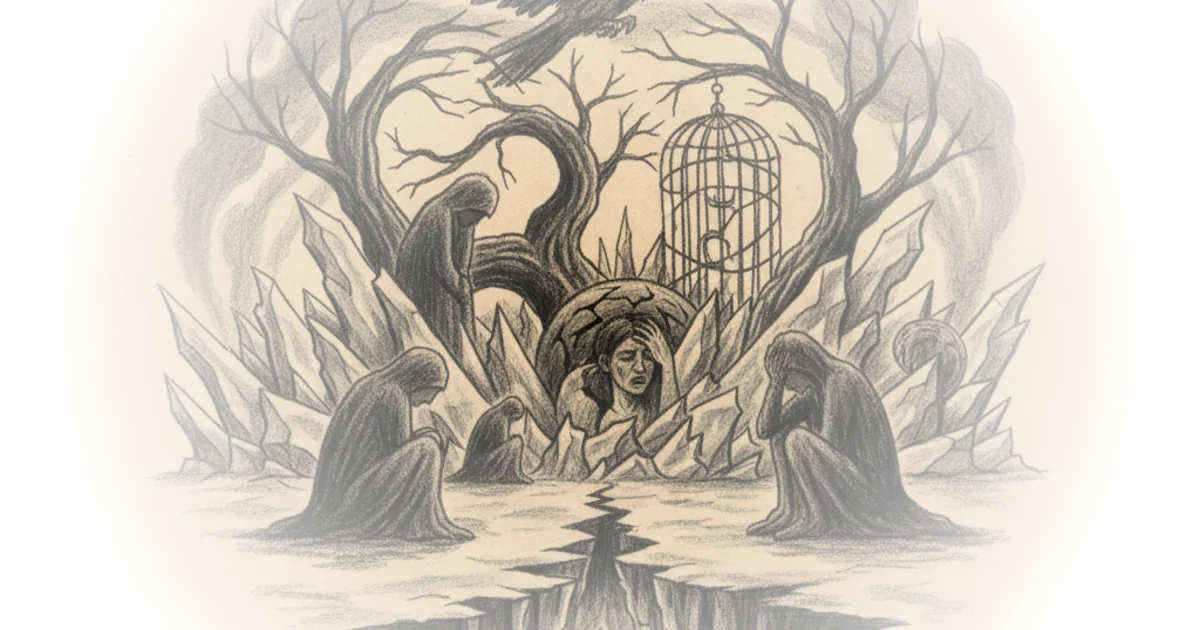
The piece draws a chilling parallel between the torture methods used in Russian penal colonies and the current reality of Ukrainian blackouts. Mak notes that for Anulia, the moment he returned to Kyiv during a blackout, "The contrast after California felt like I'd arrived in the afterlife." This sensory deprivation triggers a physiological response where the brain cannot distinguish between the safety of home and the danger of the past. As Mak puts it, "The brain and body continue to react as if the danger is still present, even though the person is now in a safer environment."
This framing is particularly potent because it moves beyond the standard narrative of PTSD as a purely internal mental struggle. Instead, Mak shows how external, geopolitical decisions—like the suspension of the energy ceasefire—have direct, biological consequences. The author highlights that cold is a specific, systematic tool of torture used against Ukrainians, a fact that aligns with historical records of how environmental deprivation has been used to break prisoners, from the Soviet Gulags to modern detention centers. By linking the current infrastructure collapse to these specific torture methods, Mak forces the reader to see the blackouts not as collateral damage, but as a continuation of the war's psychological assault.
For [POW], a sudden change in light, darkness – these are triggers [of flashbacks]. Some people even experience disorientation… A person freezes, sits with a stony face as if they are not here.
The Physiology of Survival
Mak does not shy away from the biological mechanics of this suffering. He explains that the nervous systems of trauma survivors are in a state of heightened stress, causing blood to be diverted from extremities to vital organs, making them feel colder than the average person. This physiological reality is compounded by the destruction of Ukraine's heating infrastructure. Mak writes, "People with PTSD are generally more sensitive to cold than others, which is why the lack of heating in their homes can be harder for them to endure."
The article details Anulia's time in a punishment cell where he was forced to eat worms or mice to survive, and how the memory of "constant cold urine" and "dampness" now haunts his sleep. Mak connects this personal horror to a broader pattern, noting that in Texas during the 2021 freeze, nearly one in five people who lost power showed symptoms of PTSD, with those without electricity the longest being three times more likely to develop symptoms. This historical context strengthens the argument that energy security is a mental health imperative, not just a logistical one.
Critics might argue that focusing on the psychological toll of cold risks overshadowing the immediate physical dangers of freezing temperatures or the strategic necessity of targeting energy grids in a total war. However, Mak's reporting suggests that the psychological erosion is a strategic goal in itself, designed to break the will of the society. The author notes that "Cold is one of the forms of torture Russian forces systematically use against Ukrainians held in Russian prisons. Today, that same cold has turned into a tool of pressure on civilians, aimed at breaking society and forcing Ukraine into concessions."
The Human Cost of Policy
The piece concludes by examining the human cost of the stalled prisoner exchanges and the ongoing energy crisis. Mak highlights the injustice felt by survivors like Anulia, who have returned to conditions that mirror their captivity. "Now I dream about dampness, constant cold urine. I'm standing in it in my slippers, my legs are constantly freezing and festering," Anulia says. The author underscores that while the world debates nuclear pacts or territorial concessions, the daily reality for these individuals is a struggle against the very elements that once tortured them.
Mak's narrative is driven by the resilience of survivors who refuse to be broken. Despite the trauma, Anulia dedicates himself to his children and others, finding solace in movement and community. "There is no such phrase as 'I'm tired' in my vocabulary," Anulia states, a sentiment that Mak presents not as a platitude, but as a defiant act of survival. The author effectively uses this personal resolve to critique the broader institutional failures that leave these individuals vulnerable to the cold.
Bottom Line
Tim Mak's reporting is a masterclass in connecting the dots between geopolitical strategy and individual human suffering, proving that the war in Ukraine is fought as much in the mind as it is on the battlefield. The strongest part of the argument is the undeniable link between the specific torture methods used in Russian prisons and the current infrastructure attacks, which serve as a psychological weapon. The piece's vulnerability lies in its heavy reliance on individual testimony, which, while powerful, may struggle to drive policy change without broader statistical backing on the scale of re-traumatization. Readers should watch for how the international community responds to the dual crisis of energy security and the mental health of returning veterans, as this intersection will define the next phase of the conflict's aftermath.