In a digital landscape saturated with renewed theological warfare, Scott Alexander offers a rare moment of epistemic calm, arguing that the modern debate over God's existence has devolved into a sophisticated form of overfitting rather than genuine inquiry. While the blogosphere has reincarnated as Substack, Alexander suggests the current iteration of these debates feels cold because it ignores the deeper reason we dismiss absurdities in the first place: common sense, not complex Bayesian calculus. This is not a plea for faith or a dismissal of reason, but a structural critique of how we explain anomalies.
The Napoleon Analogy and the Trap of Overfitting
Alexander begins by noting the resurgence of online atheism debates, observing that "I thought the omnipresence of the early '00s online atheism debate was a time-bound historical phenomenon. But now that the blogosphere has reincarnated as Substack, it's back, nearly as strong as ever." He admits his own intuition regarding the non-existence of God precedes any formal argument, a stance he illustrates with a striking historical hypothetical. He asks us to imagine a society debating whether aliens assisted Napoleon's rise, noting that while the evidence for such intervention is bizarre—Napoleon winning battles outnumbered four-to-one—the arguments against it are often flimsy.
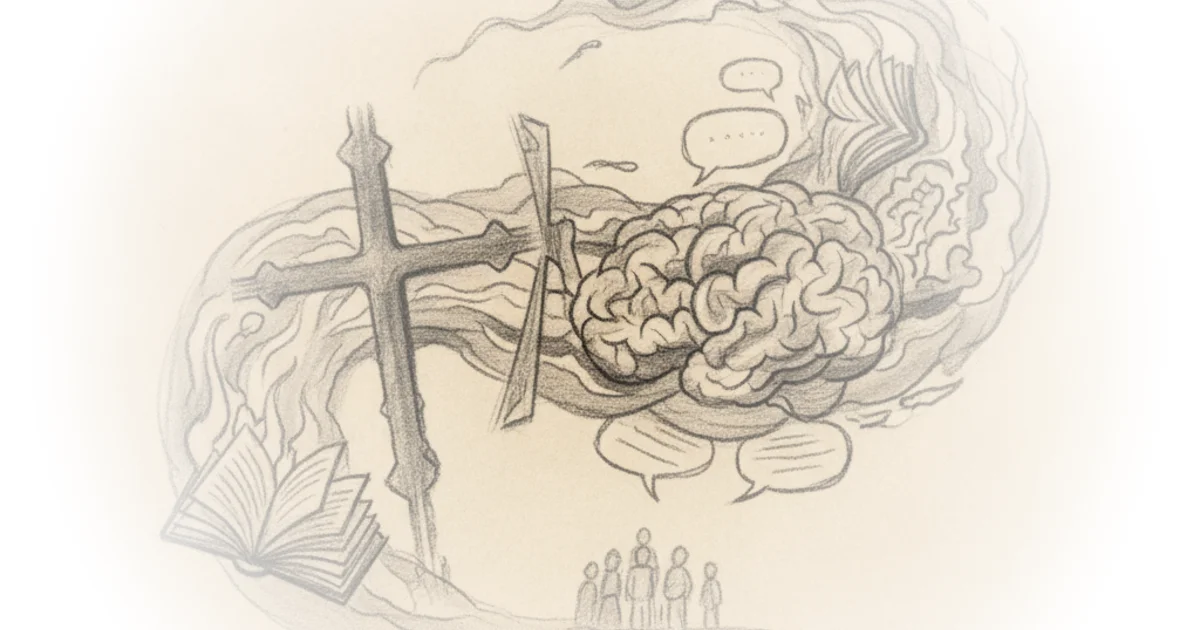
The core of his argument is that our historical community rejects the "aliens caused Napoleon" theory not because we have calculated the precise Bayesian evidence against it, but because "common sense precludes entertaining it in the first place." This is a crucial distinction. Alexander writes, "My atheism is more deeply rooted in whatever prevented us from considering this question in the first place than in the type of delicate reasoning that could get us out of it." He warns that relying solely on the "absurdity heuristic" is dangerous, as it could have dismissed nuclear weapons or heavier-than-air flight in earlier centuries. However, he argues that the current theological debates often fail to move beyond this heuristic, instead engaging in a loop of pseudo-explanations.
"The 'aliens caused Napoleon' scenario fails because of overfitting. Anything at all can be explained by 'there was a powerful hidden entity trying to make that specific thing happen'."
Alexander draws a sharp parallel to political events, noting how the "powerful hidden entity" explanation easily plows through objections. He writes, "How did Donald Trump come from behind to win the 2016 election? Well, there was a powerful hidden entity, it wanted Donald Trump to win, and so it arranged to make that happen." By reframing this as a general epistemic problem rather than a partisan one, he highlights how these theories are "strictly better" at explaining anomalies than real explanations because they require no constraints. The entity can be invisible, its technology can be implausible, and its motives can be vague, yet it always fits the data perfectly.
The Collapse of the "Simple" God
The commentary then shifts to the specific theological arguments being debated, particularly the claim that God is the simplest possible hypothesis. Alexander critiques the argument presented by Matthew Adelstein, who posits that a "mind without limit" is simpler than a world filled with complex physical laws. Alexander dismantles this by pointing out a logical sleight of hand: subtracting limits is not the same as subtracting complexity.
He argues that when theologians claim God is simple because He has no limits, they are actually adding infinite capabilities. "If this trick worked, it should be easier to build a starship than a biplane," Alexander writes. "You would start with aircraft-without-limits, and then you'd only need to add a few limits to get the starship, but you would need to add many more before you got the biplane." This inversion of Occam's Razor allows proponents to posit the most complex entity imaginable while labeling it the simplest. He notes that this relies on a dualist assumption where "Mind is just a thing that floats out there in the void," a premise that lacks the grounding of physical reality.
"This allows you to posit the most complex entity, call it the simplest, and invert Occam's razor entirely, making your 'powerful hidden entity intended this exact outcome' theory look like the least overfit hypothesis!"
Critics might note that this critique assumes a materialist framework where "limits" are synonymous with "complexity," whereas a theist might argue that the nature of a mind is fundamentally different from a machine, rendering the starship analogy flawed. However, Alexander's point stands that defining a hypothesis as "simple" by removing all constraints on its power and knowledge renders it unfalsifiable and therefore useless as an explanatory model. This mirrors the historical progression of science, where anomalies like thunder and lightning were once attributed to the Storm God but were later explained by natural laws. As Alexander puts it, "As science progressed, anomalies got fewer and fewer... Now we have some remaining set of anomalies."
The Danger of Exotic Substrates
Alexander concludes by addressing the tendency to invoke "exotic substrates" to explain the remaining mysteries of consciousness and the universe. He suggests that the debate often circles back to the same pattern: when faced with the unknown, we imagine a powerful entity with no evidence of its existence. He writes, "Whenever they had something their primitive knowledge couldn't explain, they imagined a powerful entity built on an exotic substrate who intended that outcome." This pattern is not unique to ancient myths but is alive and well in modern theological debates.
The piece serves as a reminder that the "powerful hidden entity" explanation is a broader and more dangerous category than conspiracy theories. While conspiracy theories can be debunked by noting the difficulty of maintaining secrecy among humans, alien or divine explanations are "invulnerable to the usual 'people couldn't conspire that well' heuristic." Alexander warns that accepting these explanations requires a level of credulity that eventually causes the "edifice [to] topple." He suggests that the strongest penalty should be applied to theories that claim a hidden entity intended a specific outcome, operated on an exotic substrate, and hid all evidence of its existence.
"No, you can't apply human limitations to it, the entity is an exotic form of intelligence for which we have no other evidence."
This argument resonates with the concept of overfitting discussed in Alexander's companion piece on the same topic, where a model that fits every data point perfectly often fails to predict new data. Just as a conspiracy theory with enough epicycles can explain any outcome, a God defined by infinite power and hiddenness can explain any anomaly, but at the cost of explanatory power.
Bottom Line
Scott Alexander's strongest move is reframing the God debate not as a clash of evidence but as a failure of epistemic hygiene, where the "powerful hidden entity" hypothesis is exposed as the ultimate overfitted model. His biggest vulnerability lies in assuming that the intuition to reject such hypotheses is universally shared and robust, potentially underestimating the philosophical appeal of a non-materialist ontology. Readers should watch for how this critique of "overfitting" applies to other areas of modern discourse where complex, untestable narratives are used to explain singular, anomalous events.