In a moment where trade rhetoric has devolved into viral soundbites, Richard Coffin offers a necessary reality check on the staggering tariff numbers circulating online. While the public discourse fixates on absurd figures like a 250% tax on dairy, Coffin dissects the actual mechanics of Canada's supply management system to reveal a far more nuanced, and often misunderstood, economic landscape. This is not just a fact-check; it is a deep dive into how tariff rate quotas function and why the "reciprocal" threats from the executive branch might be built on a foundation of misinformation.
The Myth of the Flat Rate
Coffin begins by dismantling the most pervasive claim: that Canada slaps a uniform, punitive tax on all American imports. He points to hard data from 2017, noting that "the ratio of Duties to the value of imports coming from the United States sat at just 0.2%." This figure, he argues, represents the effective tariff rate long before the United States-Mexico-Canada Agreement (USMCA) further lowered barriers. The author's framing is crucial here; he separates the theoretical maximums from the practical reality of trade flows.
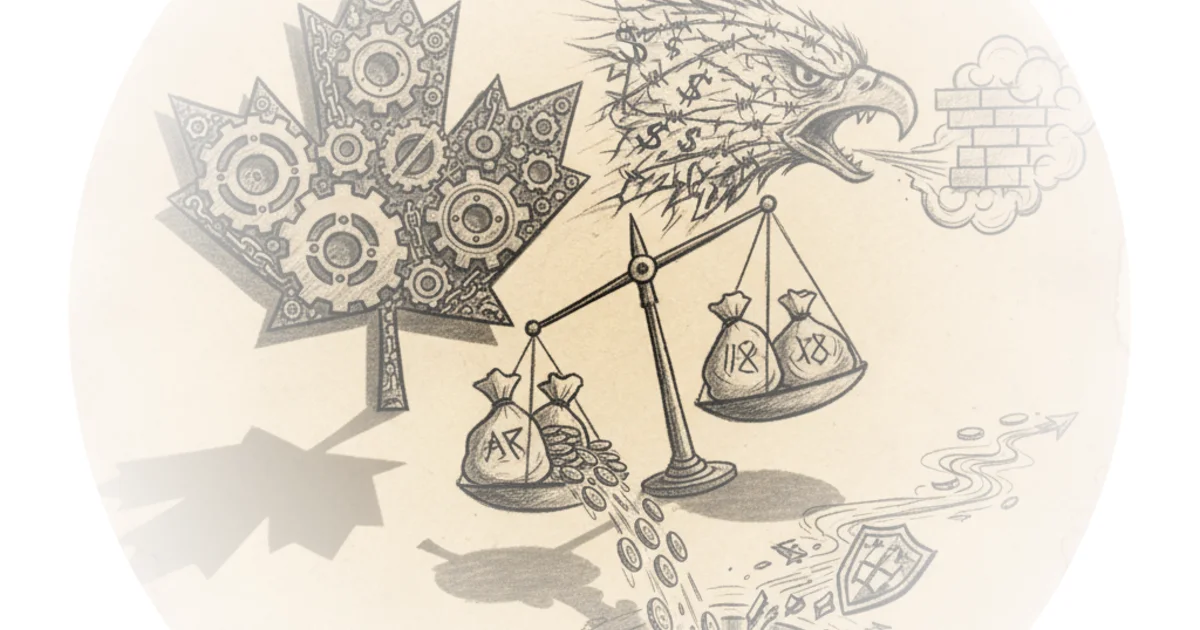
"For the everyday Joe these numbers are hard to come across when you see a tweet circulating with these ridiculous rates posted it can be hard to verify whether they're true or not," Coffin writes, highlighting the information asymmetry that fuels the current trade war. By grounding his argument in official documents from the Canada Border Services Agency and the World Trade Organization, he exposes that while high rates do exist, they are not flat taxes applied to every shipment. Instead, they are specific triggers designed to protect domestic industries only after a certain volume of imports has already been allowed in duty-free.
"These tariff rates are not flat rates but rather a component of something called a tariff rate quota meaning they only apply to Imports that are Beyond a given quota or limit."
This distinction is the linchpin of the entire analysis. Without understanding the quota system, the headline numbers are meaningless. Coffin demonstrates that for the United States specifically, the USMCA agreement grants preferential treatment, meaning "the vast majority of goods seen 0% tariffs regardless of the quantity imported." This directly contradicts the narrative that American lumber or peanut butter are currently facing prohibitive barriers, a point the author reinforces by showing that peanut butter is actually tariff-free for most nations.
The Reality of Supply Management
The commentary then shifts to the core of the friction: Canada's supply management system for dairy, poultry, and eggs. Coffin explains that this mechanism, established in the 1970s, aims to stabilize prices and prevent market volatility for farmers, a goal that has resulted in higher consumer prices but also eliminated the need for direct government subsidies. He acknowledges the trade-off: "dairy prices in Canada have generally been higher as a result," with some estimates suggesting a significant premium over US prices.
However, Coffin challenges the notion that this system is a closed door to American exporters. He reveals a surprising statistic: "the US only utilized 13.7 million kg or roughly a third of its allowed 41.7 million kg of quota" in the 2023 to 2024 year. This finding undermines the argument that the US is being blocked from the Canadian market. Instead, the data suggests that American exporters are not even filling the slots available to them under current trade rules.
"Even with these current limited amounts the hasn't even fully utilized the quotas it's been given Canada actually tracks utilization of its quotas," Coffin notes, pointing to the fact that many dairy categories have room to double imports without triggering a single cent of tariff. This is a powerful counter-narrative to the idea of a one-sided trade war. It suggests that the barrier is not just regulatory, but perhaps competitive or logistical, as US exporters have historically struggled to navigate the specific allocation rules of the Canadian system.
Critics might note that the existence of these quotas, even if underutilized, still constitutes a distortion of free market principles that the USMCA was meant to resolve. Coffin addresses this by noting that the US won a previous dispute regarding Canada's allocation methods, yet the system remains largely intact. He also points out the irony that the US maintains its own quotas for Canadian dairy products, such as ice cream and milk beverages, creating a mirror image of protectionism.
"If this whole trade war is because of immigrants and Fentanyl none of this matters anyway regardless."
This closing observation from Coffin serves as a sharp critique of the political motivation behind the trade threats. He suggests that the tariff rhetoric is often a distraction from the stated reasons for the conflict, or perhaps a tool to leverage unrelated policy goals. By highlighting that the US still runs a trade surplus in dairy with Canada, he forces the reader to question the logic of imposing reciprocal tariffs on an industry where the US is already the dominant exporter.
Bottom Line
Richard Coffin's analysis succeeds by replacing emotional rhetoric with granular data, proving that the "250% tariff" narrative is a gross oversimplification of a complex quota system. The strongest part of his argument is the revelation that the US is not even utilizing its full access rights, which fundamentally changes the conversation from "blocked access" to "underutilized opportunity." The biggest vulnerability in the current political stance is the reliance on inflated numbers that crumble under the slightest scrutiny of official trade schedules. As the administration considers its next move, the focus must shift from viral misinformation to the actual mechanics of the USMCA and the genuine gaps in market access that remain.