A Viral Meme, Zero Incidents, and a City on Edge
The Metropolitan Police confirmed to London Centric that not a single violent incident has been linked to the so-called "school wars" sweeping London. Yet dozens of schools activated emergency protocols, hundreds of officers deployed to school gates, councils stood up special response teams, and an untold number of children stayed home. Jim Waterson, Sophie Wilkinson, and Polly Smythe piece together how a crudely designed TikTok graphic from a Hackney account spiralled into a city-wide panic that cost millions in policing and upended the routines of thousands of families.
The formula was disarmingly simple. Anonymous posters divided local schools into "red" and "blue" teams, announced a time and place for battle, and told students to arm themselves. Waterson and his colleagues describe the format with precision:
The posts follow a simple formula: they divide local schools into two rival groups ("red vs blue"), notify people on social media that there will be a violent battle taking place at a specific time, and warn specific year groups at those schools to prepare for war against the other group of schools.
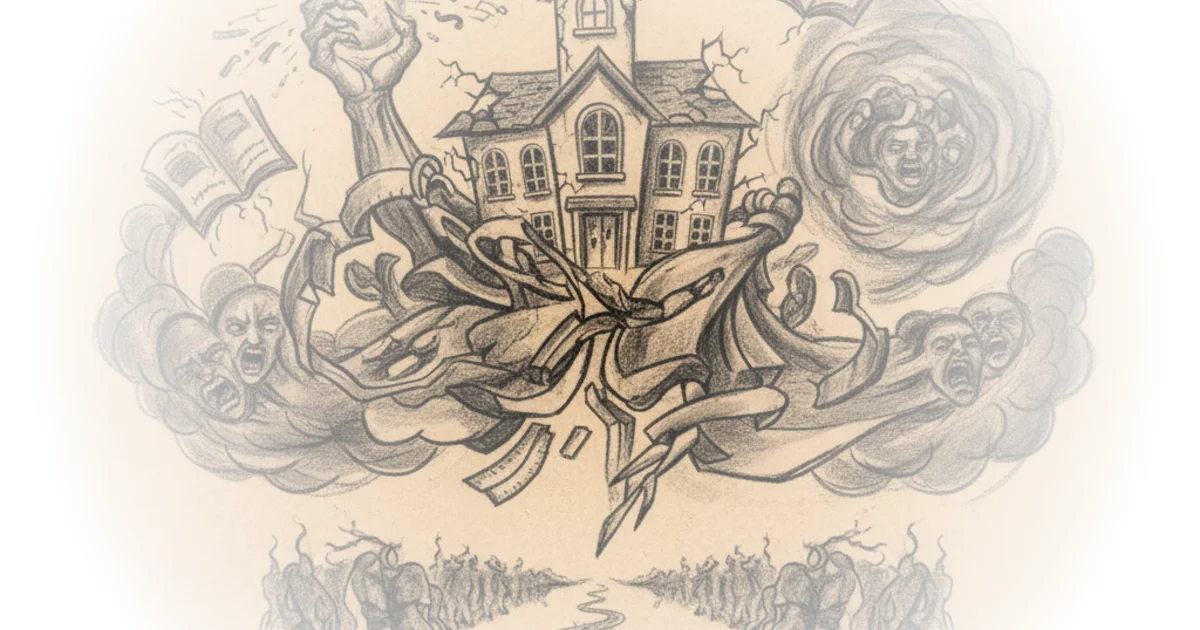
The weapons listed on these graphics were not knives or machetes but protractors, rulers, and metal combs. One headteacher found this detail telling, noting that the suggestion to brandish stationery was "quite twee" and suggested the author was hardly a seasoned gang operative. The absurdity did nothing to slow the spread.
The Hackney Non-Event
London Centric had the good sense to do something most outlets did not: send a reporter to the supposed battleground. On February 13, the day the original Hackney706 TikTok account had declared war near a Mare Street McDonald's, Waterson's team found exactly what a sceptic might have predicted.
We found a large police presence and a number of bored children standing around hoping to see something interesting. In the end, no violence was recorded and the children dispersed.
That should have been the end of it. Instead, the graphic's colour-coded format proved to be, as the authors put it, "a meme format that was made for going viral." Within days, copycat versions appeared for boroughs across the capital. AI image generators made producing convincing posters trivially easy. The reporting team demonstrated this themselves, using Elon Musk's Grok tool to whip up a plausible fake in minutes for the fictional borough of Downminster.
The Amplification Machine
Waterson, Wilkinson, and Smythe are careful to identify every layer of amplification. Influencers jumped on the trend for views. A user called The Bouncer Hub urged parents to "stop and search" their own children before school. Reformed gang member Chris Preddie posted four Instagram videos on the topic, conveniently paired with advertisements for his mentoring services. The Daily Star's TikTok account racked up nearly three million views on a Croydon version of the graphic, presented uncritically.
Then came the parent WhatsApp groups, which the authors clearly regard as an accelerant rather than a safeguard:
School WhatsApp groups tend to be dominated by drama and scaremongering so maybe they're not representative of wider concern.
A Merton parent offered the sharpest perspective on this dynamic, blaming the adults rather than the children:
The parents were getting scared and spreading it. The kids were laughing about it.
The real-world consequence in her area was not violence but traffic chaos, with parents double-parking on yellow lines and screaming at each other at the school gates. A farce born of fear.
Real Knives Behind a Fake War
The article is at its strongest when it confronts the uncomfortable truth that prevents anyone from simply dismissing the whole episode. Knife crime in London schools is a genuine problem. A stabbing in Brent days before the Hackney event had already put the Met on high alert, and a 13-year-old later appeared at the Old Bailey on attempted murder charges entirely unrelated to any "school war" poster.
Patrick Green of the Ben Kinsella Trust articulated the real danger with clarity. The threat is not that the posters will lead to organised battles but that the atmosphere of fear could push individual children toward self-defence decisions with lethal consequences. As the headteacher quoted in the piece put it:
A kid who thinks they're going to be jumped with a compass could bring in a knife.
The children themselves described genuine anxiety. A boy in Haringey told London Centric he planned to sprint home and change out of his uniform to avoid identification. Another said:
Everyone at school's really scared and people have decided not to walk home alone anymore. I'm thinking about not going to a club that ends pretty late because I don't want to be out when it's darker.
These are twelve-year-olds reorganising their daily lives around a threat that, as far as the Met can determine, does not exist in organised form.
The Feedback Loop Nobody Can Break
The most intellectually interesting section of the piece concerns what sociologists would call a self-fulfilling prophecy. The heavy police presence outside schools, deployed as reassurance, was filmed and uploaded to TikTok as evidence that the threat was real. The institutional response validated the very panic it was meant to calm.
What's hard to ascertain is whether the heavy police presence and school interventions have stopped any actual violence -- or just increased the tension.
Waterson and his co-authors do not resolve this tension, and to their credit, they do not pretend to. It is genuinely unresolvable. The authorities face a version of Pascal's wager: the cost of overreacting to a hoax is embarrassment and expense, while the cost of underreacting to a real threat is a child's life.
That said, the piece could have pressed harder on the institutional incentives at work. Schools that send children home early and councils that activate emergency protocols face no penalty for overreaction. The calculus is entirely asymmetric, which means the ratchet only turns one way. Each response makes the next one more likely, regardless of whether the underlying threat has changed. This dynamic deserves more scrutiny than the article gives it.
TikTok's Half-Measures
TikTok banned the search term "school wars," a gesture so feeble that users immediately circumvented it with "school wrs," "school warrs," and "red v blue." Green posed the question the platform has never satisfactorily answered:
Regardless of whether they're created by somebody who is doing this for menace or for fun, why is it allowed to go on a platform which then accelerates it through an algorithm?
The comparison to the 2019 Momo Challenge is apt but imperfect. Momo was entirely fabricated and easily debunked. The school wars meme draws its power from a real substrate of knife violence, which means it can never be fully dismissed as fiction. It sits in the grey zone between hoax and genuine threat, which is precisely the territory where social media algorithms do the most damage.
Some teenagers, at least, appeared to see through the whole thing. TikTok filled with clips of kids buying water guns, wiggling rulers menacingly, and sprinting from school gates in a parody of footballer Kylian Mbappe. Others floated the conspiracy theory that the entire episode was manufactured by the government to justify banning social media for under-16s. One teacher summed up the absurdity with dry wit:
My students can barely manage to equip themselves with a black biro. Plus, if we're being real, everyone knows that 'perilously sharp-edged broken protractor' would be the true weapon of choice.
Bottom Line
Waterson, Wilkinson, and Smythe have produced a thorough anatomy of a modern moral panic, one that is neither purely fabricated nor genuinely organised. The school wars meme exploited a real fear of knife crime, was amplified by algorithms, influencers, and anxious parent WhatsApp groups, and then validated by the very institutional responses meant to contain it. Zero linked incidents, millions in policing costs, and thousands of frightened children: the mismatch between threat and response is the story. The piece wisely avoids declaring the whole thing a harmless prank, because the underlying problem of youth knife crime is real enough that even a fabricated trigger could produce a genuine casualty. What it documents, ultimately, is what happens when a society's legitimate anxieties meet an information ecosystem designed to maximise engagement at any cost.