In an era where immigration debates often feel frozen in cynicism, Yale University offers a startlingly different perspective by turning to a forgotten 1912 memoir that captures a moment when the American experiment was still viewed with unbridled optimism. This episode of the "America at 250" podcast does not merely recount history; it excavates a specific emotional texture of the Progressive Era that has largely vanished from modern political discourse. By pairing the granular memories of Mary Antin with the broader anxieties of the time, Yale University reveals how the promise of assimilation was once a shared, albeit fragile, civic project.
The Lost Art of Hope
The core of the argument rests on the idea that the early 20th century possessed a unique "faith in the future" that contemporary politics has lost. Yale University highlights Mary Antin's memoir, The Promised Land, not just as a historical document, but as a deliberate intervention in the debates of her time. As Yale University notes, Antin "writes this... in 1912" and "makes this big bid at the opening to say you know this is my story I'm a woman I'm a Jewish immigrant I came from Russia But this is actually some sort of universal story." This framing is powerful because it challenges the modern assumption that immigrant narratives are inherently divisive; instead, Antin argued that her specific struggle was the very engine of a universal American identity.
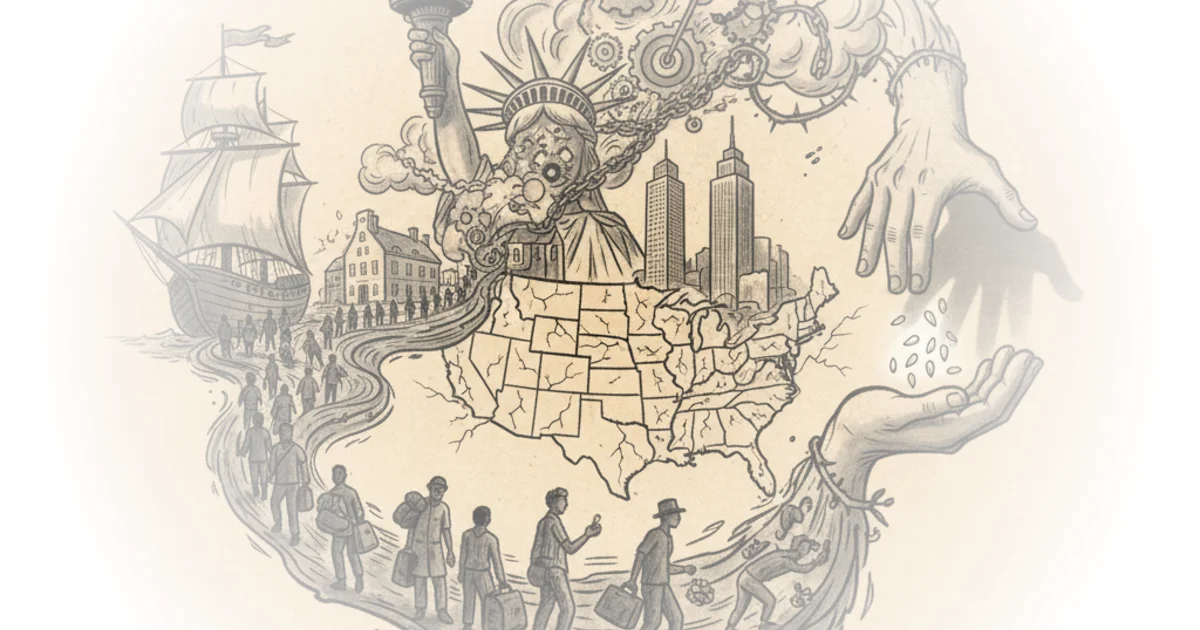
The commentary emphasizes that this book was once a staple of civics education before falling out of fashion, suggesting that the loss of the text mirrors a loss of a particular kind of Americanism. Yale University observes that Antin's story is "about the embrace of a certain kind of Americanism um that itself fell out of a certain kind of fashion uh later in the 20th century." This is a crucial distinction: the decline of the book's popularity wasn't accidental but reflected a shift in how the nation viewed its own capacity for integration. Critics might argue that focusing on Antin's success story glosses over the systemic violence and exclusion that many immigrants faced, but the podcast's strength lies in its refusal to sanitize the struggle while still honoring the aspiration.
"There's a lot of uh worry about all sorts of things that are going on... but one of the the features of that era is that people also had this incredible faith in the future."
The Schoolhouse as a Civic Engine
Perhaps the most resonant section of the coverage focuses on the role of public education as the primary vehicle for this assimilation. Yale University describes a pivotal scene where Antin's father, who speaks little English, hands his children over to a teacher who "recognizes them and she recognizes the meaning of this moment." This anecdote is used to illustrate a broader societal belief that schools were "essential to democracy, to a successful democracy." The analysis suggests that the public school was viewed not merely as a place of instruction, but as a sacred space where the "common culture" was forged.
Yale University points out that Antin "couldn't wait for the lessons as she called them... uh this was that's where the dream really" lived. This focus on the emotional weight of literacy and education connects Antin's experience to that of Frederick Douglass, creating a comparative lens that transcends specific ethnic boundaries. The argument posits that the Progressive Era was defined by a belief that the right institutions could solve the "social question" of whether society would hold together. However, the coverage also acknowledges the darker turn that followed, noting that the optimism of 1912 was short-lived. As Yale University puts it, "none of us ever know what's coming next. She published that book in 1912. She thought she understood the world she was in. And then two years later, World War I started and it it just threw the globe into uh chaos."
The Fragility of Progress
The commentary concludes by examining the fragility of the Progressive Era's hopes. The administration of the time, and the society at large, operated under the assumption that progress was inevitable, a notion that Yale University suggests "we've lost in our own politics at the moment." The podcast effectively uses Antin's narrative to show how quickly the political climate can shift from inclusion to exclusion. The "backlash" that followed the war, which led to restrictive immigration policies, serves as a stark reminder that the "American dream" is not a guaranteed trajectory but a contested political achievement.
Yale University notes that the era was marked by a "profusion of ideas about how you're going to make things better," yet this very openness made the subsequent retreat into nativism all the more jarring. The analysis holds up because it refuses to treat history as a linear march toward justice, instead presenting it as a series of precarious moments where the future was decided by human choices. The comparison to the 1912 election and the rise of modernist literature further grounds the argument in a specific cultural moment, showing how art and policy were intertwined in the struggle to define the nation.
Bottom Line
Yale University's commentary succeeds in reviving a forgotten narrative of hope, using Mary Antin's memoir to challenge the cynicism that often dominates modern immigration debates. The strongest part of the argument is its identification of public education as a once-unifying civic force, though it risks underestimating the deep-seated racial anxieties that always simmered beneath the surface of Progressive Era optimism. As the nation approaches its 250th anniversary, the most vital lesson here is that the future is never written; it is a fragile construct that requires constant, active defense.