Tim Mak's piece transcends a standard holiday retrospective by grounding Ukraine's 35th independence anniversary in the visceral, often contradictory memories of the generation that lived through the collapse of the Soviet Union. While official histories focus on parliamentary votes, Mak's reporting reveals a society where the transition to freedom was fueled by a mix of genuine hope, dangerous naivety, and the sudden, terrifying realization that sovereignty is not a permanent state but a daily struggle. This is essential listening for understanding why the current existential war feels so different to Ukrainians than the initial liberation did three decades ago.
The Myth of Instant Wealth
Mak constructs his narrative through the intimate lens of his colleagues' families, exposing the gap between political liberation and economic reality. He highlights a pervasive legend that circulated in the early 1990s: the belief that independence would instantly unlock a hidden fortune left by the 18th-century Hetman Pavlo Polubotok. "My family was promised to become millionaires but never did," Mak writes, capturing the specific flavor of that era's optimism. The author details how statuettes of Polubotok were given as gifts in pharmacies, a tangible symbol of a collective delusion that the state's freedom would immediately translate into personal wealth.
This anecdote is not merely a curiosity; it underscores the profound disorientation of the post-Soviet transition. The core of Mak's argument here is that the emotional high of 1991 was built on a foundation of uncertainty. While the Verkhovna Rada voted 346 to 1 for independence in August 1991, supported by a subsequent referendum where over 90% of citizens voted yes, the economic promise remained unfulfilled. Mak notes that his colleague's father, a former Pioneer, traded his Communist Youth League badge for a traditional embroidered shirt, a symbolic swap that carried more immediate emotional weight than the economic reality. Critics might argue that focusing on these myths trivializes the genuine political courage of the independence movement, but Mak uses them to illustrate the human cost of the transition: the crushing weight of unmet expectations that followed the initial euphoria.
The gold was never found. My family supported Ukrainian independence, even though we never did become millionaires.
The Texture of Protest
Moving from economic myths to the physical reality of the streets, Mak shifts the focus to the violence that underpinned the peaceful narrative often told today. He recounts the story of a grandmother in Kharkiv who recalls crowds so vast they stretched miles, yet the atmosphere was far from a sanitized parade. "Back then there were no cardboard signs, but the protests weren't as peaceful either," Mak quotes his source. The detail about protesters carrying fizzy drinks to spray opponents in heated arguments is a striking, almost surreal image that Mak leverages to show the raw, unpolished nature of the revolution.
This framing is effective because it strips away the romanticism of the past. Mak emphasizes that the 1991 declaration was not a foregone conclusion but a tense standoff that lasted until dawn. "All night long, they [members of Parliament] fought and argued, and it wasn't until dawn that they finally reached a decision," he writes, describing the static-filled television screens that broadcast the drama. The author connects this historical tension to the present, noting that while the 1991 independence was achieved largely through a nonviolent process, the current war has forced a brutal re-evaluation of what that freedom costs. This contrast is the piece's emotional anchor: the realization that the nonviolent path of the past is no longer an option.
The Shadow of the Coup
Mak also weaves in the broader geopolitical context, specifically the failed August 1991 coup in Moscow by hardline Communists. He describes how the trembling hands of Soviet Vice-President Gennady Yanayev during the emergency announcement signaled the end of an era. "She found it hilarious at that time," Mak writes of his colleague's mother, a reaction that seems jarring until placed in the context of the sudden, almost absurd collapse of a superpower. The coup's failure created the vacuum that allowed the Verkhovna Rada to vote for independence just two days later, a sequence of events that feels almost accidental in hindsight.
However, Mak is careful to note that this accident was not without peril. He recalls the fear of military involvement and the sudden disappearance of Soviet symbols, from red scarves to the uniforms with white aprons. The author argues that the true weight of these events was not understood until decades later. "It took watching that independence nearly slip away for its true value to become clear," Mak writes, a line that serves as a bridge between the 1991 celebration and the current war. This perspective is crucial; it suggests that the current conflict is not just a defense of borders, but a defense of the very identity that was so fragile in 1991. The historical context of the Ukrainian People's Republic, which briefly existed before Soviet occupation, looms in the background, reminding readers that the 1991 independence was a restoration of a state that had been erased, not the creation of something entirely new.
The Stakes of Today
The commentary concludes by juxtaposing these historical memories with the grim realities of the present moment. While the article celebrates the anniversary, the accompanying news briefs paint a stark picture: the postponement of high-level diplomatic visits due to missile strikes, Russia's plan to draft 300,000 troops, and the targeting of European weapons factories. Mak's narrative implies that the "interesting times" of 1991, which his grandmother described as "interesting in a good way," have been replaced by a struggle for survival where the stakes are existential.
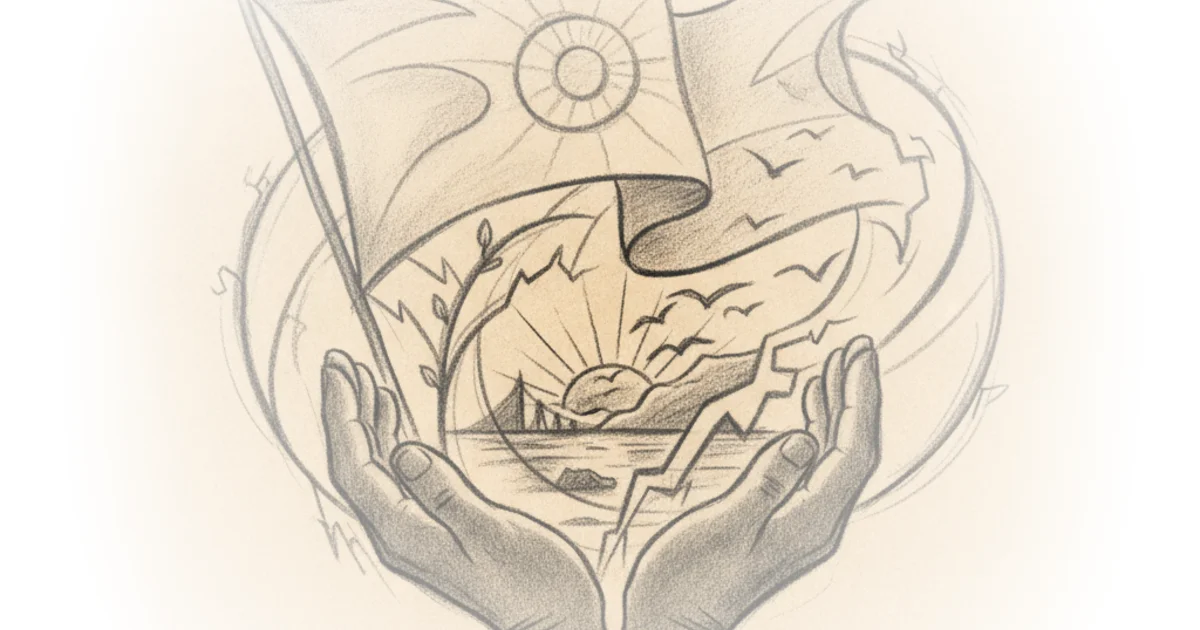
The piece effectively argues that the emotional significance of the Declaration of Independence has deepened, not faded, because of the war. "Freedom can never be taken for granted. It is a choice that must be defended every day," Mak writes, synthesizing the memories of his colleagues' parents with the current crisis. This is the strongest part of the coverage: it refuses to let the holiday become a moment of complacency. Instead, it uses the personal stories of the past to illuminate the terrifying clarity of the present. The vulnerability of the piece lies in its heavy reliance on personal anecdote, which, while powerful, may not fully capture the macro-political shifts driving the current war. Yet, for a reader seeking to understand the human soul of Ukraine, this approach is indispensable.
It is a choice that must be defended every day.
Bottom Line
Tim Mak's commentary succeeds by reframing a national holiday from a celebration of past triumphs into a somber reflection on the fragility of sovereignty. The strongest element is the use of intergenerational memory to show how the definition of freedom has evolved from a hope for wealth in 1991 to a fight for physical survival today. The piece's greatest vulnerability is its focus on individual stories, which, while emotionally resonant, leaves the broader geopolitical strategy of the conflict largely in the background. Readers should watch for how this shift in perspective influences future diplomatic and military support, as the world grapples with the reality that Ukraine's independence is once again on the line.