Yascha Mounk delivers a chilling on-the-ground report from a future Britain where the far right has not just shouted in the streets, but successfully captured the political imagination of a fractured nation. The piece's most startling claim is not the presence of hate, but the strange, unlikely coalition of Iranian monarchists, Hindu business owners, and working-class Christians all united under a banner of anti-Islam sentiment. This is not a standard political analysis; it is a forensic examination of how a movement transforms from fringe agitation into a governing threat, set against the backdrop of a Labour government in collapse and a Reform party surging to power.
The Unlikely Coalition
Mounk opens by dismantling the assumption that far-right rallies are monoliths of white nationalism. He describes a scene in Parliament Square where the crowd is a "sea of flags" and beer, populated by an Iranian couple and an Indian student who share a specific, terrifying conviction. "I think what all these people have in common is a dislike of Islam," the Iranian man tells Mounk, linking his fear of Sharia law in Britain to his trauma in Iran. Mounk notes that this sentiment is echoed by a woman holding a sign of Reza Pahlavi, the son of the deposed Shah, who sees the "same danger—radical Islam—taking root in the UK."
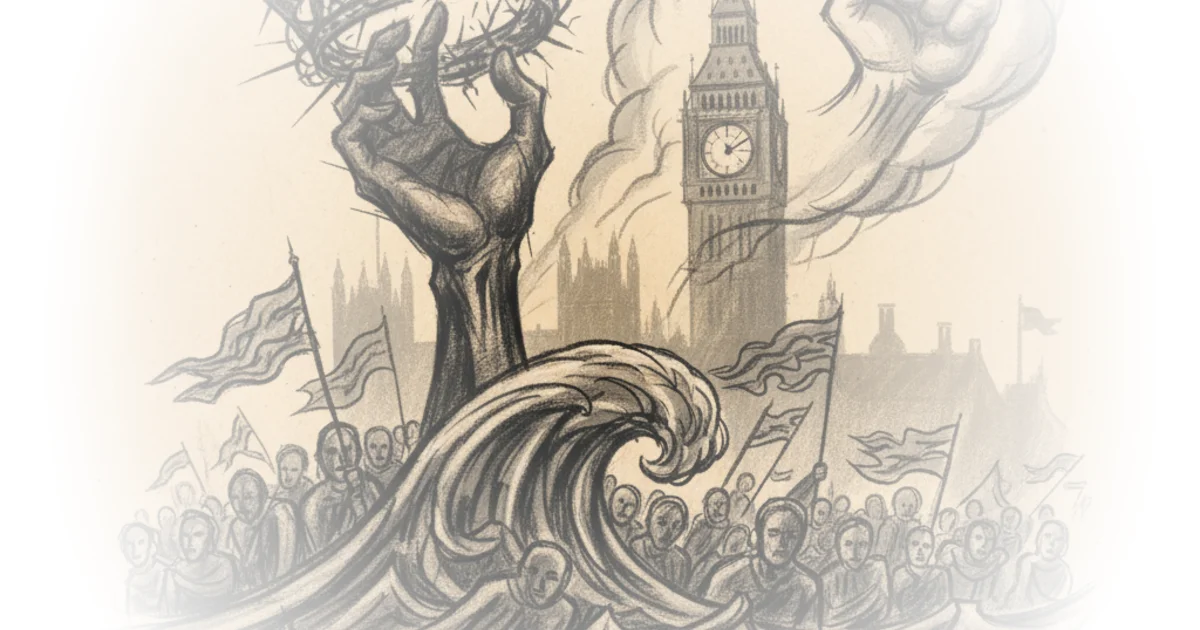
This framing is crucial because it highlights a globalization of grievance. Mounk argues that the movement has successfully exported the anxieties of the Middle East and South Asia into the British working class. The Indian student, Sneha, articulates the core fear: "I don't want Islam to be so prevalent. I don't want Sharia here." Mounk observes that while the crowd is overwhelmingly white and working class, the ideological engine is fueled by a diverse group of immigrants who view the UK as a potential second front in a global cultural war. This is a sophisticated pivot from the old EDL (English Defense League) days; the movement now claims to represent a universal defense of civilization rather than just ethnic purity.
"Issues like the grooming gangs and the migrant hotels are not failures to be learned from within a status quo that basically works; they are symptoms of civilizational collapse at the hands of one religion."
The Narrative of Collapse
The article's most potent section details how legitimate societal fractures are being inflated into a narrative of "terminal decline." Mounk interviews Daniel, a soft-spoken man from East London, who argues, "For the last thirty years, the British people have decisively voted for the party that promises to restrict immigration the most, and we've just been ignored. It's not a question of being racist, it's a question of numbers."
Mounk acknowledges that Britain faces real, quantifiable struggles. The economy has stagnated since 2008, public services are strained, and the government has struggled to manage a surge of refugees, including 200,000 crossing the English Channel on small boats since 2018. He notes that while the claim that "sharia law" has been imposed is false, real issues like religious intimidation and the failure to prosecute "grooming gangs" exist. However, Mounk argues that the far right has weaponized these specific failures to paint a picture of total systemic betrayal.
The rhetoric has shifted from policy critique to apocalyptic warning. Mounk describes a young man named Kyle, wrapped in an Israeli flag, who believes World War III is coming "from Islam." Another man, identifying as "Stan Laurel," claims, "We built all this... And now we're fucking retaliating."
Critics might argue that Mounk underestimates the genuine desperation of communities left behind by decades of austerity, suggesting that the "civilizational collapse" narrative is a rational, if extreme, response to the feeling that the state has abandoned its citizens. Yet, Mounk's reporting suggests that the movement's power lies not in solving these problems, but in offering a simple, cathartic enemy for complex economic failures.
The Rise of Tommy Robinson
The piece centers on Tommy Robinson, the movement's charismatic leader, whom Mounk describes as "the closest thing the British right has to a working-class hero." Unlike the upper-class populists of the past, Robinson's criminal past and "boyish, pugilistic" demeanor make him a martyr figure to his followers. Mounk recounts how Robinson's movement exploded following the summer 2024 riots in Southport, where false rumors about the attacker's identity were amplified by the activist, leading to a week of unrest and the firebombing of migrant hotels.
Mounk points out a disturbing evolution in Robinson's tactics: the fusion of street agitation with assertive Christianity. The rally is not just political; it is religious. Mounk writes, "I'm struck by the proliferation of Christian imagery here... At times, the tone is apocalyptic—a large banner reading 'REPENT, TODAY WE ARE IN THE LAST DAYS' flutters against the clouded sky." Attendees like Topaz express a desire to "unite the Kingdom for Jesus," while others distribute the Gospel of Saint John, convinced that Robinson is a man who has found salvation in prison.
This religious turn is a significant departure from the secular nationalism of the early 2010s. Mounk notes that the movement has folded in "working-class Brexit voters, Iranian monarchists, and British admirers of Donald Trump," creating a broad, intersectional front. The movement is no longer just about keeping Britain white; it is about defending a specific vision of Christian civilization against a perceived existential threat.
"The prevailing view is that every civilization has a right to defend itself—and that includes Britain."
The Bottom Line
Yascha Mounk's most compelling argument is that the British far right has successfully rebranded itself from a fringe hate group into a broad-based coalition of the disaffected, leveraging real grievances to push a narrative of civilizational war. The piece's greatest strength is its refusal to dismiss the crowd as merely ignorant, instead showing how their fears are carefully cultivated and amplified by a leader who understands the power of martyrdom and religious fervor. The biggest vulnerability in this movement, however, remains its reliance on a singular, monolithic enemy; as Mounk notes, this view is impossible to reconcile with the lived reality of diverse, integrated communities like Haringey, suggesting that the movement's ultimate success depends on the continued failure of the state to address the very real integration and economic issues it claims to solve.