This piece from Wayfare does something rare: it refuses to offer easy answers to the problem of suffering, instead finding a profound, unsettling clarity in the silence of ancient trees and the chaotic beauty of the natural world. By weaving together the biblical narrative of Job with the harsh reality of bristlecone pines facing climate change, the editors construct an argument that challenges the very human desire for a transactional relationship with the divine. It is a meditation for those who have grown weary of platitudes, suggesting that the universe is not a courtroom where we demand justice, but a vast, indifferent, and magnificent ecosystem where we are merely passing visitors.
The Divine Prosecutor and the Limits of Human Logic
The article begins by dismantling the popular misconception of the Book of Job as a story about patience. Instead, Wayfare reframes the text as a legal drama where the protagonist demands redress from a negligent deity. The piece notes that Job's legendary patience is a later addition; the canonical text is actually about a man who "decides to take God to court and demands he appear to answer Job's accusation of neglect of earned blessings." This reframing is crucial because it validates the anger of the sufferer rather than asking them to suppress it.
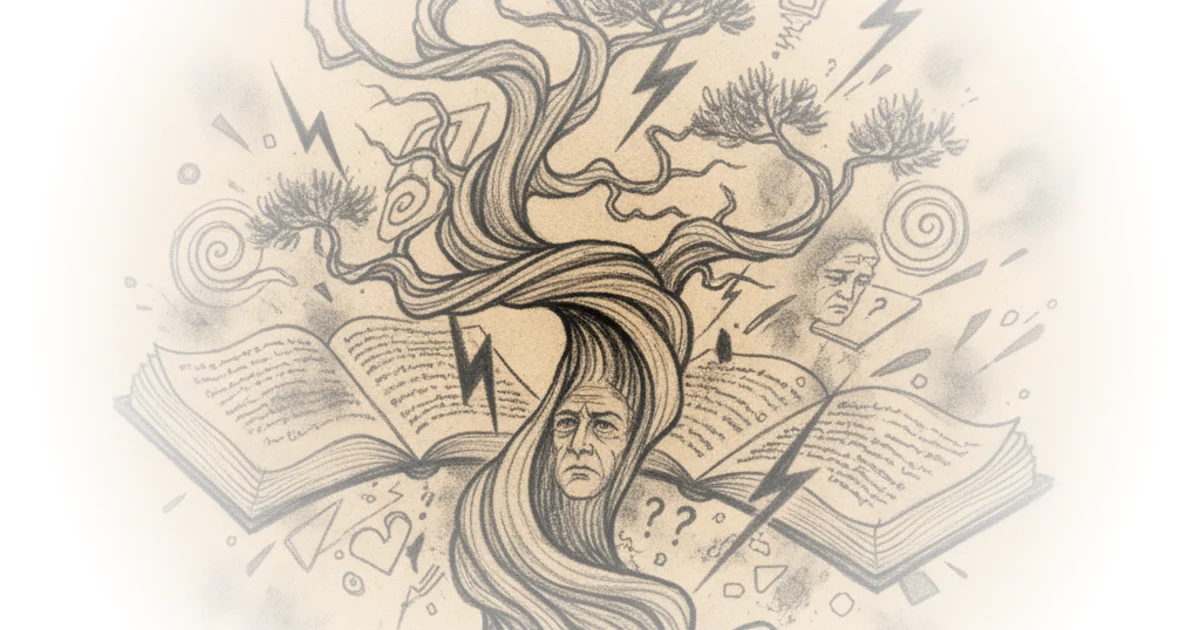
The editors highlight the often-overlooked perspective of Job's wife, whose own grief is frequently dismissed in traditional readings. Citing a variant in the Septuagint, the piece quotes her desperate plea: "Now say some word to the Lord and die!" Wayfare argues that her demand is not an act of malice, but of profound exhaustion, noting that she is "essentially a slave forced to watch the loss of all her offspring and all she has hoped for." This attention to the collateral damage of suffering adds a layer of human realism that is often missing from theological discourse.
When God finally responds, the piece argues that the divine answer is not a treatise on justice, but a display of power. God arrives not as a judge, but as a "storm god" who offers a "detailed tour of his creation" to demonstrate Job's insignificance. The text quotes the divine challenge: "Where were you when I founded earth? Tell me if you have understanding." This rhetorical strategy, the article suggests, is designed to show that the universe operates on a scale of complexity that human morality cannot fully grasp. The message is stark: "You are not ready for that question. You are incapable of understanding. The creation is beyond you—how much more so when you consider the deeper reasons for the universe's existence."
"Suffering is one of the most profound and heartrending aspects of existence. We all know this. We all have suffered. I find it strange that as I get to know anyone in any depth, it becomes apparent to me that they have suffered."
Critics might argue that this theological approach risks silencing the victim by suggesting their questions are inherently unanswerable or beneath the divine. However, the piece counters this by drawing on the Doctrine and Covenants, which describes a God who has also suffered: "Which suffering caused myself, even God, the greatest of all, to tremble because of pain, and to bleed at every pore." This connection attempts to bridge the gap between the divine and the human, suggesting that the answer to suffering is not an explanation, but a shared experience of pain.
The Silence of the Bristlecone
The argument shifts from ancient scripture to the high-altitude deserts of the Great Basin, where the author encounters the bristlecone pines. Wayfare uses the tragic history of a 5,100-year-old tree cut down by a graduate student in 1963 to illustrate the fragility of even the most enduring things. The piece notes that this ancient survivor, which had weathered millennia of drought and fire, was destroyed by a simple metal borer, a moment that serves as a metaphor for human intrusion into deep time.
The author's personal encounter with the remaining pines reveals a surprising emotional landscape. Rather than finding a sense of holiness or a connection to the divine, the author feels a profound sense of isolation. "I expected to find a sense of holiness in this place... But I find here a sense that all of my life and the life of humanity is but a passing moment. There's no concern about me at all." This admission is powerful because it rejects the anthropocentric view that nature exists to comfort or inspire us. The trees are indifferent, and that indifference is their true grandeur.
The piece draws a parallel between the biblical monsters Behemoth and Leviathan and the natural world's intricate, often brutal, systems, such as ants ranching mealybugs. The author observes that despite the pain and the "groaning of creation," there is a grounding force in the ecosystem. "Yet somehow, as the Lord so vividly describes, this 'something' depends mightily on mountain goats, ostriches, and bristlecone pines." This synthesis suggests that the divine is not found in the answers to our questions, but in the sheer, overwhelming reality of existence itself.
"I feel like I'm staring at the vast sea of being and haven't yet been able to capture even a drop in that ocean. This is an amazing place. I am so happy to be here, so happy to experience the wonder of this place, the magic at my level."
Bottom Line
Wayfare's exploration of the theology of bristlecone pines succeeds by replacing the comfort of answers with the dignity of mystery. Its strongest move is the refusal to sanitize the Book of Job, presenting it instead as a raw confrontation with a universe that does not owe us justice. The piece's vulnerability lies in its potential to alienate readers seeking immediate solace, yet it offers a more durable form of peace: the realization that our smallness is not a failure, but a feature of a creation far vaster than our capacity to comprehend.