This piece from Wayfare offers a rare, unvarnished look at the collision between spiritual conviction and political ideology, arguing that for many believers, faith does not lead to policy nuance but to a simplified, almost revelatory certainty. It suggests that the most compelling political arguments are not those built on data, but those delivered as personal testimonies—a claim that challenges the very foundation of how we debate economics and justice in a polarized era.
The Nature of Political Epiphany
The article centers on Phil Christman's book, which attempts to bridge the gap between Christianity and leftist politics. Wayfare notes that Christman's journey began not with a policy paper, but with a profound personal crisis: "When I prayed, I could not banish from my mind the fear that I was simply talking to myself." This vulnerability sets the stage for the piece's central thesis: that political conversion often mirrors religious conversion. The editors observe that Christman experienced an "epiphany" where he suddenly saw every person as "infinitely precious and infinitely interesting," a realization that he claims inevitably led him to socialism.
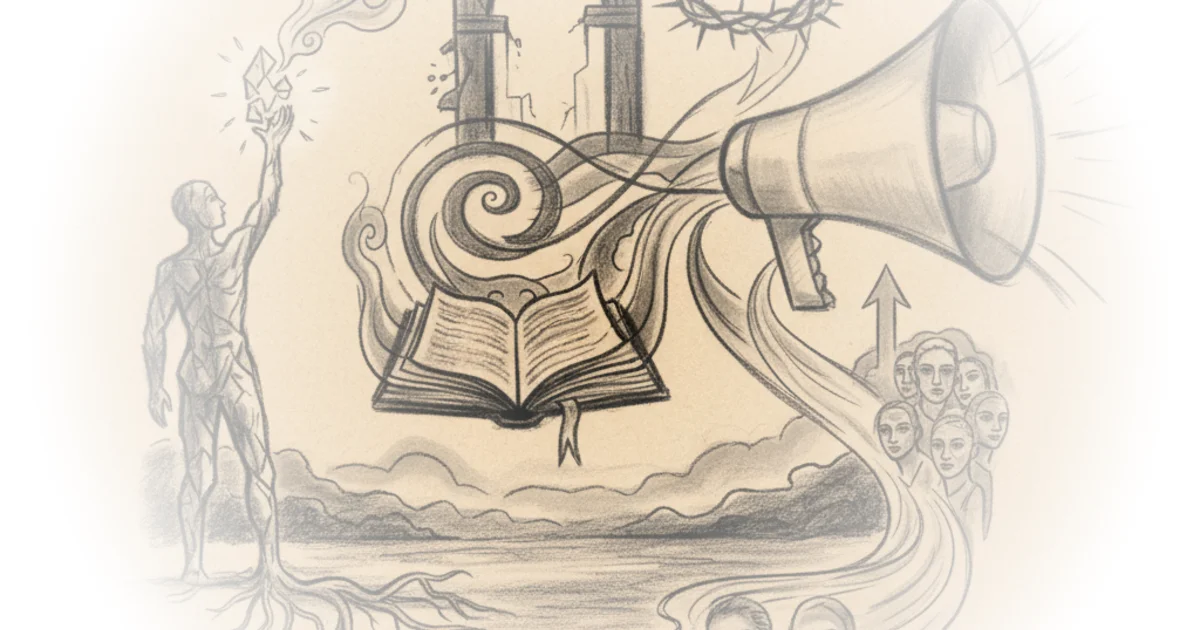
The commentary highlights a striking parallel between this experience and the concept of "testimony" in religious traditions, including the Latter-day Saint experience referenced in the text. Just as a believer might feel a spiritual confirmation that requires no further proof, Christman argues that the moral imperative of socialism is self-evident to anyone with a pure heart. The piece quotes his assertion that "the most important political ideas can mostly be explained in terms that a bright sixteen-year-old could understand." This reduction of complex geopolitical and economic history to a simple moral binary is the book's defining feature, and the article treats it with a mix of skepticism and empathy.
"For me, the fate of being a Christian and being on the left politically are, if not identical, at least closely linked."
The Danger of Simplification
Wayfare pushes back against the idea that political philosophy can be as intuitive as spiritual feeling. The editors point out that Christman's approach dismisses the need for rigorous engagement with history or theory. He treats thinkers like Aristotle, Hayek, or Mill not as serious interlocutors, but as voices rationalizing privilege. The article notes that Christman views the differences between socialism and communism as "vibes-based," a stance that glosses over the catastrophic human costs of regimes led by Lenin, Stalin, and Mao. Critics might note that this historical amnesia is dangerous; ignoring the atrocities of the 20th century to champion a specific economic model risks repeating the very errors it seeks to correct.
The piece argues that this simplification is not an accident but a feature of the "testimony" genre. Just as one does not debate the historicity of a religious text in a testimony meeting, Christman does not offer a nuanced defense of his politics. He asserts that if you do not agree with him, it is not because his logic is flawed, but because you are blinded by "greed or selfishness." The article captures this tension well: "If you do that, it seems, you should receive your own testimony of leftism immediately and intuitively in the same way that as a forlorn college student Christman received his." This framing effectively exposes the closed loop of the argument: disagreement is redefined as a moral failing rather than an intellectual difference.
Beyond the Binary
Despite its criticisms, the commentary finds value in the book's underlying spiritual insight. The editors reflect on the difficulty of maintaining relationships across deep political divides, noting that Christman's work reminds readers that "the imago dei that makes you and me and everyone else intrinsically worthy of love and respect is not dependent on... our often misguided views about economics and politics." This is a crucial distinction. While the political conclusions may be simplistic, the call to see the humanity in the "oppressor" or the "oppressed" resonates with the deeper currents of liberation theology, which historically sought to align faith with the liberation of the poor, even if the methods debated were complex.
The article concludes that while we should not accept Christman's political shortcuts, we should listen to the testimony behind them. It suggests that the real work is not in proving the other side wrong, but in recognizing that "we are in all of our faded glory—the profoundly loveable, infinitely precious, fallen, exasperatingly obtuse, glorious children of God." This shift from policy debate to human connection is the piece's most enduring contribution.
"I do not believe God or any God-substitute actually does reveal political truths in this way... if you want to be a responsible person, you 'have to really grind' your way to your convictions."
Bottom Line
Wayfare's commentary successfully navigates the tension between respecting personal faith and demanding political rigor, exposing how the language of testimony can both inspire solidarity and shut down necessary debate. Its strongest move is reframing political disagreement not as a failure of logic, but as a failure of humility, while its greatest vulnerability lies in accepting the premise that complex economic systems can be reduced to moral intuitions without historical consequence. Readers should watch for how this framework of "spiritual certainty" continues to shape political discourse in an increasingly polarized society.