This piece cuts through the noise of political theater to ask a question that has been systematically avoided: why does the standard for police accountability seem to vanish when the victim is a rioter and the shooter is an officer? Stark Realities doesn't just recount the death of Ashli Babbitt; it dissects the specific, documented failures of US Capitol Police Lieutenant Michael Byrd, arguing that the lack of prosecution stems not from a lack of evidence, but from a partisan double standard that shields certain officers from the scrutiny applied to others.
The Gap Between Policy and Action
The article's most jarring revelation isn't the shooting itself, but the admission by the officer who pulled the trigger that he was operating in the dark. Stark Realities highlights Byrd's own words from a 2021 interview, where he confessed, "I could not see exactly what was happening... it's impossible for me to see what's on the other side because we had created such a barricade." This admission is critical because it directly contradicts the legal threshold for lethal force. The piece argues that "without additional information indicating that a person is likely armed, officers cannot conclude that someone has a weapon just because they cannot see definitively that the person does not have a weapon." This logic, drawn from legal experts at Lawfare, suggests that Byrd acted on a generalized assumption rather than the "specific and individualized facts" required by law.
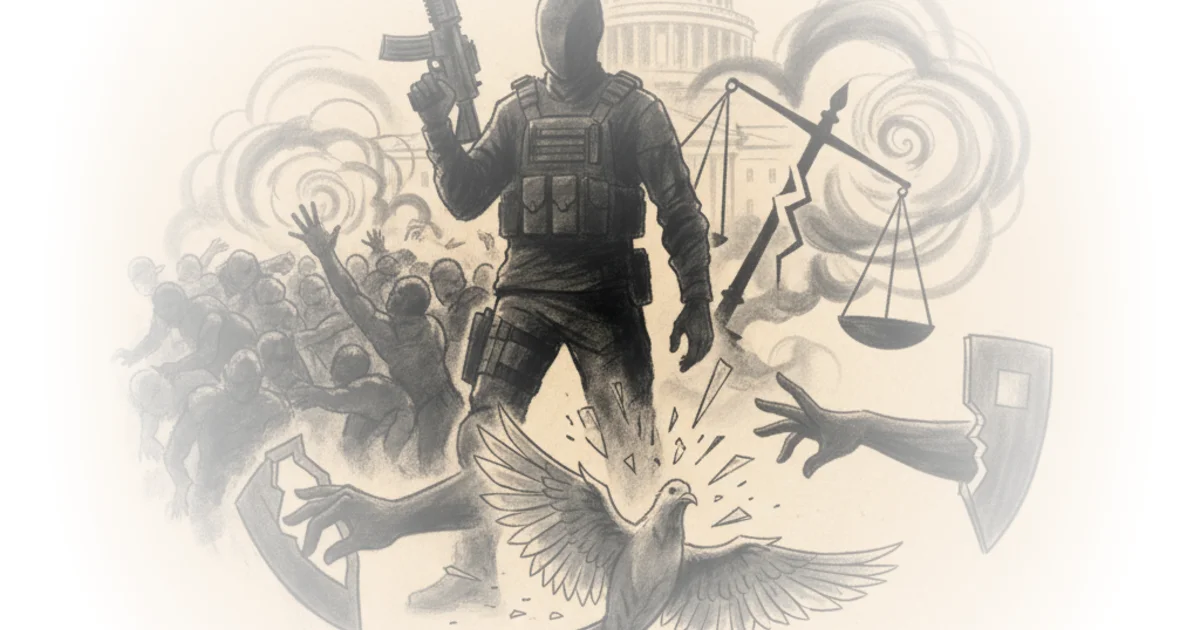
The commentary notes that this failure of judgment wasn't an isolated lapse in a chaotic moment. The piece points out that Byrd was the only officer to fire, despite multiple armed officers being present. "Byrd asserts that Babbitt's mere failure to comply with orders not to proceed through the door justified the use of lethal force," the article states, framing this as a dangerous expansion of police power. Critics might note that the chaos of a breached Capitol, with false reports of shots fired elsewhere, creates a high-stress environment where split-second decisions are inevitable. However, the article counters this by emphasizing that the three officers on the other side of the door had already abandoned their post, removing the immediate physical pressure that might have justified a defensive reaction.
"An intellectually honest person can reject Babbitt's politics, condemn her unlawful conduct on Jan. 6 and rightly conclude that she was the victim of an unjustified police shooting."
A History of Recklessness
Perhaps the most damning section of the coverage is the detailed look at Byrd's prior disciplinary record, which the article suggests was ignored by the system. Stark Realities reports that in 2019, Byrd was suspended for leaving a loaded weapon in a public bathroom, and in 2004, he fired at a fleeing car in a manner investigators called "careless and imprudent." The piece draws a sharp line between these past incidents and the Jan. 6 shooting, noting that Byrd "put his finger inside the pistol's trigger guard, tapping it on and off the trigger for at least 14 seconds before he shot and killed Ashli." This specific detail violates a fundamental safety rule in law enforcement and military training, suggesting a level of casualness with a deadly weapon that is difficult to reconcile with the claim of imminent threat.
The article also touches on the positioning of the officer, describing it as an "ambush" because Byrd was tucked in a doorway with only his pistol visible, making it unlikely Babbitt saw the threat before it was too late. "It's very unlikely Babbitt saw his raised pistol and knew she was being threatened with death if she went through the window," the piece argues. This framing challenges the narrative of a heroic stand, suggesting instead a tactical failure where the officer's own positioning created the deadly scenario. The connection to Graham v. Connor, the Supreme Court case establishing the "objective reasonableness" standard for use of force, is implicit here; the article implies that Byrd's actions would not meet that standard under any objective review.
The Double Standard of Public Reaction
The final thrust of the commentary addresses the societal reaction, or lack thereof. The piece contrasts the outrage following the death of George Floyd with the "indifferent shrug" that greeted Babbitt's death. "The contrast illustrates how partisan framing short-circuits people's ability to uniformly and objectively apply principles to the facts before them," Stark Realities writes. The article suggests that the refusal to apply the same scrutiny to Byrd that was applied to officers in other high-profile cases is a failure of moral consistency. It notes that Byrd himself declared, "I showed the utmost courage on January 6... I know that day I saved countless lives," a claim the piece labels as "baseless" given the lack of evidence that Babbitt posed a lethal threat.
The coverage also highlights the upcoming civil trial, where Babbitt's husband is seeking $30 million in damages, as the next battleground for these questions. The article reminds readers that the Department of Justice found "insufficient evidence to support a criminal prosecution" but notably "did not... assert that Byrd's use of deadly force was warranted." This distinction is crucial: the government may not be able to prove intent beyond a reasonable doubt in a criminal court, but that does not mean the force was justified under policy or law.
Bottom Line
The strongest part of this argument is its reliance on the officer's own admissions and documented history to dismantle the "hero" narrative, forcing a re-evaluation of the event based on facts rather than political affiliation. Its biggest vulnerability is the inherent difficulty of reconstructing the subjective mindset of an officer in a life-or-death moment, though the article effectively uses policy violations to counter that defense. Readers should watch the July 2026 civil trial closely, as it may finally provide a judicial determination on whether the use of force was reasonable, regardless of the victim's political identity.