Nietzsche wasn't just challenging morality—he was challenging how we understand language itself, and why even our most educated scholars are missing something crucial about the classics they claim to love. In sections 27-29 of Beyond Good and Evil, he makes a startling argument: the German language is structurally incapable of capturing the lightness and genius of Aristophanes, and that gap reveals something fundamental about why the independent thinker must inevitably become isolated.", ## The River and Its Observers
Nietzsche opens with a striking metaphor. He imagines himself as a massive, slow-moving spiritual being—like the Ganges river—while everyone else is either a frog or a tortoise trying to perceive it from outside. A frog cannot comprehend the Ganges; neither can a tortoise. The gap between Nietzsche's way of thinking and that of ordinary people is so vast that he feels genuinely lonely.
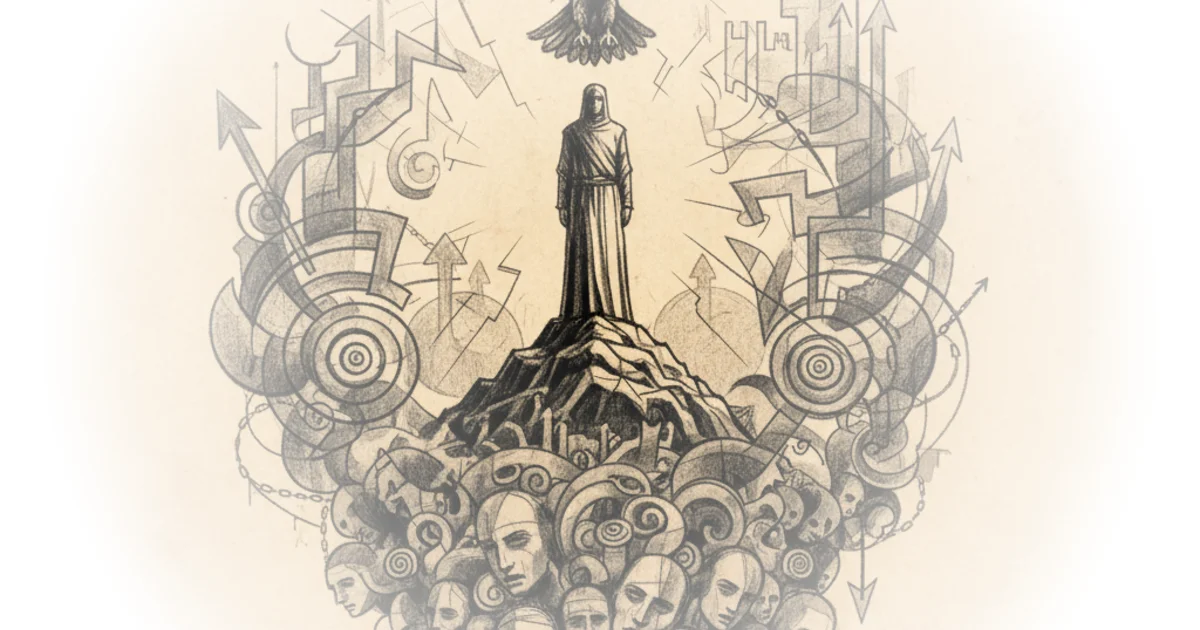
When reading his letters and biographies, one finds that Nietzsche felt this isolation deeply. He sent out his works hoping for understanding, but his friends simply couldn't figure out what he was driving at. His writing was too challenging even for his era—perhaps still too challenging today—but in his time, it was nearly impossible to appreciate or understand why he wrote the way he did.
Nietzsche offers a stark choice: either grant your good friends a playground for misunderstanding and still enjoy them, or expect them to understand you and be continuously disappointed—or simply get rid of them and laugh about it. The choices he presents are uncomfortably honest, revealing the cost of exceptional thinking.
The Untranslatable Classics
Section 28 contains one of Nietzsche's most powerful arguments: translation is fundamentally impossible for certain kinds of texts. He draws on his background as a philologist to demonstrate that so much of language isn't just meaning—it's tempo, pacing, alliteration, tone. These nuances become uncapturable simply because other languages are structured differently.
German specifically struggles with presto—the quick, staccato, fast-paced speaking style. German words are long; German phrases extend into maddeningly complex constructions. Even if someone attempted to capture the quick tempo in German, it wouldn't be received well because such speed doesn't exist within the language's nuances.
Nietzsche points out that when examining the classic Greeks and Romans, Aristophanes and Petronius are untranslatable for him. Everything ponderous, viscous, pompously clumsy—all the long-winded species of style—developed most abundantly among Germans. Even the great German writer Gertha, held up as a model of good German prose, is no exception to this criticism.
The stakes are higher than just losing some elegant phrasing. When language fails to capture these nuances, you're not just losing poetry—you're losing Aristophanes entirely. And Nietzsche knew this intimately because he had access to the original languages. He could feel that difference in a way others couldn't. This became another source of alienation: even classical scholars who claimed to understand Plato and Aristophanes didn't actually grasp what they were reading.
The Antidote: Aristophanes
Nietzsche argues that one reason philologists study the classical world is because it represents an apogee of human achievement—the culture we should be shooting for. But Nietzsche stands there saying not only is this possibly wrongheaded, but you don't even understand the culture you're holding up as ideal.
Crucially, Nietzsche points to what Plato valued: under his pillow at death, they found not a Bible or Egyptian text, but Aristophanes. How could Plato have endured Greek life—which he repudiated—without Aristophanes? The humor, the lightness, the joy in how language is deployed is what made Aristophanes great.
This matters because it's the antidote to all the heaviness Nietzsche finds in Hellenistic culture. Yet even today, Aristophanes' plays are difficult to perform—they're so embedded in the culture of the time and so fundamentally risqué that they're virtually impossible to carry across cultural boundaries. In Nietzsche's Germany—a very conservative society—there was no chance for Aristophanes to resonate at all.
The people were picking and choosing what they liked, what they thought they understood, and holding that up as an ideal. Nietzsche is saying: you're not even close.
The Independent Thinker's Isolation
Section 29 makes the case that it is the business of the very few to be independent. It's a privilege of the strong—and anyone who attempts it without being forced proves they're not only strong but daring beyond measure.
Nietzsche enters a labyrinth where he multiplies the dangers life already brings. The greatest danger: no one can see how or where he loses his way. When you're doing what others do, you can tell when you've gone off the path—but when you're independent, there's no roadmap. There's no clear path, and no one can tell you whether you've wandered from it.
When such an independent thinker comes to grief, it's far from the comprehension of ordinary men—they cannot feel it or sympathize with it. He cannot go back even if he wanted to, because their sympathy is wrongheaded. Placing yourself outside common human culture means they don't understand your struggles when you fail—you can't even use their empathy.
Their sympathy becomes irrelevant. It's a non-thing. You have neither the support of their understanding nor any need for it. And this isolation intensifies repeatedly throughout Thus Spoke Zarathustra, where the protagonist goes to the mountain, decides to return to the crowd, realizes that was probably a mistake, and wanders off again.
Language is so much more than meaning—it's tempo, pacing, alliteration, tone—and these nuances become uncapturable simply because other languages are structured differently.
Counterpoints
Critics might note that Nietzsche's argument risks creating an elite hierarchy that dismisses genuine scholarly work in translation studies. Modern philologists have spent decades refining translations precisely to capture what he describes—tempo, nuance, and cultural context. His critique could be read as intellectual gatekeeping rather than a genuine observation about translation's limits.
Additionally, his use of Aristophanes as the unreachable ideal might overstate how inaccessible the comedies truly are. Many scholars have produced accessible translations and performances that capture meaningful portions of his genius, even if some wordplay is lost.
Bottom Line
Nietzsche's core argument—about the gap between exceptional thinking and common understanding—is powerful and enduring. The greatest vulnerability lies in how easily it slides into elitism: the claim that others simply cannot understand what you're doing becomes a justification for isolation rather than an insight about communication. Yet the tension between needing to be understood and accepting being misunderstood is where this philosophy remains most provocative—and most useful.