Derek Muller wants to take you somewhere most science communicators don't go — into the heart of one of physics' most unsettling ideas: that every quantum outcome happens, all at once, everywhere. The video is a bold attempt to make the Many Worlds interpretation accessible without shying away from how strange it actually is.
The Measurement Problem
Muller opens with what he calls "a beautiful symmetry": classical mechanics lets you predict a particle's future if you know its position and velocity; quantum mechanics lets you do the same with a wave function. But here's the problem, as Muller frames it: "in quantum mechanics we never actually observe the wave function" — only the particle at a single point. This is the core of what physicists call the measurement problem.
He walks through how the founders of quantum theory approached this: "the founders of quantum theory approached this problem they considered the measurement more real than the wavefunction after all the measurement was something we had actually observed and it matches our experience of a world of matter particles." This is effective because it humanizes the history — these weren't reckless speculators, they were trying to reconcile math with what they could actually see. The irony Muller builds is that their solution — adding a second set of rules for measurement — created exactly the kind of split he wants to resolve.
"the founders of quantum theory may have got it exactly backwards"
The Born rule introduced probability into the core of physics: "no longer is the universe deterministic" — Muller writes this with the weight of someone delivering news that still makes Einstein uncomfortable. The point isn't just that randomness exists in physics; it's that everything we observe is now understood as a fraction of what actually happens.
Schrödinger's Cat Gets Real
Muller walks through the famous cat experiment not as a curiosity but as evidence for his larger argument. He builds carefully: "the state of the atom does not have to be either decayed or not decayed generally it's in a superposition" — this is the key to everything that follows.
The thought experiment's power, Muller argues, isn't just weirdness — it's wrong: "Schrodinger himself hated this formulation which is actually why he invented the famous Schrodinger's cat thought experiment put a cat in a box" — the point was to show quantum mechanics as formulated was broken, not to parade strange outcomes for clicks.
What makes this section land is how Muller connects the cat to us: "we are also made of electrons and atoms which obey the laws of quantum mechanics so we are quantum mechanical" — meaning there's no special divide between observer and observed. This isn't just philosophy; it's the physics he's asking you to take seriously.
The Many Worlds Answer
Muller then pivots to what happens when you drop measurement-as-collapse entirely: "when we open the box there is no measurement no wavefunction collapse we simply get entangled with the state of everything inside the box" — and then comes the parallel worlds claim: "the solution is it's because the you that saw the cat alive and the you that saw it dead actually inhabit separate worlds by that I mean they exist in their own complete realities and those realities will never interact."
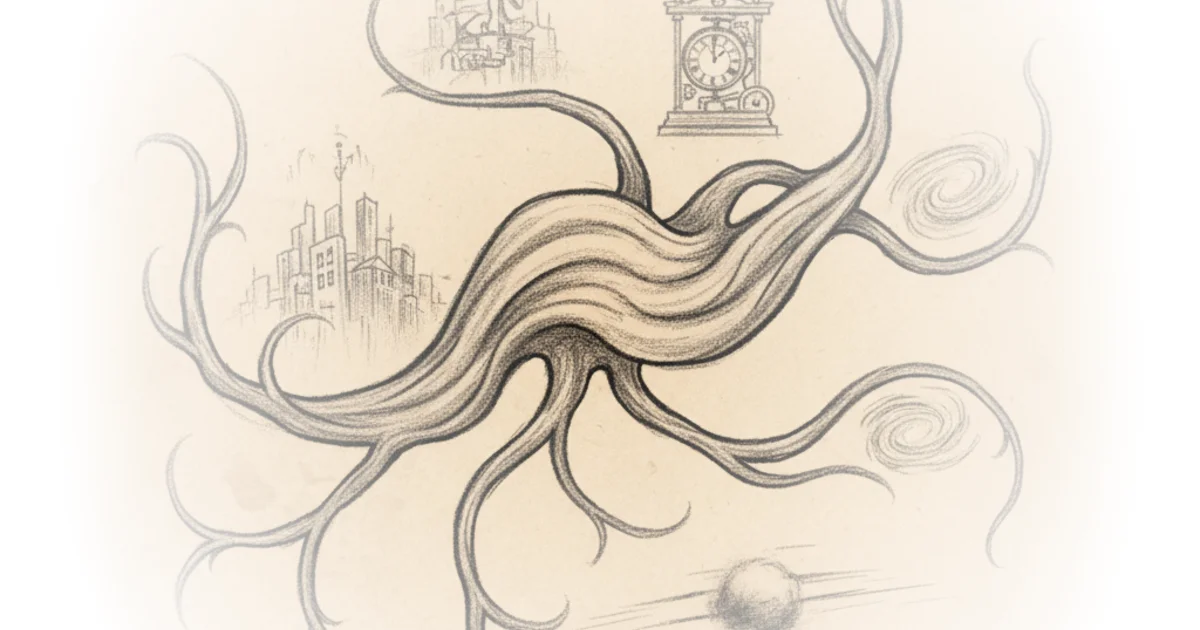
This is the video's most daring move. Muller isn't just explaining physics — he's asking you to accept that every quantum branching creates an entire copy of reality, including copies of you. The framing works because he doesn't minimize how strange this sounds: "I imagine that a lot of you have questions and possibly objections to this" — acknowledging the resistance before answering.
The interview with Sean Carroll provides expert validation. What emerges isn't certainty but honest uncertainty: "we don't know whether the total number of possible branches is infinitely big or finite" — the field's open questions made visible.
Counterpoints
Critics might note that Many Worlds faces real problems: the measure problem (how to weight infinite branching), whether decoherence actually is equivalent to branching, and what counts as a measurement trigger. Muller's argument also assumes quantum mechanics applies at macroscopic scales — unproven experimentally. The video doesn't fully resolve these but rather invites the viewer into them.
Bottom Line
Muller's strongest contribution is making the philosophical stakes of quantum mechanics visceral through Schrödinger's cat, then showing how the math actually suggests parallel worlds rather than requiring them. His biggest vulnerability: the video ends by acknowledging we don't know how many branches exist or whether branching is infinite — which is honest but leaves the core claim partially suspended. The argument's power comes from taking the mathematics seriously enough to ask what it implies about reality itself.