The Pawn That Begs to Be Captured
Transnistria presents one of the most counterintuitive puzzles in modern geopolitics. Here is a sliver of land, roughly the size of Rhode Island, wedged between Moldova and Ukraine, that has spent decades pleading with Russia to annex it. Russia, the same country that launched a full-scale invasion of Ukraine partly under the banner of protecting Russian citizens abroad, refuses. PolyMatter's analysis of this apparent contradiction reveals a story not about territorial ambition but about strategic patience and the cold arithmetic of leverage.
The territory declared independence from Moldova in 1992 after a brief war that claimed fewer than a thousand lives. It has governed itself ever since, complete with its own parliament, currency, central bank, and border crossings. Its flag still bears the Soviet hammer and sickle. Statues of Lenin line its streets. Its security service operates from the old KGB headquarters. In 2006, the Transnistrian government formally requested absorption into the Russian Federation. Last year, it renewed that appeal.
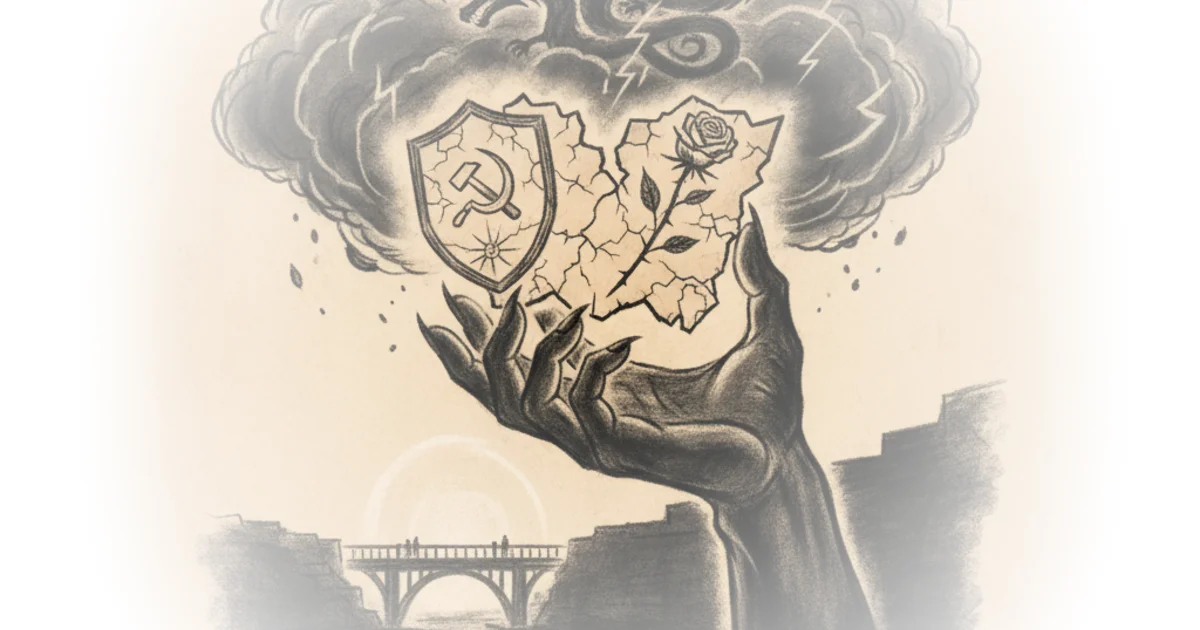
Putin refuses to absorb Transnistria despite its pleading because it's more useful to him as a pawn in a larger chess game. He hopes to one day negotiate Transnistria's unification with Moldova, but only on his terms.
That single observation carries the weight of the entire analysis. Putin does not want the territory. He wants the leverage the territory provides.
Stalin's Long Shadow
The roots of the conflict trace back to a characteristically cynical Stalinist maneuver. Rather than simply absorbing Bessarabia (roughly present-day Moldova) into the Ukrainian Soviet Socialist Republic after seizing it from Romania, Stalin manufactured a distinct Moldovan identity. He created an autonomous Moldovan republic within the Ukrainian one, despite ethnic Moldovans being a minority there from day one. The political utility became clear fifteen years later when the territory expanded westward: Moscow could claim it was merely restoring Moldova to its "rightful full size."
The result was a country stitched together from two fundamentally different halves. The western eighty percent had been under Romanian control and remained largely agricultural. The eastern sliver, present-day Transnistria, had been collectivized under Soviet rule and housed enormous industrial capacity.
Despite being much smaller, it produced 56% of Moldova's consumer goods and 90% of its energy.
This economic asymmetry created a dependency that persists to the present day. When the Soviet Union collapsed, the two halves pulled in opposite directions along predictable lines. Moldova pivoted toward Romania and the West, adopting the Latin script and the Romanian tricolor. Transnistria clung to Moscow and the Soviet past, becoming what PolyMatter aptly describes as "a strange sort of living Soviet museum."
The Comfortable Stalemate
What makes the Transnistria situation genuinely unusual among frozen conflicts is how little urgency either side feels to resolve it. There is no religious animosity. No ethnic division drives the separation; Transnistria's population splits almost exactly into thirds among Moldovans, Russians, and Ukrainians. The border between Moldova and Transnistria is nothing like the Korean DMZ. Citizens cross freely. Some Moldovans even save money by registering their cars with Transnistrian license plates.
In one survey, Moldovans ranked solving the Transnistrian issue as their ninth or 10th highest priority, far below everyday concerns like crime and corruption. As one of the poorest nations in Europe, Moldova simply has bigger fish to fry.
This apathy is not irrational. Reintegrating Transnistria would force Moldova to absorb a population heavily oriented toward Moscow, radically shifting its political culture at precisely the moment it is pursuing European Union membership. The frozen conflict, paradoxically, may serve Moldova's westward ambitions better than resolution would.
The Sheriff in Town
One of the more striking elements of the analysis concerns the company called Sheriff, which dominates Transnistria's economy with a grip that would make any oligarch envious. Transnistria's first president exempted his associates' company from taxes. In return, Sheriff provided political support. The company now owns most of the territory's gas stations, supermarkets, malls, and television stations. It also owns a professional football club and one of the largest stadiums in Eastern Europe.
One can only guess how the company earned the $200 million it took to build.
The smuggling economy that sustains this arrangement is staggering in scale. At one point, Transnistria officially imported four and a half times as many goods as Moldova proper, despite having roughly one-sixth the population. The cigarette statistics alone tell the story: if the territory actually consumed all the cigarettes that passed through its borders, every resident would need to smoke twelve packs a week.
This is worth pausing on. The frozen conflict is not merely a geopolitical abstraction. It is a profit center for a narrow elite who have every incentive to maintain the status quo. The workers, meanwhile, receive Soviet-nostalgia benefits from Sheriff and access to Ukrainian, Russian, or Moldovan passports for travel. The arrangement works well enough for enough people that pressure for change remains weak.
The Gas Weapon
Russia's most powerful tool in this arrangement is not its thousand-troop garrison in Transnistria, though the symbolic weight of Russian soldiers on internationally recognized Moldovan territory is considerable. The decisive lever is energy. Moscow charges dramatically different prices depending on political alignment: in 2019, Moldova proper paid $391 for a given quantity of gas while Transnistria paid just $163 for the same amount.
But the real subsidy goes beyond discounted rates. Transnistria has accumulated over six billion dollars in unpaid gas bills, roughly seven times its entire GDP, and Russia has never enforced collection. The billing charade is elegant in its cynicism: Gazprom sends a bill, Transnistria responds that since Russia does not recognize its independence the bill should go to Moldova, and Moscow shrugs.
Billions of dollars worth of free energy, it's learned, makes for an exceptionally loyal ally.
This arrangement serves triple duty. It keeps the client state alive and loyal. It demonstrates to other Eastern European nations the material benefits of staying within Russia's orbit. And it hangs an enormous unpaid debt over Moldova's head, implying that resolution of the conflict might come with a six-billion-dollar invoice.
Counterpoint: Patience Has Limits
PolyMatter's framing of Putin as an "extraordinarily patient" strategist deserves some scrutiny. The analysis was produced before the full consequences of Russia's Ukraine invasion became clear for its satellite relationships. The war has disrupted the very land corridor that would connect Russia to Transnistria, making the territory more isolated than ever. Moldova, galvanized by the invasion next door, has accelerated its EU candidacy. The geopolitical window for Russia to extract concessions through Transnistria may be narrowing rather than holding steady.
There is also the question of whether strategic patience and strategic paralysis are truly distinguishable from the outside. Russia's refusal to absorb Transnistria may reflect less a grand chess strategy than an inability to find any move that improves its position. Annexation would trigger sanctions and international condemnation for minimal strategic gain. Recognition of independence would eliminate its usefulness as a bargaining chip. And the status quo, while comfortable, yields diminishing returns as Moldova drifts further toward Brussels.
The comparison to Kaliningrad also warrants more attention than PolyMatter gives it. Kaliningrad is a fully Russian exclave sustained by massive federal subsidies and connected to the mainland by negotiated transit agreements through Lithuania. Absorbing Transnistria would create a far more precarious version of the same arrangement, without the NATO transit agreements or federal budget to sustain it.
Bottom Line
Transnistria is less a frozen conflict than a deliberately maintained one, kept on ice because every major party benefits from the ambiguity. Russia retains leverage over Moldova without the costs of annexation. Transnistrian elites profit from smuggling and subsidized energy. Moldova avoids absorbing a pro-Russian population block while pursuing EU membership. The losers are ordinary Transnistrians living in a Soviet time capsule with no international recognition and no clear path forward, and Moldovans who cannot fully control their own sovereign territory. The chess metaphor is apt, but it is worth remembering that pawns do not choose to be sacrificed.