A federal agency has pulled the legal rug out from under more than a decade of automobile greenhouse gas regulation — not by disputing climate science, but by arguing that a half-century-old statute never gave it the power in the first place. Roger Pielke Jr. reads the rule carefully and finds something that neither environmental alarmists nor deregulation champions want to acknowledge: it might actually hold up in court.
The Legal Pivot
The entire debate hinges on 112 words in the Clean Air Act, specifically a clause that authorizes the Environmental Protection Agency to set emission standards when pollution can "reasonably be anticipated to endanger public health or welfare." In 2009, the agency interpreted those words as authority to regulate carbon dioxide and five other greenhouse gases from motor vehicles. The new rule interprets those same words to mean the opposite.
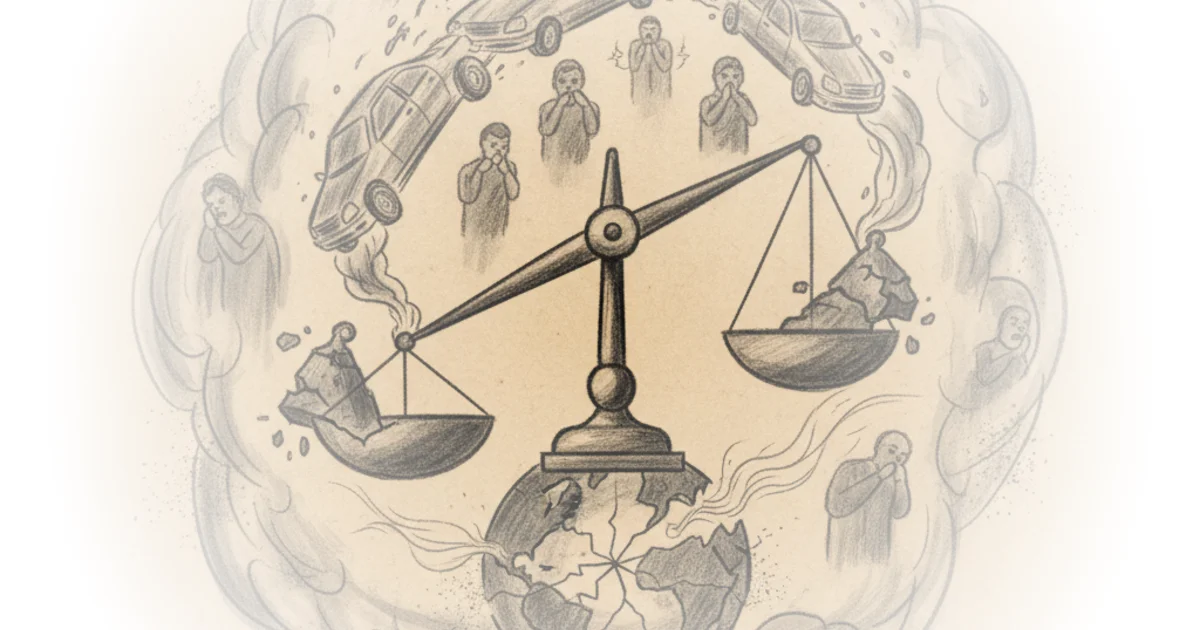
Roger Pielke Jr. writes, "The EPA determines that CAA section 202(a)(1) does not authorize the Agency to prescribe emission standards in response to global climate change concerns for multiple reasons, including the best reading of the statutory terms 'air pollution,' 'cause,' 'contribute,' and 'reasonably be anticipated to endanger.'"
The shift is possible because of the Supreme Court's 2024 decision in Loper Bright Enterprises v. Raimondo, which stripped federal agencies of the automatic judicial deference they had enjoyed for decades under the Chevron doctrine. Courts now decide what statutes mean — agencies no longer get to fill in the ambiguities. Pielke Jr. notes that Loper Bright demands more precision from Congress, and he views legislative ambiguity as something of a political Rorschach test: each side sees in the text what it wants to see.
"The ambiguities of the Clean Air Act are nothing more than political Rorschach tests."
What Gets Eliminated
The rule strips away greenhouse gas emission standards spanning light-duty passenger cars, medium-duty trucks, and heavy-duty engines — every major vehicle category. Model year standards dating from 2012 through the 2030s are gone.
As Roger Pielke Jr. puts it, "Retaining a GHG emission standards program for vehicles and engines would result in a 0.007 °C impact on projected global mean surface temperature through 2050 and 0.019 °C impact through 2100." The agency argues that effects this small cannot constitute a "material impact" on public health or welfare, which means they cannot satisfy the endangerment standard the Clean Air Act requires.
Science Is Out of Scope
Perhaps the most revealing moment in the rule is what it does not do. Climate advocates and outlets like the New York Times have framed the rescission as a rejection of climate science itself. The EPA disagrees and explicitly declines to weigh in on the science.
Roger Pielke Jr. notes that "comments related to climate science are out of scope of this rulemaking," including analysis from the Department of Energy's Climate Working Group. The agency made a "smart decision," he writes, by abandoning any scientific alternative rationale and sticking purely to legal interpretation.
But critics might note that removing the regulatory foundation for greenhouse gas vehicle standards — regardless of the legal reasoning — functionally produces the same outcome as dismissing climate science: fewer limits on emissions that the scientific community overwhelmingly agrees are warming the planet. The distinction is procedural. The consequence is practical.
The Numbers Don't Lie, But They Also Don't Tell the Whole Story
Pielke Jr. points to the Environmental Protection Agency's own Automotive Trends Report to show that fleetwide fuel economy and carbon dioxide emissions had already begun improving steadily around 2004 — five years before the endangerment finding was issued. The long-term trend line of vehicle efficiency predates the regulation.
He writes, "One thing we can be certain of, whatever carbon dioxide emissions reductions have resulted from these regulations, they are tiny in a global context and consistent with the longer-term record of improvements in fuel economy under Corporate Average Fuel Economy standards."
Critics might counter that regulatory standards accelerate what the market does slowly, and that without binding federal limits, the improvements could stall — particularly if automakers face no penalties for selling less efficient vehicles. The correlation Pielke Jr. highlights does not prove that the regulations were redundant; it proves they coincided with broader technological change, including the emergence of electric vehicles.
"If climate advocates are fighting over the EPA Endangerment Finding, then they have already lost."
Congress Made This Mess. Congress Could Fix It.
The clearest through-line in Roger Pielke Jr.'s analysis is frustration with congressional abdication. He argues that the Clean Air Act was written nearly sixty years ago to address domestic air pollution, not global greenhouse gas concentrations, and that lawmakers have repeatedly declined to clarify what they intended.
"The appropriate policy response to global climate change concerns is a decision vested in Congress," he writes, echoing the EPA's own explanation, "and Congress did not decide the Nation's policy response to these concerns when it enacted CAA section 202(a)(1) to address domestic air pollution problems nearly sixty years ago."
Pielke Jr. suggests a bipartisan opening: Republicans could lock in clarification that the agency's authority has limits, preventing the endangerment finding from being resurrected by a future administration. Democrats could use the same conversation to push for comprehensive energy policy addressing affordability, competitiveness, and decarbonization together.
Critics might note that this optimism about bipartisan cooperation in a deeply polarized Congress reads as more aspirational than realistic. The same legislative gridlock that allowed statutory ambiguity to fester for sixty years shows little sign of breaking.
Will It Survive the Courts?
Legal scholars are divided. Cass Sunstein compares the rescission to the student loan forgiveness program the Supreme Court struck down, predicting it is "more likely than not" to fall. Roger Pielke Jr. is less certain, suggesting the current court could well uphold the rule — or at least give the agency wide latitude to deregulate.
Bottom Line
Rescinding the endangerment finding is neither a death knell for American climate policy nor a masterstroke of regulatory theory. It is a bet that a rewritten statute can survive a rewritten doctrine — and that Congress will eventually do the job it has been avoiding for sixty years. Bet against Congress at your own risk.