Matt Christman delivers a startling thesis that reframes the last two centuries of global conflict not as a struggle between democracy and autocracy, but as a secular holy war between two competing versions of Christianity. He argues that the socialist and communist movements were not a rejection of faith, but rather the final, materialized evolution of Christian eschatology, where the promise of heaven was brought down to Earth through class struggle. For a listener navigating the fatigue of modern political discourse, this piece offers a radical new lens to understand why the world feels so perpetually on the brink of Armageddon.
The Secularization of Faith
Christman begins by dismantling the idea that the Enlightenment killed religion. Instead, he suggests that the religious impulse merely shifted its vessel. "When the apocalyptic Vision comes to Christianity... it is this swelling yearning to align our understanding... with the world that we find ourselves living in," he writes. He traces this from the Anabaptists and Hussites to the modern era, arguing that these movements were always about creating a just social reality, even if they were eventually crushed by ruling classes who controlled the institutions.
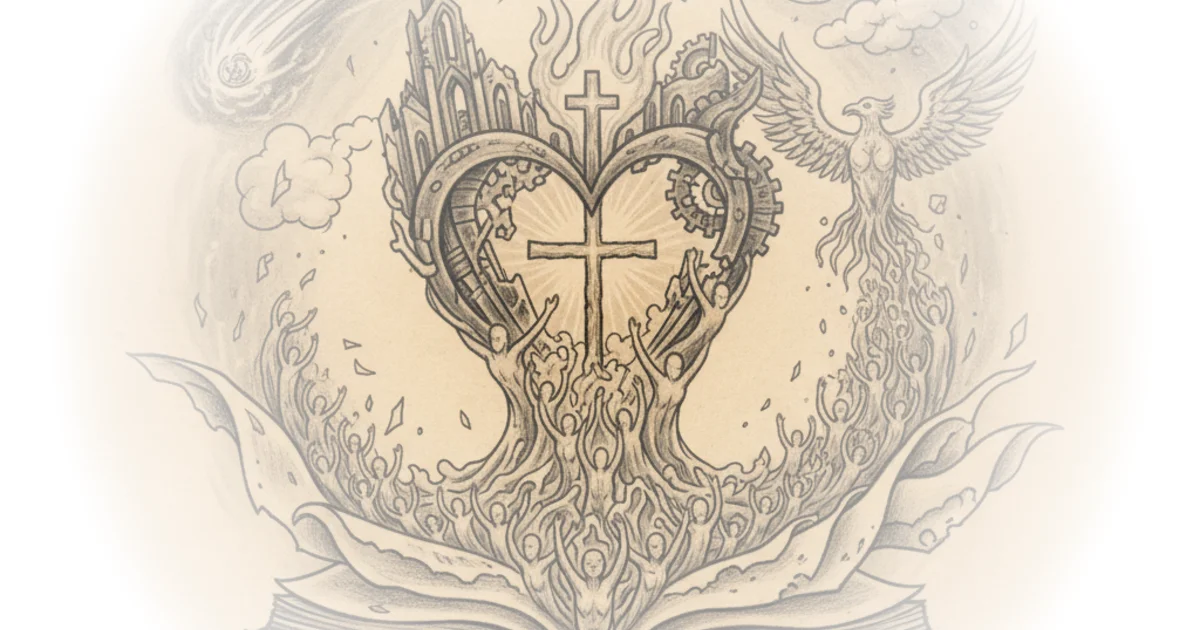
The core of his argument is that the working class, unable to access the supernatural, began to imagine heaven as a physical place they could build themselves. "We can have heaven on Earth not because Jesus is going to show up but because we are going to overthrow those who rule us," Christman explains. This is a powerful reframing of the Marxist project. It suggests that the fervor of the 20th century was not cold, rational materialism, but a hot, religious zeal for a new world order. Critics might note that equating Marxism with Christianity risks oversimplifying the distinct philosophical roots of each, but Christman's point is about the function of the belief system rather than its theological accuracy.
"God didn't go away and it's just not God isn't where the language of God is... the Socialist movement broadly stated with Marxism as the approximation of a holy book at its heart."
The Great War as Armageddon
The commentary takes a darker turn as Christman identifies the period from 1789 to 1945 not as a series of political wars, but as a literal, global Armageddon. He posits that the First World War was the moment the working class failed to stop the ruling class from dragging them into a conflict that served only elite interests. "The 19th and 20th Century from 1789 to 1945 is Armageddon," he asserts. "It is a series of battles between Christianity which is actually satanism... against Christianity." Here, he distinguishes between a top-down religion of rule and a bottom-up religion of mutual aid.
He argues that the Bolsheviks succeeded in Russia not just due to tactical genius, but because they were "religious believers" who felt the cosmic weight of the moment. "The Bolsheviks were religious believers they believed in this extension of the cosmic conflict between good and evil that is going to be resolved at Armageddon," Christman notes. This explains the sheer, terrifying decisiveness of the revolution. It wasn't just a coup; it was an attempt to trigger a world-revolutionary event. The failure of the German Social Democrats to vote against war credits, by contrast, is framed as a failure of faith—a willingness to surrender to the state rather than die for the cause.
The End of Expansion and the Rise of Nihilism
The piece concludes with a grim diagnosis of the post-1945 world. Christman argues that the working class was ultimately defeated, and the system became "self-enclosed," unable to expand outward to soothe its internal contradictions. "The working class was defeated in 1945 and the institutions that would have propelled working class towards a conflict with capital... is gone," he states. Without the ability to project conflict outward, the system began to eat itself, leading to the current era of stagnation and nihilism.
He contrasts two types of people under capitalism: those who want to "die in battle" in a righteous cause, and those who simply want to "die in their bed" surrounded by loved ones. The tragedy of the modern age, according to Christman, is that the former urge has been sublimated into destructive violence because the positive social feedback loop of a unified working class no longer exists. "Now that's gone and we live in in the world where Satan won the battle of now," he declares. This is a bleak assessment, yet he offers a sliver of hope: "That doesn't mean we're damned though... we will all as people be reconciled."
"The working class was defeated in 1945... the system becomes self-enclosed it can no longer expand outward and therefore will begin to eat itself."
Bottom Line
Matt Christman's most compelling contribution is the identification of the religious fervor underlying secular political movements, offering a unifying theory for the violence of the last two centuries. However, the argument's greatest vulnerability lies in its deterministic view that the working class is permanently defeated, potentially underestimating the capacity for new forms of organization to emerge from the current chaos. Listeners should watch for how this framework explains the rise of modern reactionary movements that seem to crave the very "death in battle" Christman describes.