Most coverage of electric vehicles fixates on the race to sell more cars, but Asianometry turns the lens to what happens after the sale: a looming waste crisis that threatens to undo the environmental gains of the transition. The piece argues that while China has successfully built the world's largest EV market, its infrastructure for handling the inevitable mountain of spent batteries is dangerously fragmented and economically unviable without radical intervention.
The Policy Trap of Extended Producer Responsibility
Asianometry begins by establishing the sheer scale of the problem, noting that China saw 5.5 million EV sales as of March 2021, creating a waste stream that is only just beginning to swell. "In 2020, 200,000 tons of batteries were decommissioned and the figure is anticipated to rise to 780,000 tons by 2025," they write, highlighting the exponential growth curve that policymakers are struggling to match. The author traces the Chinese government's response, which relied heavily on a concept known as Extended Producer Responsibility (EPR). This framework shifts the burden of disposal from the state to the manufacturers, forcing car and battery makers to build their own collection networks.
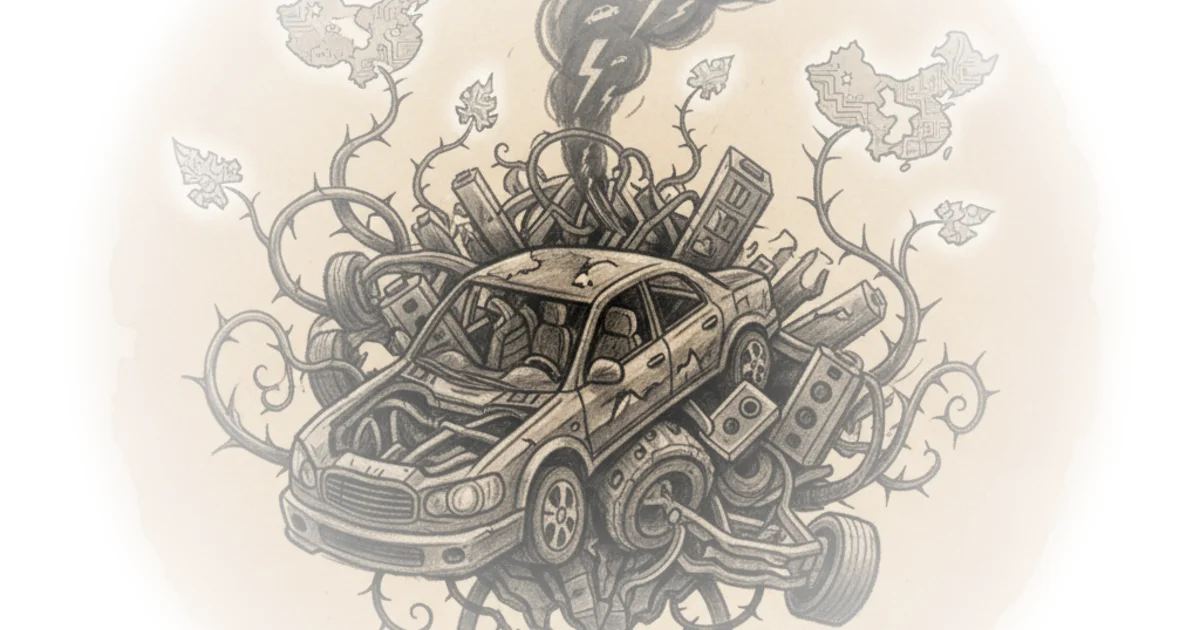
The commentary effectively frames this as a classic case of policy intent clashing with market reality. Asianometry explains that the 2018 framework "largely places the onus on private entities like the EV and EV battery makers to deal with this problem," expecting them to design for disassembly and manage end-of-life logistics. This is a logical approach in theory, but the author points out a fatal flaw: the economic incentives are misaligned. As battery manufacturing costs plummeted from $1,000 per kilowatt-hour in 2008 to $268 in 2015, the value of recovering materials dropped, making recycling a "cost drain on their manufacturers who already work on pretty tight margins."
"If the government is always the one cleaning up all this e-waste, the companies making that e-waste will never be incentivized to make their stuff easier to recycle."
This observation cuts to the heart of the issue. The policy assumes that regulation alone can force a circular economy, but it fails to account for the fact that without subsidies or a levy, the cheapest option for a manufacturer is often to ignore the waste until forced otherwise. Critics might note that the government is slowly introducing pilot programs, but as Asianometry suggests, these are insufficient to counter the market forces driving the problem.
The Technical and Economic Hurdles of Recycling
The piece then dives into the technical complexities that make recycling far from a simple industrial process. Asianometry distinguishes between the two dominant battery chemistries: Nickel Manganese Cobalt (NMC) and Lithium Iron Phosphate (LFP). While NMC batteries contain valuable metals like cobalt and nickel, LFP batteries—favored by Chinese giant Contemporary Amperex Technology Co. Ltd. (CATL)—are much harder to recycle profitably. "Recycling these things has turned out to be more technically difficult than at first anticipated," the author notes, explaining that LFP batteries lack the high-value metals that usually fund the recycling process.
The analysis of the two main recycling methods—pyrometallurgy (melting) and hydrometallurgy (chemical leaching)—reveals significant inefficiencies. Pyrometallurgy is energy-intensive and loses lithium, while hydrometallurgy is complex and expensive. Asianometry writes, "Neither of these methods are ideal and further work is needed to address their technical shortcomings." This technical nuance is crucial; it explains why the theoretical recovery rates set by the government (98% for nickel, 85% for lithium) are so far from reality. The gap between policy targets and industrial capability is where the crisis is brewing.
The Rise of the Informal "Chop Shops"
Perhaps the most alarming section of the coverage is the description of the informal recycling sector. Because official channels are expensive and unprofitable, a shadow economy has emerged. Asianometry describes how "small unlicensed workshops" dominate the market, paying EV owners more for their spent batteries than licensed recyclers can afford to offer. These informal operators "basically go to town on these batteries for their cathode materials, reselling them to the highest bidder and dumping the rest."
The author draws a parallel to China's struggles with lead-acid batteries, where informal recycling led to severe public health crises. "China has experienced multiple major lead poisoning incidents in recent years as a result of this improper handling," they warn, suggesting that the same fate awaits the lithium-ion sector if the informal market is not curbed. The piece notes that despite the existence of licensed giants like GEM and Brunp, the majority of the sector remains unregulated. "The lithium-ion recycling rate in China remains quite low," Asianometry states, citing a figure of just 10% in 2019, which "beats a sharp stick in the eye but this is still far from ideal."
"The informal shops do not have the proper tools or training... thus the lithium-ion recycling rate in China remains quite low."
This framing is powerful because it moves the conversation from abstract environmental goals to concrete safety risks. The lack of a national collection incentive means that the most profitable path for a used battery is often the most dangerous one. A counterargument worth considering is that the government's crackdown on these shops could eventually force consolidation, but the current economic reality heavily favors the black market.
Second-Life Solutions as a Stopgap
The article concludes by exploring the concept of "second-life" applications, where batteries with 80% capacity are repurposed for stationary energy storage rather than immediately recycled. Asianometry highlights the Dang Bay wind and solar project in Hebei province, a joint effort between State Grid and BYD, as a prime example. However, the author offers a sobering perspective on this solution: "I think ultimately it more forestalls the recycling problem than solves it because the inevitable end of every battery is either recycling or the landfill."
This distinction is vital. While second-life use delays the waste problem, it does not eliminate the need for a robust recycling infrastructure. The piece ends by acknowledging China's leadership in EV technology but warns that the "coming EV battery waste problem" remains an unresolved threat to the sustainability of the entire industry.
Bottom Line
Asianometry delivers a critical reality check: the world's EV success story is built on a foundation that is currently crumbling under the weight of its own waste. The strongest part of the argument is the exposure of the economic disconnect between government mandates and market incentives, which has allowed a dangerous informal sector to flourish. The biggest vulnerability in the current approach is the lack of a national financial mechanism to make recycling profitable, leaving the industry reliant on a patchwork of voluntary compliance that is failing to scale. Readers should watch for whether the administration introduces a levy or subsidy to finally align economic self-interest with environmental necessity.