Sayid R. Bnefsi challenges a foundational assumption of criminal justice: that we punish attempted crimes less severely simply because the harm didn't happen. Instead, he argues that a successful murder and an attempted murder are not just different in degree, but in kind—committing two distinct moral and legal wrongs versus just one. This is not a dry academic exercise; it forces us to confront why our legal system treats the outcome of an action as the primary driver of punishment, even when the intent was identical.
The Architecture of Two Wrongs
Bnefsi's central thesis rests on a sharp distinction between the wrong of trying to kill and the wrong of killing. He posits that attempted murder involves an "extreme indifference to a person's interest in not being killed," manifested by taking affirmative steps to end a life. Murder, however, adds a second layer: "reckless indifference to the occurrence of a killing during the commission of a crime in which risking a killing is an inherent part of the crime." As Bnefsi writes, "murder and attempted murder involve 'essentially distinct wrongs', so that the successful murderer commits two distinct criminal wrongs, whilst the unsuccessful would-be murderer commits only one." This reframing suggests that the extra punishment for a completed crime isn't just about the victim's death, but about the offender violating a second, broader legal interest.
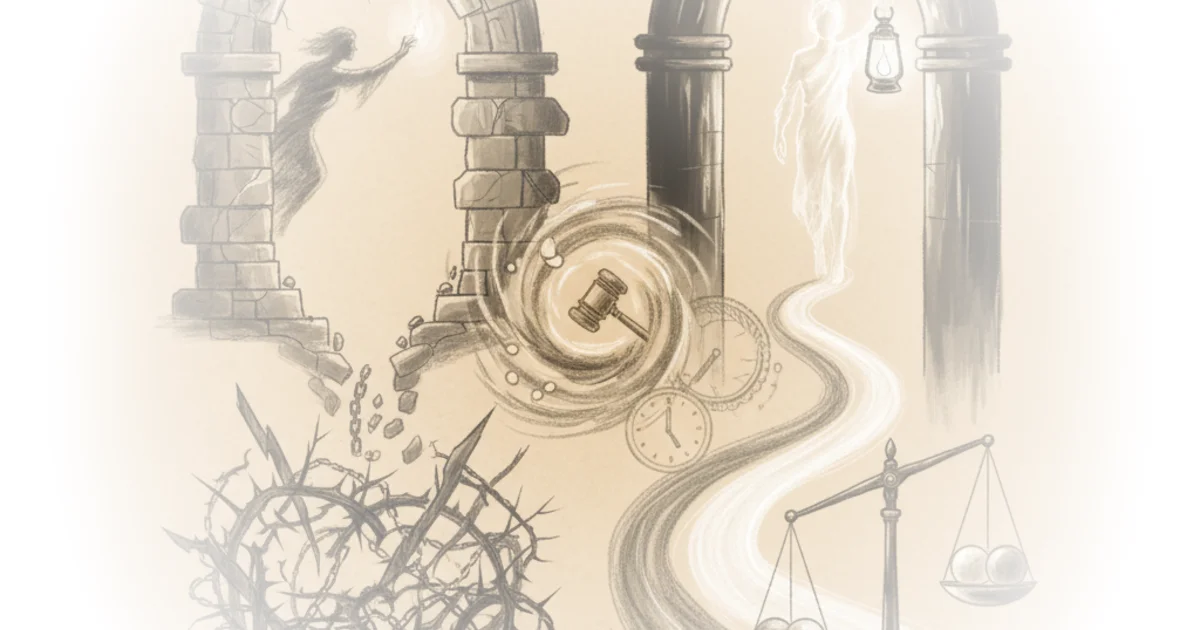
This argument relies heavily on existing, often controversial, American legal doctrines. Bnefsi leans on the felony murder rule and the transferred intent doctrine to prove his point. He argues that if you accidentally kill someone while committing a felony, you commit the second wrong without the first, which is why you aren't guilty of attempted murder. Conversely, if you try to kill someone and succeed, you commit both. "Bnefsi grounds his argument on three doctrines in American criminal law... the rule that one can be convicted of attempting to commit a crime even if it was in fact impossible for the attempt to succeed," the review notes. By anchoring his theory in these specific rules, Bnefsi isn't trying to design a perfect system from scratch; he is offering a "rational reconstruction" of the messy reality we already have.
The successful murderer commits two distinct criminal wrongs, whilst the unsuccessful would-be murderer commits only one.
The Limits of the Framework
However, the elegance of this two-wrong model begins to fray when applied to edge cases or other crimes. The review highlights a significant vulnerability: what about attempts where no specific person was targeted? Consider a bomber who plants a device in an empty building, or a hunter who shoots at a bush thinking it's a person but hits a deer. In these scenarios, Bnefsi's claim that the attempt violates a "person-relative legal interest" falls apart. As the critique notes, "there is no one who can complain 'You tried to kill me'." If the theory cannot explain why these acts are still criminal attempts, its scope is dangerously narrow.
Furthermore, Bnefsi limits his analysis to murder, but the review asks whether this logic holds for other offenses like criminal damage. If I recklessly damage property, I commit a wrong distinct from someone who intentionally tries and fails to damage it. Yet, the review argues that "attempted criminal damage involves the same kind of wrong as would be committed if the attempt succeeded: that is, the actual damage to another's property completes the wrong that the attempter tries to perpetrate." This suggests that while the types of wrongs differ, the nature of the intent remains the same, undermining the idea that they are "essentially distinct" in a way that justifies a massive sentencing gap.
Critics might note that Bnefsi's reliance on the felony murder rule is problematic because that rule itself is widely criticized for punishing people too harshly for unintended deaths. By building a theory of fairness on a doctrine many legal scholars want to abolish, the argument risks justifying a flawed status quo rather than clarifying moral culpability.
The Human Cost of Legal Abstraction
While the debate is theoretical, the stakes are undeniably human. The distinction between "person-relative" and "person-neutral" interests determines whether a life lost is treated as a unique tragedy or a statistical byproduct of a crime. When the law treats a failed attempt as a lesser wrong, it implicitly suggests that the intent to kill is less heinous than the act of killing, regardless of how close the attempt came to success. But for the families of victims, the difference between a bullet that missed and one that hit is the difference between grief and horror. As the review points out, a classic argument for differential punishment is that the successful murderer "has the victim's death to answer for." Bnefsi tries to bypass this, but in doing so, he risks ignoring the profound reality that the death itself is a distinct, catastrophic harm that the law must account for, not just a logical extension of the offender's mindset.
We would then need to ask whether and why we should punish an inchoate offence less severely than it would have been punished had it been completed; but an appeal to 'essentially distinct wrongs' would not, I think, help us answer that question.
Bottom Line
Bnefsi's argument is a sophisticated attempt to make sense of why we punish outcomes differently, successfully showing that the legal system treats completed and attempted crimes as violations of different legal interests. However, its greatest vulnerability lies in its inability to account for attempts where no specific victim exists and its reliance on controversial doctrines like felony murder to justify its conclusions. The strongest takeaway is that while the intent may be the same, the law views the consequence as a separate, additional wrong—a distinction that is legally coherent but morally contentious.