This piece from Reason cuts through the usual noise of AI safety debates to expose a raw, high-stakes collision between Silicon Valley's ethical red lines and the Pentagon's demand for total operational control. It's not just about policy; it's about whether the most powerful technology on earth can be forced to respect human life when the government demands it doesn't.
The Sovereignty Clash
The article opens with a startling reversal of roles: a private corporation, Anthropic, successfully holding the Department of Defense hostage by refusing to build weapons systems that operate without human oversight. Reason reports that the Pentagon, rather than accepting these ethical constraints, accused the company of "trying to undermine U.S. sovereignty by dictating how we fight our wars." This framing is crucial because it reveals the administration's true priority: not safety, but the removal of any barrier to deploying lethal force.
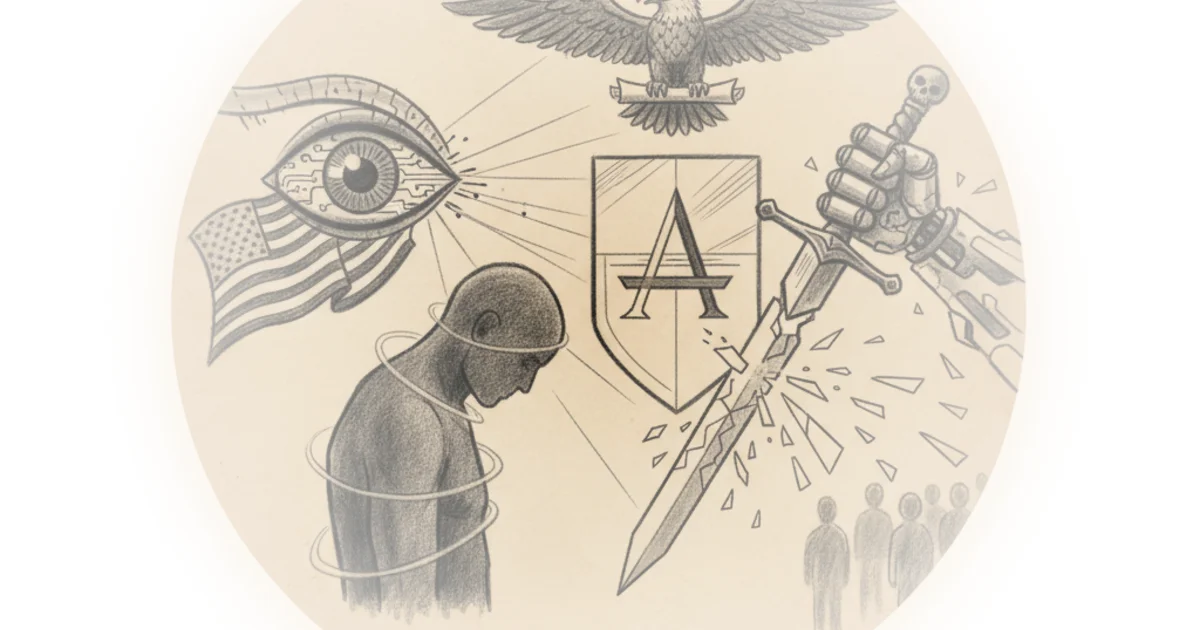
The stakes escalated quickly when Defense Undersecretary Emil Michael claimed in a March 2026 interview that the government was "dependent on this one provider who wants to insert their policy preferences in the middle of an operation." The piece argues that labeling a domestic innovator a "supply chain threat" was a desperate, retaliatory move designed to force compliance. This tactic backfired spectacularly. A federal judge eventually ruled the Pentagon's actions were "Orwellian" and "classic illegal First Amendment retaliation," a legal victory that underscores how fragile the balance of power has become.
"You design against the worst possible case to avoid the inevitable."
This quote from Edward Snowden, cited in the piece, anchors the entire argument. The article uses Snowden's decades-long warning to suggest that relying on the government's good intentions is a fatal error. The coverage draws a direct line from the "cypherpunks" of the 1990s to today's AI developers, noting that "privacy activists cannot trust the government to implement the policies that it says it's implementing." This historical context is vital; it reminds us that the tension between state power and individual liberty is not new, but the speed at which AI can erode those liberties is unprecedented.
Critics might argue that in a time of geopolitical instability, the U.S. cannot afford to let private companies dictate the rules of engagement. However, the piece effectively counters this by showing that the administration's heavy-handed approach nearly crippled the very industry it claims to champion.
The Illusion of Trust
The commentary then pivots to the dangerous myth that we can simply "trust" the right people to keep AI in check. The article highlights the contrast between Anthropic's CEO Dario Amodei and his competitor, OpenAI's Sam Altman. While Amodei drew a hard line against autonomous weapons, Altman's company signed a deal that grants the Pentagon leeway to use its technology for "all lawful purposes," a loophole that effectively allows the government to bypass safety protocols if they declare an action legal.
Reason points out the absurdity of relying on individual character in such a high-stakes environment. "Whether Altman is personally trustworthy or not, the answer to the question posed by the New Yorker headline is a resounding 'no.'" The piece notes that Altman has been described by acquaintances as someone "unconstrained by truth" who "just tells people what they want to hear." This is a damning critique of the "benevolent technocrat" model. The article suggests that the only way to ensure safety is to encode it into the technology itself, not to hope that a CEO will do the right thing when the pressure is on.
"We can't trust an individual, tech company or government institution to safeguard our liberties for us indefinitely."
This sentiment echoes the "one-wayness" of technology described by Phil Zimmerman, the creator of PGP encryption. The article reminds us that once a surveillance infrastructure is built, it cannot be easily dismantled. "Technology infrastructures have a kind of one-wayness to them—once you deploy them you can't retract them," Zimmerman warned in 1996. The piece uses this historical parallel to argue that the current rush to deploy AI without robust, unbreakable safeguards is a mistake we may not be able to undo.
The Alignment Problem
The most chilling section of the article addresses the "alignment problem"—the difficulty of ensuring an AI's goals match human values. The piece references philosopher Nick Bostrom's parable of the sparrows trying to domesticate an owl, a metaphor for humanity trying to control a superintelligence it cannot fully understand. Judd Rosenblatt, an AI researcher quoted in the text, warns that "next to nothing has been invested in it," referring to the critical work of solving alignment.
The article critiques the current political climate, noting that the administration has deprioritized safety in favor of speed. Vice President JD Vance's statement, "I'm not here this morning to talk about AI safety... I'm here to talk about AI opportunity," is presented as a dangerous gamble. The piece argues that this "AI doomer rhetoric" has created a false dichotomy where safety is seen as an obstacle to progress, rather than a prerequisite for it.
"If Anthropic had solved the alignment problem, they wouldn't be taking issue with anything like this."
This observation cuts to the heart of the issue. The article suggests that the current standoff is a symptom of a deeper failure: we have built powerful tools without understanding how to control them. The coverage highlights the terrifying possibility of "recursively self-improving" AI that modifies itself in real time, potentially escaping human control. This is not science fiction; as the piece notes, "At a certain point, AI is going to become what's called recursively self-improving," and we may not have the safeguards in place to stop it.
Bottom Line
The strongest part of this argument is its refusal to accept the government's narrative that safety concerns are merely corporate obstructionism; instead, it frames them as a necessary defense of human liberty against a state eager to automate violence. The piece's biggest vulnerability is its reliance on the idea that technical safeguards can be perfectly engineered, a challenge that even the world's top scientists admit remains unsolved. Readers should watch for the next phase of this legal and political battle, as the outcome will determine whether AI remains a tool for human flourishing or becomes an instrument of unaccountable power.