This piece cuts through the usual techno-optimism to deliver a stark, institutional warning: artificial intelligence in China is not just a productivity tool, but a structural threat to the very fabric of employment stability. Zichen Wang presents a rare, high-level blueprint from within the Chinese academy, arguing that the state must pivot from reactive safety nets to proactive, universal income support before the labor market fractures beyond repair. What makes this coverage essential is its origin; it is not an outsider's critique, but a prescription drafted by Cai Fang, a former Vice Minister of the Chinese Academy of Social Sciences, published in the Party School's flagship journal.
The Scale of the Disruption
Wang frames the core argument around the inevitability of structural imbalance. The text does not shy away from the severity of the coming shift. "AI is a double-edged sword," Wang writes, noting that while it raises productivity, "it can also disrupt employment." The author explains that we are moving past the era where machines only replace manual labor; the new wave targets cognitive skills. "Large language models are proliferating and improving at remarkable speed," Wang observes, pointing out that in many white-collar tasks, they have "already reached roughly the average level of human performance."
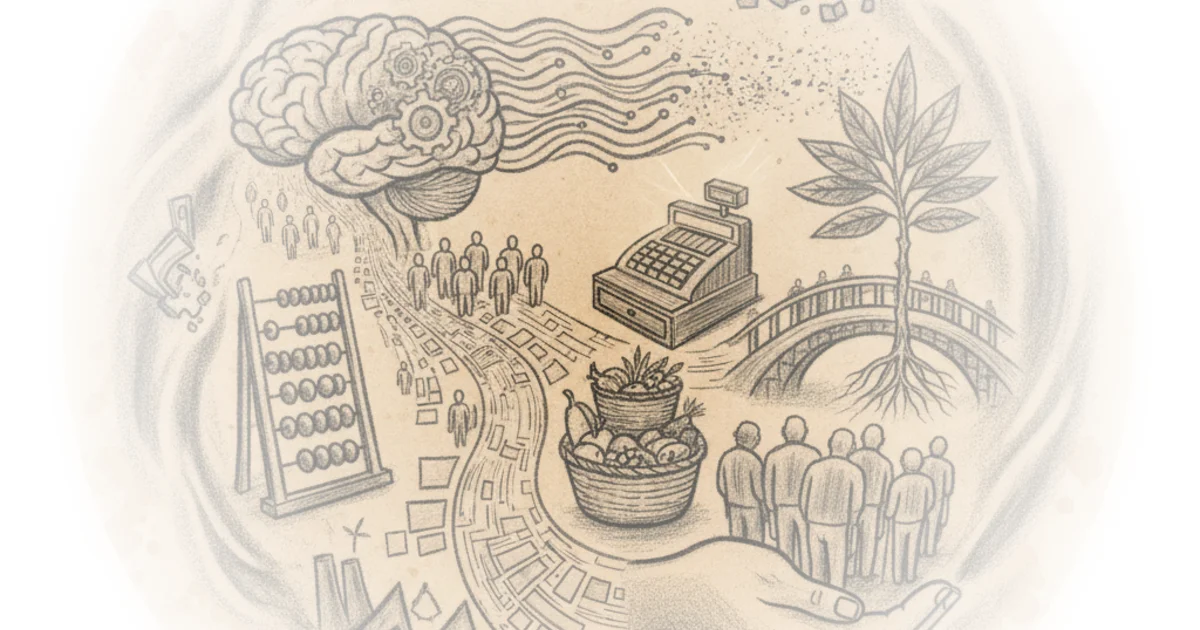
This is a critical distinction. The disruption isn't just about the unskilled; it is about the erosion of the middle-skill and even high-skill tiers. Wang warns that as AI advances, "the scope of displacement will gradually move from work requiring average skills to work requiring the highest levels of expertise." The implication is that no job is immune, creating a scenario where the "digital and AI divide" could widen exponentially if policy remains static.
The employment shock caused by AI therefore remains, in essence, a manifestation of structural employment imbalances: the balance between the supply of and demand for particular skills and forms of human capital is repeatedly disrupted and then re-established through adjustment.
Wang's analysis holds up under scrutiny because it treats AI not as a magical fix, but as a market force that requires deliberate, heavy-handed correction. However, a counterargument worth considering is the assumption that the state can accurately predict which skills will remain valuable. If the pace of obsolescence is truly exponential, as the article suggests, even a "lifelong" training model might struggle to keep workers ahead of the curve.
A Radical Shift in Social Policy
The most striking element of Wang's commentary is the specific policy prescription: a move toward universal, non-contributory support. Cai Fang, the economist behind the proposal, argues that the current system of minimum wages and contributory pensions is insufficient for an AI-driven future. Wang reports that Cai calls for "moving from minimum wages towards living wages" and developing a pension scheme that covers "all older people equally and unconditionally."
This represents a fundamental philosophical shift. The article suggests that social security must become "markedly more universal, with lower eligibility thresholds and wider coverage, drawing on universal basic income to strengthen the minimum living allowance system." The logic is that in an era where human labor may be devalued by algorithms, the state must guarantee a baseline of survival that is decoupled from employment status. This echoes the historical urgency found in the Dibao (ancient Chinese gazette) records, where the state's legitimacy was often tied to its ability to prevent famine and destitution during times of rapid change. Here, the threat is not crop failure, but algorithmic displacement.
Wang highlights that this isn't just about money; it's about the nature of training. "Skills training cannot be treated as a one-off intervention capable of solving the problem once and for all," the author writes. Instead, training must become a "principal channel for lifelong learning," with the government bearing the primary funding responsibility. This aligns with the concept of Study Times as a training ground for officials, suggesting that the bureaucracy itself is being retooled to manage a post-labor economy.
Unless an upgraded generation of active employment policies is introduced quickly and effectively, and unless an employment-friendly model of development suited to the AI era is established, the exponential progress and diffusion of AI could produce an exponentially widening digital and AI divide.
The argument for a non-contributory pension is particularly bold. It challenges the traditional social contract where benefits are earned through decades of work. Critics might note that such a massive fiscal expansion could strain public finances, especially if the tax base shrinks due to automation. Yet, Wang presents this not as a choice, but as a necessity to maintain "common prosperity," a phrase recently emphasized by top leadership during the annual two sessions.
Aligning Technology with Human Needs
The piece concludes by addressing the "alignment" problem. Wang argues that the direction of AI development must be actively guided to maximize job creation rather than displacement. "The intended result should be clear: AI models should be developed and applied more to augment workers' capabilities than to replace their jobs," Wang writes. The author points to specific technologies, such as augmented reality and embodied AI, as pathways that could "compensate for gaps in particular skills and enable relatively disadvantaged workers to perform a wider range of jobs."
This is where the article moves from diagnosis to engineering. The proposal is to use "the authority of law, regulation, and industrial policy" to force the market toward employment-friendly outcomes. Wang notes that replacing workers often yields immediate market returns, while creating jobs generates "social returns only over the longer term." To bridge this gap, the state must "share the long-term social returns in advance." This reframes the role of the executive branch from a passive regulator to an active architect of the labor market.
Replacing workers can produce immediate market returns, whereas creating employment often generates social returns only over the longer term. This helps explain why the employment-displacement effect of AI so often exceeds its job-creation effect.
The reliance on state intervention to solve a market failure is consistent with China's broader economic model, but it raises questions about the efficiency of such top-down direction. Can a central authority truly outmaneuver the rapid, decentralized innovation of the private tech sector? Wang acknowledges the difficulty, noting that "the difficulty lies in the structure of incentives," but remains convinced that policy can tip the scales.
Bottom Line
Zichen Wang's coverage of Cai Fang's proposal offers a rare glimpse into how China's top economic planners are preparing for a future where human labor may no longer be the primary engine of growth. The strongest part of the argument is its refusal to treat AI as an unstoppable force of nature, instead insisting on a deliberate, state-led realignment of technology toward social stability. Its biggest vulnerability lies in the sheer scale of the fiscal and institutional overhaul required; moving to non-contributory pensions and universal living wages is a political and economic leap of faith that few nations have attempted. Readers should watch closely to see if the "employment-friendly model" moves from the pages of Study Times to actual legislation, as the window for proactive adjustment may be closing faster than the policy machinery can turn.