A Superpower's Pressure Campaign Against a Small Island
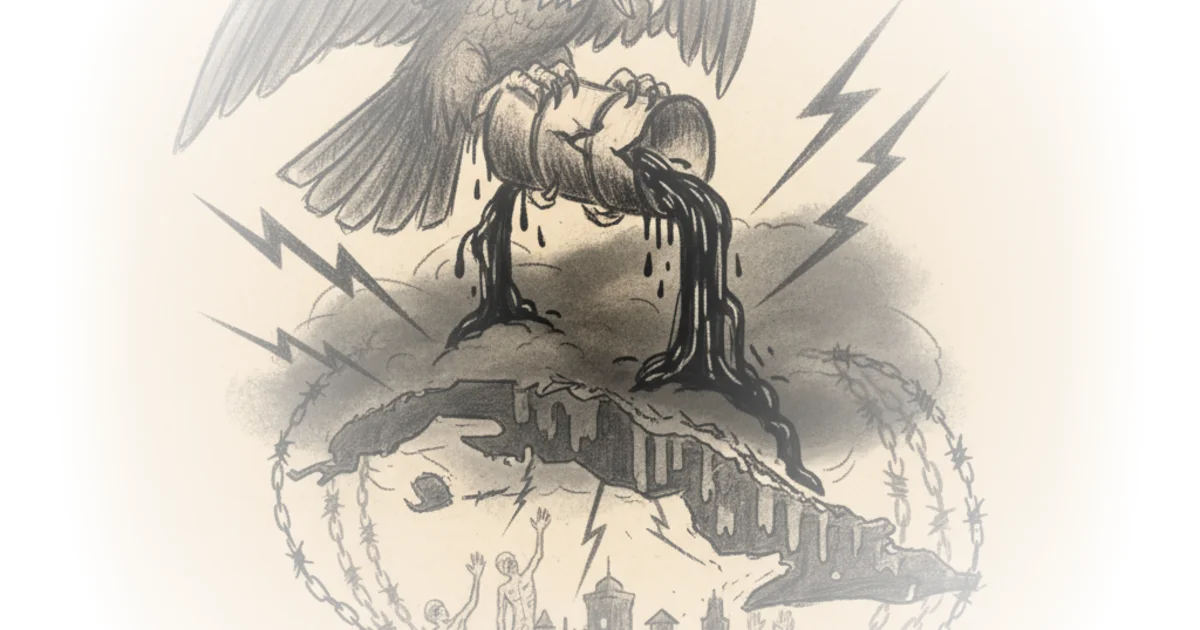
Steven Methven's on-the-ground report from Havana offers a street-level view of what decades of United States economic pressure look like when they escalate to an outright energy blockade. The piece, filed during the Newest America solidarity convoy's visit to Cuba, documents rolling blackouts, crumbling infrastructure, uncollected garbage, and a population that Methven describes as losing hope. It is advocacy journalism in the clearest sense — Methven traveled with the convoy and frames the crisis almost entirely through the lens of American aggression — but the concrete details he provides are difficult to dismiss.
The Blockade as Collective Punishment
The centerpiece of the report is Methven's meeting with Cuba's Deputy Foreign Minister Carlos Fernandez Cosio, who articulated the Cuban government's position with considerable directness. Cosio described the situation as fundamentally about sovereignty:
The failure historically and still today influential elements within the US political class and government to accept the notion that Cuba is and has a right to be a sovereign country and has a right to self-determination.
Cosio went further, characterizing the blockade as deliberately designed to manufacture popular discontent. If citizens endure 36-hour blackouts, lose access to clean water, and cannot get medical procedures, the resulting anger becomes a tool of regime change. He laid out the logic plainly:
They know that their policy causes harm, that it causes irritation. If you have 36 hours without electrical power and the consequences of not having then availability of fresh water... naturally that provokes irritation. It provokes desperation in some people and in some people a motivation a need to protest which is natural.
This framing — that Washington intentionally creates humanitarian suffering to destabilize the Cuban government — is not new. Cuban officials have made this argument for decades. What gives Methven's report its weight is the visual and experiential detail: buildings collapsing in central Havana, 40-to-50-foot piles of uncollected garbage in the streets, a residential hospital for adults with intellectual disabilities where ceiling tiles are missing and lights leak water.
What the Report Acknowledges — and What It Omits
To Methven's credit, the report does not present the Cuban government as blameless. He notes that many Cubans he spoke with are "also critical of the current government" and "think that the government has failed in various ways over the past decade to make the kinds of investments in the country or to resource various aspects of infrastructure correctly." He also acknowledges that Cuba's energy infrastructure is Soviet-era equipment that is difficult to maintain regardless of sanctions.
But the report largely declines to explore these concessions. Cuba's centrally planned economy has produced its own inefficiencies and misallocations independent of any American embargo. The government's restrictions on private enterprise, its dual-currency system (only recently reformed), and its limited tolerance for political dissent have all contributed to the economic stagnation that makes the country so vulnerable to external shocks. Methven gestures toward these realities but does not dwell on them, preferring to keep the camera trained on Washington.
Similarly absent is any sustained engagement with the American perspective on the embargo. The United States government has long argued that the embargo is designed to pressure Cuba toward democratic reforms and respect for human rights — a rationale that can be debated on its merits but deserves more than dismissal. The piece also does not address the Cuban government's own role in restricting information flow, beyond a brief aside that the government "perhaps is controlling even more at the moment because of a fear of misinformation."
The Human Cost, Undeniable
Where the report is most effective is in its granular human detail. The deputy foreign minister himself described the conditions in his own household:
In our home we had I think it was 36 hours no electricity... my son has to pedal 14 kilometers a day to go to work and he's an electrician. He works in the electrical company and he has to go to then go back home to a blackout with no electricity.
That a senior government official's own son bicycles 14 kilometers to work at the electrical company and returns to a house without power is a detail that communicates more than any policy analysis could. It suggests either that the Cuban government's hardship is genuine and shared across classes, or that Cosio is a skilled communicator who knows exactly which anecdotes will resonate with sympathetic Western journalists. Possibly both.
The medical dimension is equally stark. Cuba has long been celebrated for its healthcare system and its practice of sending medical brigades to developing countries — tens of thousands of doctors deployed across Latin America, Africa, and the Middle East, including to Italy during the early Covid-19 crisis. Cosio quoted an American publication's apparent blueprint for eliminating Cuban medical presence from the Western Hemisphere:
They say they want to erase any Cuban doctors from the Western Hemisphere, which is also the same as saying we want to deprive millions of people of health care that they never had before the Cuban brigades were there and they will never have again once the Cuban doctors leave.
Critics of Cuba's medical internationalism have long argued that these programs amount to a form of labor exploitation, with doctors earning a fraction of their generated revenue while the Cuban state collects the rest. That counterpoint is worth noting, though it does not negate the real healthcare access these programs provide to underserved populations.
The Convoy Question
Methven's report is embedded within the Newest America convoy, and the piece does not attempt to disguise this. The convoy delivered medical supplies to a municipal hospital and to the residential facility for disabled adults. Methven describes the gratitude of medical staff and notes that the convoy's approximately 600 participants have been engaging directly with Cuban citizens.
The more interesting claim is that some Cubans view the convoy's foreign presence as a form of protection — not just symbolic solidarity but a practical deterrent against potential incursions by Cuban exiles in Miami or even American military action. Whether that protective effect is real or imagined, the fact that ordinary Cubans articulate it speaks to the depth of insecurity the current crisis has produced.
Bottom Line
Methven's report from Havana is a vivid, empathetic dispatch that effectively documents the human toll of the American blockade on Cuba. Its strength is eyewitness detail; its weakness is analytical balance. The piece treats the Cuban government's framing as largely correct while giving minimal space to the internal policy failures, governance deficits, and information restrictions that compound the country's problems. For readers already sympathetic to Cuba, it will confirm their understanding. For skeptics, the one-sided framing may undercut the genuine humanitarian concerns it raises. The most honest reading lies somewhere in between: the United States embargo is indeed inflicting severe suffering on ordinary Cubans, and the Cuban government's own choices have made the country less resilient to that suffering than it might otherwise be. Both things are true, and a fuller account would hold both in view simultaneously.