History is often written in the language of grand strategy and dynastic succession, but Kings and Generals reminds us that the fate of empires has frequently hinged on a single misstep in the wilderness. This piece stands out by reframing hunting not merely as a pastime for the elite, but as a high-stakes political theater where the boundary between recreation and statecraft was perilously thin. For the busy observer, the takeaway is stark: even the most powerful rulers were not immune to the chaotic, unscripted violence of nature.
The Fatal Cost of Prestige in Byzantium
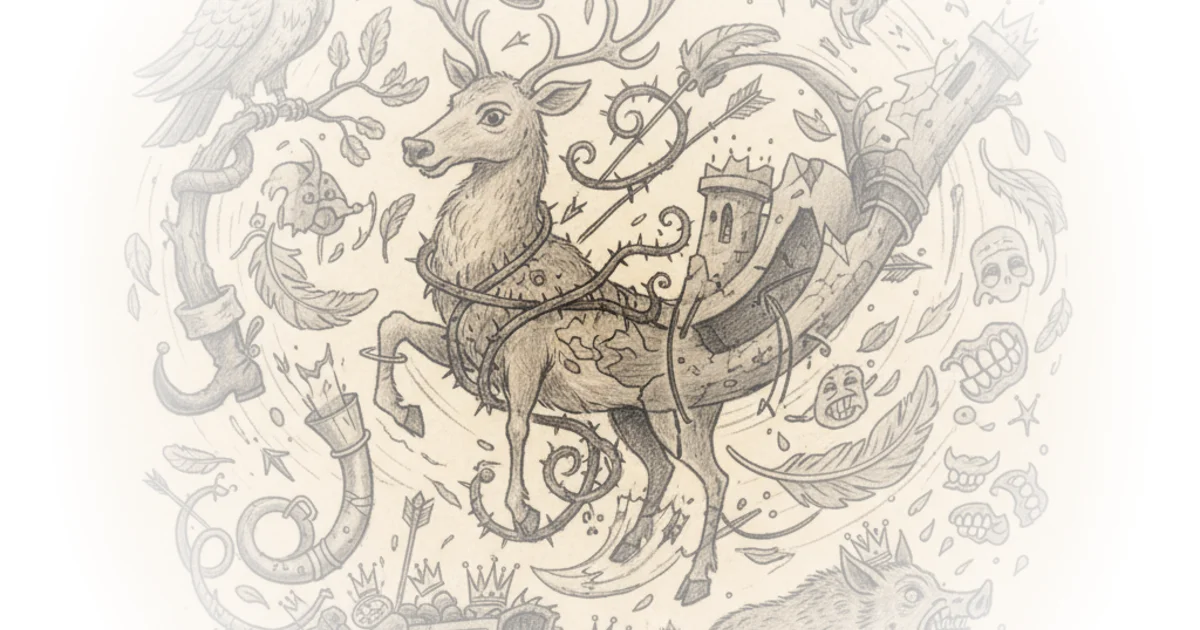
Kings and Generals opens its analysis in the Eastern Roman Empire, arguing that for the Byzantines, hunting was a performative assertion of divine stewardship over creation. The author notes that while the aristocracy viewed the chase as a mark of prestige, the peasantry saw it as a struggle for subsistence, highlighting a deep class divide masked by imperial spectacle. The narrative zeroes in on Emperor John II Komnenos, whose death illustrates the fragility of power. Kings and Generals writes, "The boar charged at him and he struck it with his spear under the chest. The animal went berserk and flung the emperor around, thrashing him about so much that his wrist was slashed by a poisoned arrow that he had equipped in his quiver." This detail transforms a simple accident into a tragic irony of preparation; the very tools of his trade became his executioners. The commentary effectively uses this to show how a moment of physical vulnerability could cascade into a succession crisis, forcing the dying emperor to designate his heir amidst the chaos of blood poisoning.
Even the mightiest emperors can be brought low by some twist of fate.
Critics might argue that the source material for these ancient accidents is often colored by later moralizing or myth, yet the recurrence of such stories across different dynasties suggests a genuine historical pattern of risk. The piece also touches on Basil I, whose belt was snagged by a stag's antlers, dragging him to death, reinforcing the theme that nature was an unpredictable adversary even for the most fortified rulers.
The Political Theater of Macedon and Persia
Shifting to ancient Greece, the coverage explores how hunting served as a crucible for military aristocracy in Macedon, where the king's relationship with his nobles was cemented through the shared hunt. Kings and Generals presents the death of King Archelaus I as a tale of "dubious historical value" that nonetheless reveals the volatile personal dynamics of the court. The author outlines the conflicting accounts of his murder by his page, Catateros, noting that "one tale says that Cataros did this to become king of Macedon himself," while another suggests a romantic dispute over a denied marriage. This ambiguity is not a weakness but a feature of the analysis; it underscores how hunting expeditions were often the setting for conspiracies where personal grievances and political ambition collided. The framing suggests that the hunt was less about the animal and more about the human relationships it exposed.
In the Persian tradition, the piece highlights the ritualized nature of the hunt, where the king's precedence in striking the beast was a non-negotiable symbol of authority. Kings and Generals writes, "In these instances, the sha and sha was always first to strike a beast as he was meant to take precedence." This rigid protocol, however, did not guarantee safety. The account of King Darius I dislocating his ankle and the subsequent legend of Bahram V disappearing into a cave while chasing an onager serves to illustrate the limits of royal control. The author points out that while the Shahnameh claims Bahram died in his sleep, the hunting accident version persists because it resonates with the cultural understanding of the king's dangerous intimacy with the wild.
Nature as a Political Tool in the Mughal Empire
Perhaps the most compelling section of the coverage focuses on the Mughal Empire, where hunting evolved into a sophisticated instrument of statecraft. Kings and Generals describes the shikargah not just as hunting grounds but as "early attempts at curating nature, making them a form of proton nature conservation program." This is a crucial insight, reframing the slaughter of animals as an act of environmental management and territorial control. The piece details how Emperor Akbar used the guise of a hunt to launch surprise military assaults, citing the specific instance where he "pretended to merely be passing by on a hunt, going after leopards and other animals" before capturing the rebel Adam Khan in Sarangpur. This demonstrates that the hunt was a flexible cover for political maneuvering, blurring the lines between leisure and warfare.
These events were highly theatrical with servants managing hunting scenarios and preparing the animals for their ritualized slaughter at the hands of their royal hunters.
The analysis of the Holy Roman Empire further cements this argument, noting that for Frankish and Carolingian rulers, the hunt was an expression of masculinity and royal splendor where "politics was on full display and where many conspiracies and murders took place." The death of King Louis V, who suffered a fatal blow to the liver after slipping while hunting, serves as a grim reminder that the political stability of the realm could hinge on a single fall. Kings and Generals writes, "Because the liver produces the blood, as the physicians tell us, he began to weaken," a detail that underscores the ancient medical understanding that compounded the tragedy of the accident.
Bottom Line
The strongest element of this piece is its ability to strip away the romanticism of the hunt to reveal the brutal political machinery operating beneath the surface. By weaving together disparate eras and geographies, Kings and Generals successfully argues that hunting was a high-stakes arena where the fate of empires was often decided by chance, betrayal, or the sheer unpredictability of the natural world. The biggest vulnerability lies in the reliance on anecdotal and sometimes mythologized accounts, but the author mitigates this by explicitly acknowledging the dubious nature of certain stories while still extracting their historical significance. Readers should watch for how modern conservation efforts might be re-evaluated through this historical lens of royal curation and control.