In a landscape often dominated by Western-centric philosophical debates, Alex O'Connor's conversation with Swami Sarvapriyananda offers a startling revelation: the most pressing questions of modern consciousness and metaphysics were not just anticipated, but rigorously debated in ancient India millennia ago. This is not a soft spiritual retreat into mysticism; it is a high-stakes intellectual excavation revealing that the tools for analyzing reality were sharpened in Sanskrit long before the analytic tradition took root in Cambridge or Oxford.
The Ancient Roots of Modern Debate
O'Connor opens by admitting a significant blind spot in his own philosophical framework, noting that "there's basically a massive blind spot in my thinking and on my channel when it comes to the exclusion of Indian philosophy." He quickly pivots to a compelling thesis: these ancient traditions have "preempted and answered all of the questions which I've been thinking about and which western philosophy has been battling over in the past few hundred years." This admission from a prominent skeptic is powerful because it reframes Indian thought not as a competing religion, but as a parallel, and perhaps superior, philosophical lineage.
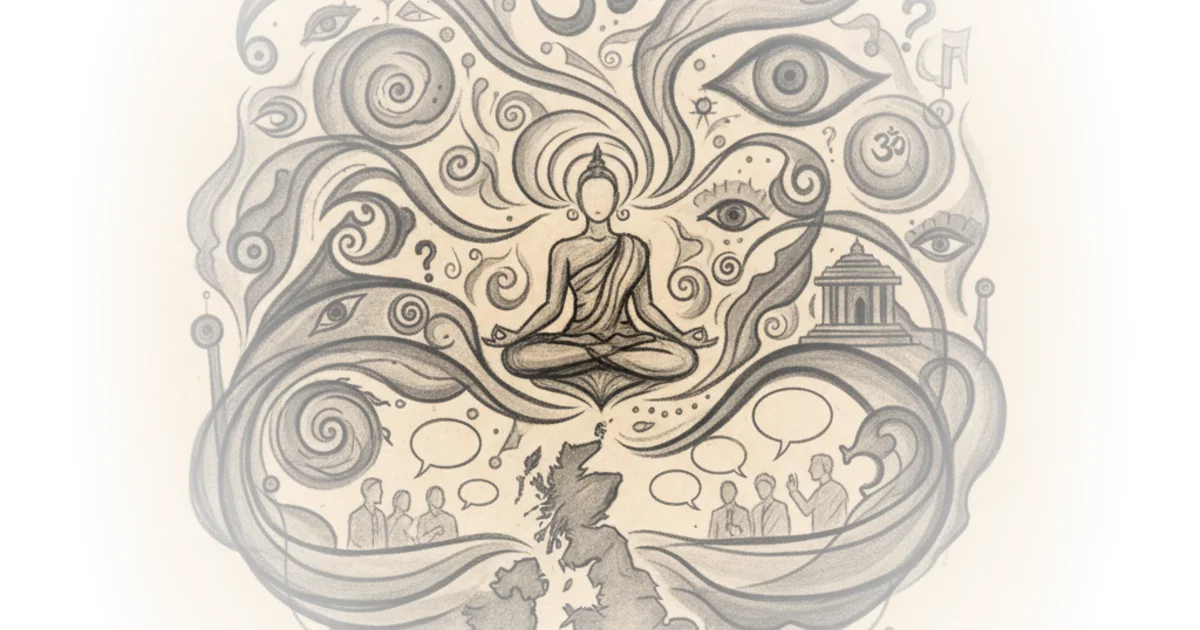
The discussion grounds itself in the etymology of the tradition. Swami Sarvapriyananda explains that "Vanta means ant literally means the end... end the end of the Vedas in the sense of the final or the highest philosophical teachings of the Vedas." By defining Advaita Vedanta as the culmination of the Vedic texts, the conversation moves immediately away from ritualistic superficiality toward the core metaphysical inquiries. The author highlights that while the Vedas contain ancient rituals, the Upanishads—the foundation of Vedanta—focus on "the nature of ultimate reality" and "what we truly are."
"One of them is Advaita Vedanta and a pretty prominent one for certain reasons... it is what might be called philosophical as against what might today we might call theological."
This distinction is the piece's intellectual anchor. O'Connor and the Swami argue that while other schools rely on theology, faith, and promises of an afterlife, Advaita Vedanta relies on "experience and reason." This approach resonates deeply with a modern, skeptical audience that often dismisses religion as purely dogmatic. By emphasizing the empirical nature of the inquiry, the commentary elevates the tradition to the level of hard philosophy.
The Precision of Ancient Logic
Perhaps the most surprising claim in the text is the sophistication of ancient Indian logic. The discussion reveals that Indian philosophers engaged in "philosophical gladiatorial combats without the swords," debating realism versus idealism and theism versus atheism centuries before their Western counterparts. The text notes that these debates lasted for a thousand years, forcing philosophers to refine their language to an extreme degree.
The Swami describes the development of Navya Nyaya, a school of logic that emerged around 900 AD. He asserts that this was "a new kind of extremely precise philosophical Sanskrit which... made language extremely precise." The evidence for this precision is striking: "Today there is a whole subschool of people trying to translate those ancient Navyana texts into modern symbolic logic. It translates very easily."
This claim challenges the assumption that symbolic logic is a purely modern, Western invention. If ancient Sanskrit could be mapped so cleanly onto modern mathematical logic, it suggests that the structural problems of language and reality were solved with a rigor that the West is only now rediscovering. Critics might note that equating ancient Sanskrit logic directly with modern symbolic logic risks oversimplifying the vast differences in cultural context and the specific goals of each system. However, the sheer longevity and complexity of these debates, as described by O'Connor, suggest that the depth of the analysis cannot be ignored.
"Many of the debates we find in modern philosophy... were already sort of anticipated... thousand years before our contemporary debates."
The conversation shifts to the practical application of these ideas. O'Connor observes that the appeal of ancient philosophy lies in its freedom from "temporal bias." He argues that finding similar problems addressed in the Middle Ages or ancient Greece allows us to "engage with it free of that sort of temporal bias." The Swami reinforces this by introducing the concept of the "perennial philosophy," where wisdom from Greek, Chinese, and Indian traditions converges on the same fundamental truths about human nature.
Philosophy as a Lived Reality
A crucial differentiator highlighted in the text is the integration of philosophy into daily life. Unlike the purely academic nature of much Western philosophy, the Indian tradition is described as a "philosophy of life" where "millions of people today will say that it's part of their lived philosophy of life." The Swami clarifies that while there is an academic side, the tradition is "first and foremost practical."
This practicality extends to the texts themselves. The Swami advises against trying to read the entire Vedas, noting that "a large portion of the Vedas has become in a sense obsolete as far as modern Hindus are concerned." Instead, the Upanishads stand alone as the philosophical core. This clarification is vital for the busy reader; it strips away the intimidation of an entire library of ritualistic texts and points directly to the dense, philosophical heart of the tradition.
"These are philosophies of life. There will be people who are actually practicing it and trying to live by it."
The dialogue effectively bridges the gap between abstract metaphysics and human experience. By framing Advaita Vedanta as a system where reality is "basically consciousness and appearances in consciousness," the text invites the reader to consider idealism not as a fringe theory, but as a time-tested worldview that has sustained millions of practitioners.
Bottom Line
Alex O'Connor's coverage succeeds in dismantling the Eurocentric view of philosophical history, presenting Indian thought as a rigorous, logical, and highly sophisticated discipline that anticipated modern debates on consciousness and language. The strongest element is the evidence of Navya Nyaya's logical precision, which challenges the narrative of Western intellectual superiority. However, the piece's biggest vulnerability lies in its tendency to generalize "Indian philosophy" as a monolith, potentially glossing over the fierce, sometimes irreconcilable differences between the various schools that have existed for millennia. For the busy intellectual, this is a necessary correction to the historical record, urging a re-evaluation of where the most profound tools for understanding reality actually reside.