Brad DeLong upends the standard narrative of economic history by arguing that the story begins not with markets or money, but with the peculiar, contingent evolution of a collective mind. He posits that human progress is less about individual genius and more about a "biocultural evolution" where our capacity for cumulative culture and social learning outpaced our raw biological hardware. For the busy listener trying to grasp the deep roots of modern prosperity, this reframing is essential: it suggests that the true engine of growth is the density of our social networks, not just the efficiency of our transactions.
The Birdbrain Paradox
DeLong opens with a startling comparison that challenges our anthropocentric view of intelligence. Citing recent research, he notes that "complex neural circuits likely arose independently in birds and mammals," yet birds achieve cognitive feats with brains a fraction of the size of mammals. He highlights the efficiency of avian cognition: "A bird with a 10-gram brain is doing pretty much the same as a chimp with a 400-gram brain." This isn't just a biological curiosity; it serves as a metaphor for how density and architecture can trump sheer mass.
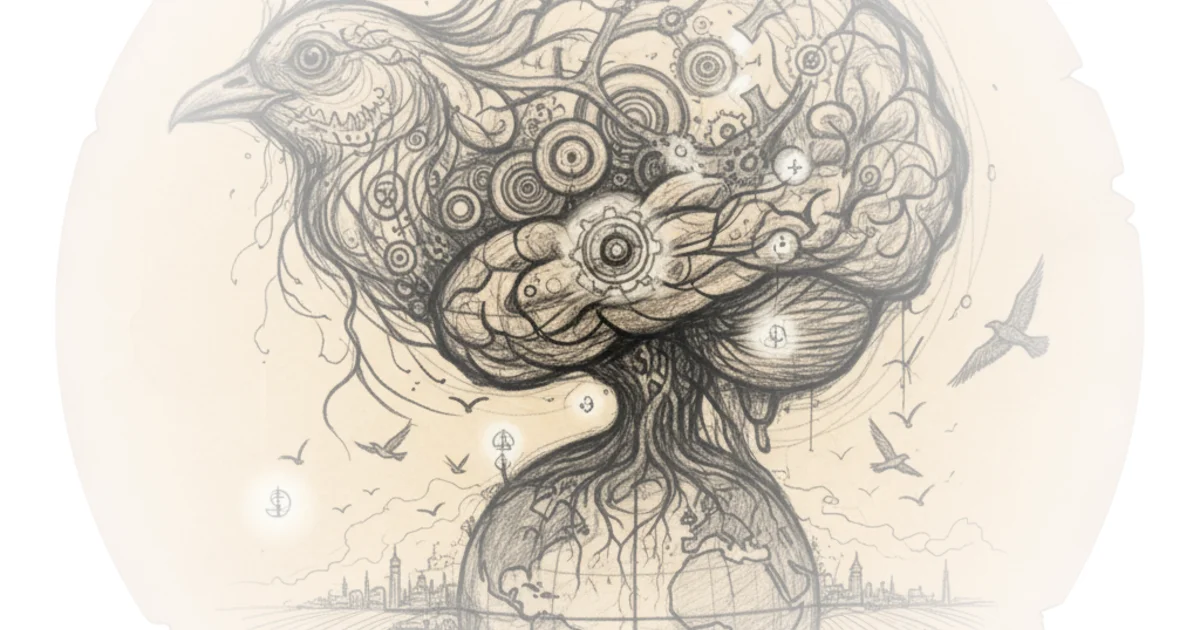
The author draws a sharp distinction between brain size and neuron count, referencing neuroanatomist Suzana Herculano-Houzel. He explains that while an ostrich has a larger brain than a crow, it has far fewer cortical neurons because its neurons are simply bigger. "It seems pretty clear what the elephant is doing with all those neurons: they are for its incredibly flexible trunk," DeLong writes, illustrating that biological investment is often driven by specific sensory-motor needs rather than abstract reasoning. This analysis forces a reconsideration of what constitutes "intelligence." If a crow can plan for the future and use tools with a brain 10 times smaller than a macaque's, then the human advantage cannot be solely rooted in the size of our neocortex.
"The story of economic history begins with the evolution of minds, not markets. And not with the evolution of individual minds either."
The Collective Brain and the Ratchet Effect
Having dismantled the idea of the solitary genius, DeLong pivots to the core of his argument: the "anthology intelligence" of humanity. He argues that our species' dominance stems from being "astonishingly social" with "hands, and can talk and listen." This social architecture allows for what he calls the "ratchet effect," a concept where each generation builds upon the innovations of the last, preventing the loss of knowledge. He contrasts the crow, which might bend a wire into a hook, with humans, who possess the capacity for "teaching, language, and the capacity for 'overimitation'."
DeLong leans heavily on the work of Joseph Henrich to illustrate that cumulative culture is ancient, dating back hundreds of thousands of years. He describes the site of Gesher Benot Ya'aqov, where early humans manufactured complex tools from distant quarries and cooked diverse foods. "There's little doubt that we are dealing with a cultural species who hunts large game, catches big fish, maintains hearths, cooks, manufactures complex tools," he notes. This evidence suggests that the "explosive increasing-returns runaway" of human history was fueled by social learning long before the advent of agriculture or formal markets.
Critics might argue that this view downplays the role of individual innovation or the specific institutional structures that later enabled the Industrial Revolution. While DeLong acknowledges the importance of the "pin factory," he insists the precondition was the "prior evolution of a species capable of listening, speaking, and, above all, learning from one another." This framing effectively shifts the focus from economic policy to evolutionary biology, though it risks oversimplifying the complex interplay between culture and material conditions.
Language as Economic Infrastructure
The commentary culminates in a redefinition of language and social trust as the foundational infrastructure of the economy. DeLong asserts that "language is not merely a vehicle for information transfer; it is a technology for the coordination of minds, the transmission of norms, and the creation of shared fictions." He connects the "ultrasocial" nature of humans to the emergence of markets, stating that the "biocultural evolution of societal-scale preferences—altruism, fairness, punishment—was a precondition for the emergence of markets, states, and all the other machinery of economic history."
He points out the fragility of this system, noting that when social networks are severed, knowledge regresses. He cites the case of Tasmanian toolkits, which regressed after isolation, proving that "the larger and more interconnected the network, the faster the rate of innovation." This perspective challenges the notion of the "Great Divergence" as purely a result of capitalism or institutions, suggesting instead that it may owe as much to the density of social networks. The argument is compelling because it treats social capital not as a soft variable, but as the hard substrate upon which all economic complexity is built.
"The 'market' is merely a latecomer, a surface ripple atop the vast ocean of social learning, language, and trust that made Homo sapiens the protagonist of the coming of the Anthropocene."
Bottom Line
DeLong's most powerful contribution is his insistence that economic history is fundamentally a story of cognitive ecology, where the "collective brain" matters more than the individual one. The argument's greatest vulnerability lies in its difficulty to quantify; while the evolutionary logic is sound, applying it to specific historical economic outcomes requires navigating a minefield of variables. However, for any reader seeking to understand the deep roots of human cooperation and innovation, this piece offers a necessary correction to the myth of the solitary genius.