Most market commentary assumes an AI bust must mean the technology fails or the economy collapses. Brad DeLong, writing in DeLong's Grasping Reality, challenges this binary by arguing the most likely crash scenario is one where the technology succeeds spectacularly, yet investors lose everything. This is a crucial distinction for busy readers: the danger isn't that AI won't work, but that it will work so well it becomes a utility with zero profit margins.
The Airline Trap
DeLong anchors his argument in a counterintuitive economic reality: high utility does not guarantee high returns. He points to the airline industry as the historical precedent for this dynamic. "Think of airlines: very useful, very high-tech, immense user surplus, next to no profits," DeLong writes. He suggests that even if AI adoption accelerates faster than any technology in history, the market structure may prevent capital owners from capturing value.
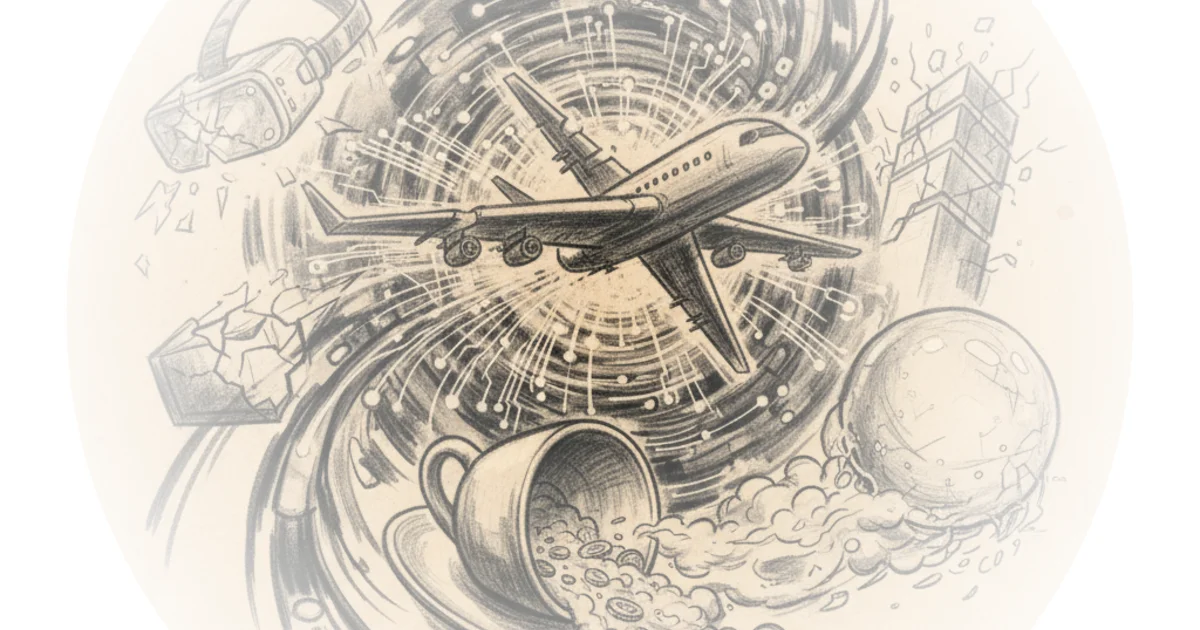
The author outlines three potential bust scenarios, dismissing the first—the idea that AI is simply a useless fad like the Metaverse—as unlikely given current adoption rates. Instead, he focuses on the structural risks of the buildout. The second scenario, which he calls the Railroad Scenario, draws on the Panic of 1873. Just as the railroad network expanded massively before the economic value of those lines could be realized, AI infrastructure is being built at a pace that outstrips immediate profitability. "The railroad buildout in the 1800s was, in percentage terms, the greatest single feat of capital expenditure in U.S. history, dwarfing even what the AI industry is spending on data centers right now," DeLong notes. The risk here is financial, not technological; the debt comes due before the new industries enabled by the tech can generate enough cash to pay it back.
The technology works. It diffuses. It becomes infrastructural. Yet the rents flow not to the operators, and in the long run not that many rents flow to the toolmakers and the suppliers.
DeLong argues that the third scenario, the Airline Scenario, is the most probable outcome. In this world, AI becomes a foundational layer of the economy, but competition drives prices down to the marginal cost of computing. The value accrues to the users and the companies that build applications on top of the AI, not the companies that built the models or the data centers. This framing is effective because it shifts the focus from "will AI fail?" to "who actually gets paid?" Critics might note that this assumes a perfectly contestable market, ignoring the possibility that early movers could establish moats that prevent price erosion. However, DeLong counters this by highlighting the aggressive nature of the current tech giants.
The Platform Defense
The piece's most distinctive contribution is its analysis of how incumbent tech giants will react to new AI competitors. DeLong argues that companies like Google, Microsoft, and Apple will not allow a new platform aggregator to emerge. They will replicate AI capabilities and give them away for free to protect their core revenue streams in search, advertising, and hardware. "Google and Facebook and Amazon do not want anybody—anybody—to take their search and social-media profits away from them by providing front-end natural-language interfaces," DeLong writes.
He draws a direct line to the antitrust battles of the 1990s, noting that these firms will act as they did against Netscape. "All of these will do what Microsoft did to Netscape before they will let any of that happen," he asserts. This suggests that even if a startup like OpenAI creates a superior product, the hyperscalers can simply bundle a "good-enough" substitute into their existing ecosystems, stripping the startup of its pricing power. This dynamic reinforces the Airline Scenario: the technology becomes ubiquitous, but the profits are squeezed out by the very giants that own the distribution channels.
If it ever looks like OpenAI or anyone else is attaining platform-aggregator scale by selling AI-based services, Google or Facebook or Amazon or Apple or Microsoft—or probably all five at once—will stop that from happening by giving good-enough substitutes away for free.
This analysis holds significant weight given the current concentration of capital in the sector. While some might argue that innovation cycles are too fast for incumbents to react effectively, the sheer scale of the hyperscalers' cash flow suggests they can sustain a price war longer than any startup. The argument implies that the "AI bubble" is not a bubble of overhyped expectations that will pop, but a bubble of misplaced capital allocation that will deflate as returns fail to materialize.
Bottom Line
Brad DeLong's strongest insight is that the AI bust may look like a triumph for society and a disaster for investors, a paradox that current market narratives ignore. The argument's greatest vulnerability lies in its assumption that tech giants will prioritize short-term margin protection over long-term platform dominance, potentially leaving room for a new winner to emerge. Readers should watch not for signs of technological failure, but for signs of price compression in the sector, which would signal the arrival of the "Airline Scenario."
The technology works. It diffuses. It becomes infrastructural. Yet the rents flow not to the operators, and in the long run not that many rents flow to the toolmakers and the suppliers.