Mehdi Hasan delivers a chilling inventory of institutional erosion, arguing that the most dangerous aspect of the current administration's second term is not its overt aggression, but the systemic dismantling of the very checks and balances designed to stop it. This week's report is notable not for a single scandal, but for the sheer velocity with which legal norms are being ignored, from the weaponization of immigration enforcement against US citizens to the erasure of climate science from federal websites. For the busy reader, the takeaway is stark: the machinery of authoritarianism is no longer a theoretical threat; it is operating in real-time, often with the silent complicity of agencies meant to guard the public trust.
The Erosion of Judicial and Institutional Checks
Hasan opens with a sobering assessment of the administration's relationship with the rule of law, noting that while "judges and grand juries block" specific overreaches, the executive branch is still "managing to do a lot of harm to the country and free societies worldwide." The author highlights a disturbing pattern where the administration treats the judiciary not as a co-equal branch, but as an obstacle to be circumvented or attacked. When a federal judge blocked the Justice Department from using private communications to re-indict a former FBI director, the response was not legal reflection but a personal attack on the media covering it. Hasan writes, "On Truth Social, Trump attacked CNN's Kaitlin Collins, calling her 'Stupid and Nasty' over what he claimed was a question about the increasing cost of his new White House ballroom."
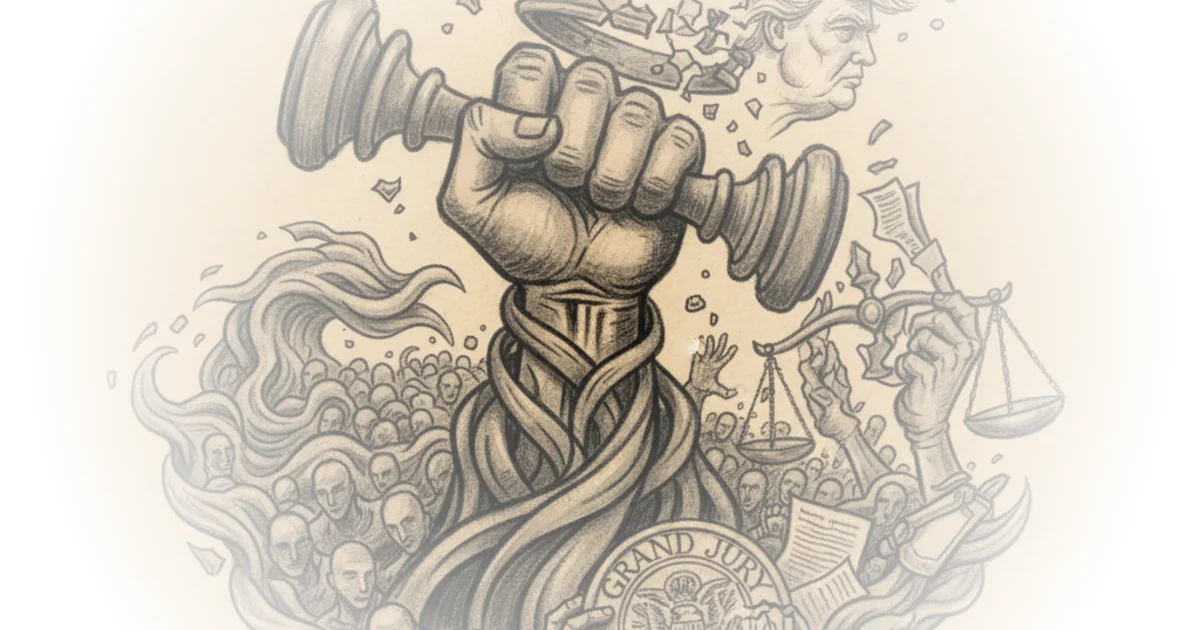
This tactic of deflecting legal scrutiny with personal vitriol is a recurring theme. The commentary effectively frames these outbursts not as mere personality quirks, but as strategic attempts to delegitimize the institutions that are doing their jobs. The author points out that even when the administration loses in court, it continues to push boundaries, such as the Department of Housing and Urban Development pausing a policy change to cut homelessness funding only "less than two hours before a court hearing." This suggests a strategy of governing by litigation, forcing courts to play catch-up while policies are implemented and harms are inflicted.
The administration appears to be treating the rule of law as a suggestion rather than a constraint, testing how far it can push before the courts force a halt.
Critics might argue that the administration is simply exercising its executive authority aggressively, as any president might when facing a hostile judiciary. However, Hasan's evidence of targeting specific journalists and dismantling long-standing civil rights regulations suggests a pattern that goes beyond standard political friction. The argument holds weight because it connects disparate events—attacks on reporters, removal of climate data, and legal battles over immigration—into a cohesive narrative of institutional decay.
The Human Cost of Immigration Enforcement
Perhaps the most harrowing section of Hasan's piece details the human toll of the administration's immigration policies, moving beyond statistics to the lived experiences of families and children. The author brings to light the case of Bruna Ferreira, the mother of the press secretary's nephew, who was detained by Immigration and Customs Enforcement (ICE) despite her family connections. Hasan notes that Ferreira "moved mountains" to ensure her son could attend a White House event, yet she was detained for a civil visa violation. The administration's response was to claim she hadn't spoken to her family in years, a claim the mother disputed with specific details about godmother roles and wedding attendance.
The piece does not shy away from the brutality of the enforcement apparatus. Hasan reports that the American Civil Liberties Union (ACLU) alleged that ICE agents "coerce immigrants being held at a makeshift detention center in Texas to leave the country for Mexico, without written warning or hearings." The human cost is visceral: "Two of them said they were beaten after they initially refused to be transported to the border." Furthermore, the author highlights the plight of children, noting that "hundreds of children were held in ICE custody for more than the 20-day limit," with some held for over five months in conditions described as having "worms and mold in the food."
The author's framing is particularly effective in connecting these abuses to the administration's rhetoric. When the administration speaks of "Operation Irish Goodbye" to apprehend immigrants voluntarily returning home, Hasan contrasts this with the reality of families being "denied access to urgent medical care" and threatened with separation. The argument is that the administration's policies are not just legally questionable but morally bankrupt, creating a system where human dignity is secondary to political posturing.
The administration's immigration policies are not merely about border security; they are about inflicting suffering as a deterrent, with children and families bearing the brunt of this cruelty.
A counterargument worth considering is that the administration is facing an unprecedented migration crisis and must take drastic measures to maintain order. Yet, Hasan's reporting on the lack of criminal histories for over a third of those arrested by ICE suggests that the current approach is not targeted at dangerous criminals but is a broad-brush enforcement strategy that sweeps up innocent people. The evidence of children being held for months without medical care undermines the claim of necessary order, pointing instead to systemic negligence.
The Weaponization of Information and History
Hasan also dissects the administration's assault on truth and historical record, from the scrubbing of climate change data to the rewriting of civil rights history. The author notes that the Environmental Protection Agency has "scrubbed references to human-caused climate change from its website," removing statements from the Intergovernmental Panel on Climate Change that declared human influence on warming as "unequivocal." This is not just a policy shift; it is an attempt to erase scientific consensus from the public record. Similarly, the Justice Department's move to reinterpret regulations to eliminate statistical disparities as evidence of racial discrimination signals a broader effort to dismantle the tools used to enforce civil rights.
The piece also touches on the administration's relationship with the media, highlighting the push to change the ownership and programming of major news networks. Hasan reports that the administration has "privately said that he wants new ownership of the network and changes to its programming," while also labeling unfavorable reporting as "seditious" and "perhaps even treasonous." This rhetoric creates a chilling effect, where the press is not just criticized but criminalized for its reporting. The author draws a parallel to historical attempts to control information, noting that the administration's actions are reminiscent of authoritarian regimes that seek to monopolize the narrative.
The inclusion of the Juan Orlando Hernández case adds a layer of international complexity. Hasan points out that the former Honduran president, who was pardoned by the administration after serving a 45-year sentence for drug trafficking, is now facing new charges in his home country. This highlights the administration's willingness to use pardons as political tools, potentially undermining international efforts to combat corruption and drug trafficking. The author writes, "Hernández was pardoned by Trump and released from a US prison, where he was serving a 45-year sentence for conspiring to import cocaine to the US," a move that raises questions about the administration's commitment to the rule of law both domestically and abroad.
When the government begins to label scientific consensus as 'seditious' and criminalizes the press for reporting the truth, the foundation of a free society begins to crumble.
Critics might argue that the administration is simply correcting what they see as biased or inaccurate information in federal agencies. However, the systematic removal of climate data and the reinterpretation of civil rights laws suggest a deliberate effort to rewrite history rather than correct errors. The argument is strengthened by the specific examples of what is being removed and how, leaving little room for the claim of benign correction.
Bottom Line
Mehdi Hasan's analysis is a powerful indictment of an administration that views the rule of law, the press, and human rights as obstacles to be removed rather than pillars to be upheld. The strongest part of the argument is its ability to connect disparate events into a coherent narrative of institutional decay, showing how each attack on a check and balance contributes to a broader authoritarian project. The biggest vulnerability is the sheer volume of negative news, which risks overwhelming the reader with despair rather than mobilizing action. The reader should watch for how the courts and civil society respond to these challenges, as the coming months will likely test whether the institutions of democracy can withstand this level of pressure. The human cost of these policies is already being paid, and the question remains whether the system can recover before the damage becomes irreversible.