Paul Cooper doesn't just recount the history of ancient Egypt; he reframes the civilization's entire existence as a geological accident that defied the odds of human survival. While most histories focus on pharaohs and wars, Cooper anchors the narrative in the sheer, overwhelming physics of the Nile River, arguing that without its specific flow patterns, the "Black Land" would never have emerged from the "Red Land" of chaos. This approach transforms a familiar story into a meditation on how geography dictates destiny, offering a perspective that feels startlingly fresh even to those who think they know the pyramids.
The River as Architect
Cooper begins by stripping away the romanticism often associated with Egypt to reveal the brutal environmental reality. He writes, "Every blade of grass and every tree in the Nile Valley, every animal and every person to ever live, every priest and every King owes their existence solely to this River." This is not merely poetic flair; it is the central thesis of the piece. The argument is that Egypt was not a triumph of human will over nature, but a desperate migration into a single, narrow corridor of survival as the Sahara dried up. Cooper effectively uses the concept of the "two lands" to illustrate how the Egyptians' entire worldview was dictated by the river's flow, noting that they oriented their maps upstream, making the south their "left" and the north their "right."
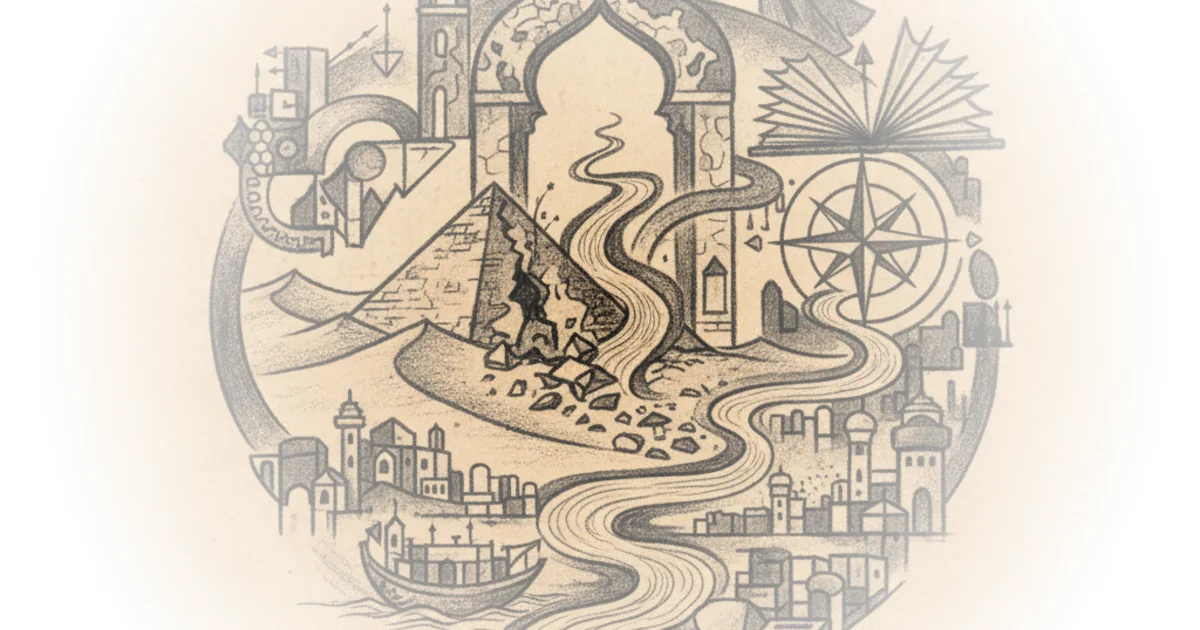
This framing is powerful because it forces the reader to visualize the ancient world not as a static backdrop for history, but as a dynamic, life-or-death relationship with water. Cooper notes that the Egyptians called the fertile floodplain chemet, or "the Black Land," while the surrounding desert was desr, the "Red Land" presided over by the god of chaos. The distinction wasn't just cultural; it was existential. "If geography had been only a little different and Lake Victoria had not begun to drain westwards, we can only imagine how differently history might have gone for at least the last 5,000 years," Cooper posits. This counterfactual highlights the fragility of the civilization's foundation.
Every blade of grass and every tree in the Nile Valley, every animal and every person to ever live, every priest and every King owes their existence solely to this River.
Critics might argue that this environmental determinism downplays the agency of the people who built these societies. However, Cooper balances this by showing how the river's predictable cycles allowed for the development of complex agriculture and astronomy, as seen in the Nabta Playa stone circle, which predates Stonehenge by millennia. The river didn't just feed them; it taught them to measure time.
A Gaze Across Millennia
The piece takes a unique turn by introducing the perspective of Abd al-Latif al-Baghdadi, a 13th-century scholar who visited the ruins long after the civilization had collapsed. Cooper uses al-Baghdadi's writings to bridge the gap between the ancient builders and the modern observer. "The ancient monuments in Egypt are such as I have never seen nor heard tell of in other lands," al-Baghdadi wrote, a sentiment Cooper uses to emphasize the timeless awe these structures inspire. The commentary here is particularly effective because it shifts the focus from the construction of the pyramids to their endurance.
Cooper highlights al-Baghdadi's confusion and wonder at the inscriptions, noting, "In the entire land of Egypt I have never found a single person who so much as claimed to have heard of anyone who knew how to read them." This detail is crucial; it underscores the total erasure of the civilization's voice by the time of the medieval period. The pyramids stood as silent testaments, their meaning lost to the very people living in their shadow. Cooper argues that the structures themselves became the only remaining language of the builders: "Noble intellects gave the pyramids their all... they all but speak aloud of their Builders, telling us what sort of folk they were."
This section is a masterclass in using a historical witness to humanize the passage of time. By quoting al-Baghdadi's description of the Sphinx as "Old Father Dread" and noting its buried state, Cooper reminds us that even the most iconic symbols of Egypt were once lost to the sands. The narrative choice to let a medieval traveler describe the ancient world adds a layer of melancholy that a modern historian's dry facts could never achieve.
The Engineering of Immortality
The final thrust of Cooper's argument concerns the sheer impossibility of the engineering feats achieved. He writes, "The construction of the pyramids was carried out according to a methodology remarkable in respect both to design and to precision of execution." This is not just about moving stones; it is about a level of societal organization and intellectual capability that the modern world struggles to comprehend. Cooper suggests that the longevity of these structures is a direct result of the "pure minds" and "loftiest capabilities" poured into them.
He points out that when al-Baghdadi visited, the Great Pyramid was still the tallest man-made structure in the world, a title it held for over 3,700 years. "It has enabled the pyramids to endure time's passing eras or rather it has meant that time itself has had to endure the era of the pyramids," Cooper writes. This inversion of the relationship between time and human achievement is the piece's most striking rhetorical move. It suggests that the civilization was so potent that it forced history to pause around its creations.
It has enabled the pyramids to endure time's passing eras or rather it has meant that time itself has had to endure the era of the pyramids.
A counterargument worth considering is whether this focus on the monuments overshadows the daily lives of the millions of laborers who built them. Cooper touches on the "crumbling beside the Waters of the Nile" and the local people who quarried the stones, but the narrative remains heavily weighted toward the grandeur of the structures. Yet, even this limitation serves the piece's purpose: to show how a civilization can become so defined by its peak achievements that its decline feels like a disappearance of the world itself.
Bottom Line
Paul Cooper's greatest strength is his ability to weave geological necessity with human ambition, creating a narrative where the river and the pharaohs are inextricably linked. The piece's vulnerability lies in its occasional tendency to romanticize the silence of the ruins, potentially glossing over the complex social stratifications that sustained them. Ultimately, this is a definitive reminder that civilizations are not just stories of kings, but fragile experiments in survival against the indifferent forces of nature.