Anarchierkegaard delivers a sharp, unsettling critique of the very foundation of modern religious debate: the belief that logic alone can prove God exists. In a landscape often dominated by apologetics and fine-tuning arguments, this piece argues that such proofs are not just insufficient, but fundamentally circular and disconnected from the reality of human suffering. For the busy reader seeking clarity on why faith and reason often talk past each other, this is a necessary intervention that exposes the intellectual dead ends of trying to "solve" divinity with a syllogism.
The Circular Trap of Design
The author begins by dismantling the classic teleological argument—the idea that because nature looks designed, a designer must exist. Anarchierkegaard writes, "The most basic problem for these kinds of arguments is that they are, after having dug under the skin of the proof, simply question-begging." This is a devastatingly simple observation. The argument assumes the conclusion it is trying to prove: it presumes a designer is necessary to explain design, effectively smuggling the answer into the question. As Anarchierkegaard puts it, "It looks like it was designed; designers design designed things; therefore, it was designed... QED, there is a God. Hallelujah, we have toppled the heathen scourge. Sadly not, my reader."
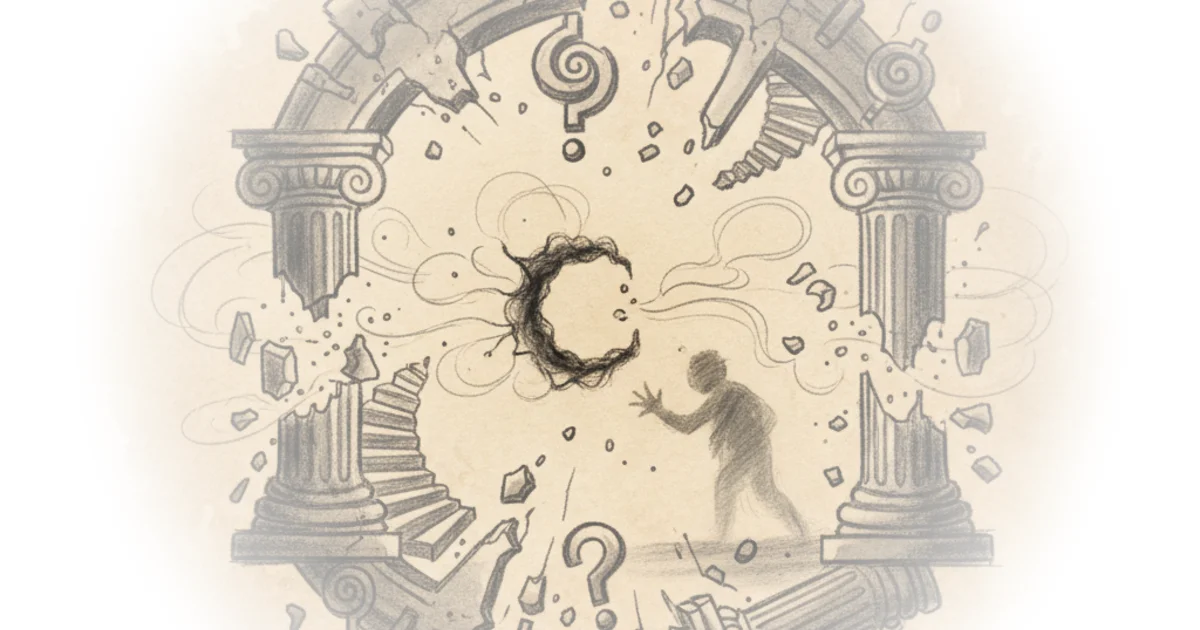
The commentary here is effective because it strips away the technical jargon to reveal the logical sleight of hand. The author suggests that for a believer, the concept of a designer is already "filled" with meaning, while for a skeptic, it remains an empty shell. Without a pre-existing faith, the argument collapses because one cannot demonstrate the existence of something one cannot conceptually grasp. Anarchierkegaard notes that "the thought-object is not transmitted through this argument," meaning the logic fails to bridge the gap between disbelief and belief.
Critics might argue that this dismissal is too harsh, suggesting that while logic may not force belief, it can still provide rational support for theistic worldviews. However, the author's point stands: if the argument only works for those who already accept the premise, it serves no evidentiary purpose for the undecided.
Existential statements are always also about us because they cannot be true unless they are true in the world in which we exist.
The Problem of Evil as a Logical Dead End
Moving beyond the mechanics of the argument, the piece tackles the elephant in the room: the problem of evil. Anarchierkegaard argues that any argument for a designer who is also "very good" must account for the reality of suffering. The author cites Genesis 1:31—"Then God saw everything that He had made, and indeed it was very good"—to highlight the disconnect between the claim of a benevolent designer and the reality of a world filled with agony. "It is not enough to assert that there is design to any degree of technical complexity, but rather there must be clear evidence that this design is also very good in the sense that a divine being would assent to its existence as being as such."
The piece lays out the logical progression of the problem of evil with brutal clarity, noting that an omnipotent, omniscient being allowing preventable suffering is, by definition, morally imperfect. Anarchierkegaard writes, "If there is an omnipotent and omniscient being, then that being performs some morally wrong actions." This creates a paradox that standard philosophical theology struggles to resolve without resorting to "sceptical theism"—the idea that God's reasons are simply unknowable to us. The author dismisses this as a "Babelic failure," suggesting that we are trying to climb a ladder to heaven that we cannot reach.
This framing is crucial because it shifts the debate from abstract logic to the concrete reality of human pain. The author argues that a thinker who ignores the problem of evil is "getting on the bus at the wrong stop," lacking the proper footing to discuss existence meaningfully. While some theologians might argue that suffering serves a greater, hidden purpose, Anarchierkegaard insists that without a robust answer to why a good God allows a child to die of cancer, the argument for a benevolent designer remains hollow.
The Necessity of Faith Over Proof
Ultimately, the piece concludes that the search for objective, philosophical proof is a dead end that distracts from the actual nature of faith. Anarchierkegaard suggests that the "thrust" of any real belief system is not found in arguments but in the personal, subjective encounter with the divine. "The person who would be convinced with these kinds of arguments... is one who already has some particular content qua thought-object when they reflect on the idea of God or Creator or Designer." In other words, the proof is not the cause of the belief; the belief is the precondition for seeing the "proof."
The author writes, "Without that, a thinker who focuses on teleological or fine-tuning arguments without a robust response to the problem of evil is getting on the bus at the wrong stop." This is a call to abandon the futile attempt to turn faith into a math equation. Instead, the focus should shift to the lived experience of faith and the paradoxes it entails, rather than trying to rationalize them away. The piece challenges the reader to stop looking for a "god of the philosophers" and start engaging with the messy, difficult reality of the divine as it is actually encountered.
Bottom Line
Anarchierkegaard's strongest move is exposing the circularity of design arguments and refusing to let the problem of evil be swept under the rug as a mere intellectual puzzle. The piece's biggest vulnerability is its potential to alienate readers looking for rational defenses of faith, but its verdict is clear: objective proof is a mirage, and the only path forward is through the subjective, often paradoxical, reality of belief itself.