Laura Rozen delivers a chilling account of a pivotal moment where the executive branch explicitly redefined the military's domestic role, shifting focus from external defense to internal suppression. The piece's most disturbing revelation is not merely the rhetoric used, but the specific operational directive to treat American cities as training grounds for quelling dissent. For busy listeners tracking the erosion of civil norms, this report provides the raw evidence that the line between citizen and enemy is being redrawn in real time.
The Redefinition of the Enemy
Rozen captures the gravity of the address delivered at the Marine Corps Base in Quantico, where the administration's stance was laid bare before hundreds of generals. The author writes, "President Trump made clear in a horrifying speech to U.S. generals today that he plans to use the U.S. military primarily to quell protests and fight 'the enemy within' in American cities led by elected Democrats." This framing is significant because it moves beyond political posturing into a concrete strategy of deployment against domestic populations.
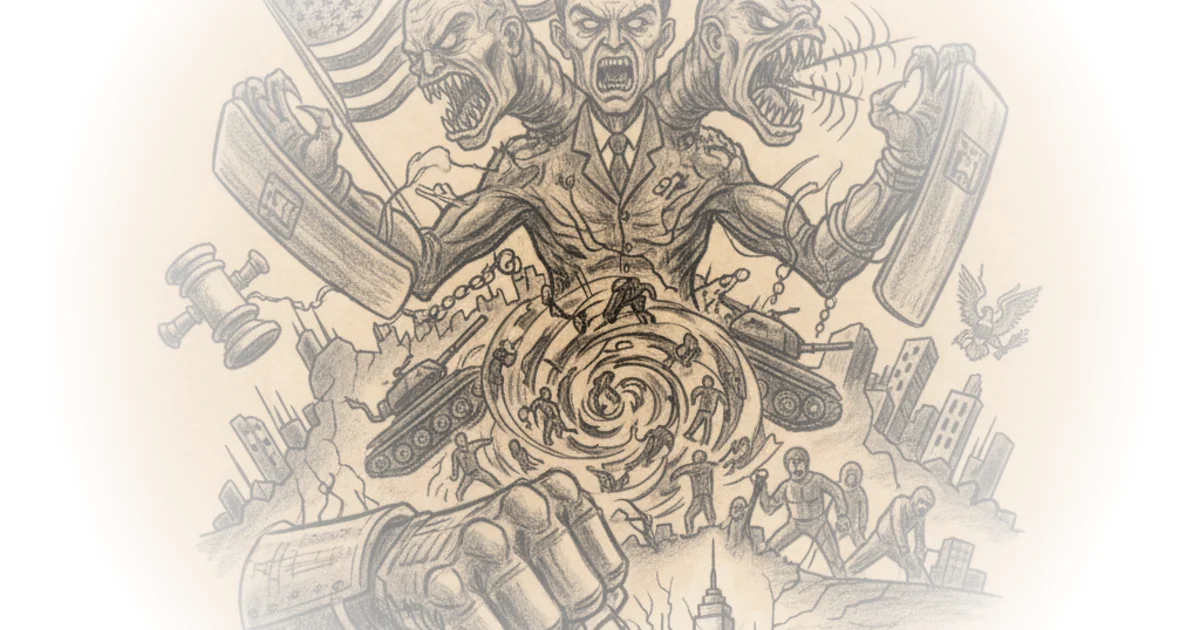
The core of the argument rests on the administration's assertion that internal dissent is equivalent to foreign invasion. As Rozen puts it, "America is under invasion from within... No different than a foreign enemy, but more difficult in many ways because they don't wear uniforms." This rhetorical shift is dangerous; by stripping protesters of their identity as citizens with rights and recasting them as an amorphous, uniform-less threat, the executive branch creates a moral and legal pretext for overwhelming force. The logic here is that the lack of a uniform justifies the suspension of normal rules of engagement.
Critics might note that labeling internal political opposition as an "invasion" is a standard authoritarian trope, yet the administration's willingness to state it so plainly to military leadership is unprecedented in modern American history. The silence of the generals in the room, noted by Rozen, suggests a profound institutional tension between their oath to the Constitution and the orders they are receiving.
Cities as Training Grounds
Perhaps the most alarming operational detail Rozen uncovers is the plan to use specific municipalities as testing grounds for military intervention. The author reports, "I told Pete we should use some of these dangerous cities as training grounds for our military — National Guard, but military — because we're going into Chicago very soon." This is not a hypothetical discussion about disaster relief; it is a directive to practice urban combat scenarios on American soil.
The administration's targeting is explicitly political, focusing on areas with elected leaders who oppose the executive branch. Rozen highlights the disdain for local governance, quoting the speech: "That's a big city with an incompetent governor. Stupid governor." This personalization of policy reveals that the deployment is less about public safety and more about punishing political adversaries. The argument that cities like Chicago, Portland, and San Francisco are "very unsafe places" serves as the justification for this militarization, yet the piece implies these claims are driven by political animus rather than objective crime data.
"U.S. cities should never be 'training grounds' for the military. There is no 'enemy from within.'"
The human cost of this strategy is the potential for escalated violence in civilian neighborhoods. If the military is trained to view cities as battlefields, the distinction between a rioter and a bystander blurs, increasing the risk of catastrophic errors. The administration's focus on "straightening out" cities one by one suggests a systematic campaign of occupation rather than a temporary response to emergencies.
The Abandonment of External Defense
In a stark pivot, the speech also signaled a retreat from traditional global commitments. Rozen notes the administration's declaration: "We don't want you fighting wars abroad... From that standpoint, we don't want you fighting wars." This creates a paradox where the military is being pulled away from its primary mission of national defense to engage in domestic policing.
The author emphasizes the shift in resource allocation, quoting the directive to save forces for "other things, or save them for nothing." This suggests a future where the military's primary utility is internal control, leaving the nation's external security posture ambiguous. The framing here is that the greatest threat to the nation is no longer a foreign power, but its own population. This is a profound strategic realignment that could leave the country vulnerable on multiple fronts.
The response from military veterans and elected officials underscores the severity of the breach. Rozen cites Representative Seth Moulton, a former Marine, who expressed that "The reputational and operational damage being done to our military will take years to undo." This counterpoint is vital; it suggests that the long-term health of the institution is being sacrificed for short-term political gains, potentially fracturing the military's cohesion and public trust.
Bottom Line
Rozen's coverage is at its strongest when it documents the specific language used to justify the militarization of domestic spaces, exposing the administration's intent to treat political opposition as an existential threat. The piece's greatest vulnerability lies in its reliance on the administration's own rhetoric to prove its intent, though the specificity of the quotes leaves little room for denial. Readers should watch for the actual deployment of these forces, as the transition from speech to action will determine the true cost to American democracy.