Matt Stoller delivers a scathing indictment of a legal and corporate ecosystem where the rule of law is treated as a mere obstacle to be circumvented rather than a boundary to be respected. He argues that we are witnessing a shift where elite corporate lawyers, regardless of their political donations, are engineering mergers with the brazenness of criminal enterprises, relying on corruption and judicial intimidation to consolidate media power. This is not a standard antitrust analysis; it is a forensic look at how the machinery of the American state is being hijacked by oligarchs and their legal enablers.
The Anatomy of a Corrupt Merger
Stoller begins by dissecting the $6.2 billion merger between Nexstar and TEGNA, two major local broadcast owners. He posits that understanding modern corporate America requires "thinking like a criminal," a stark framing that immediately sets the stakes. The core of his argument rests on the revelation that these companies leveraged their control over local news to blackmail the executive branch. Stoller writes, "Last September, both companies demanded that Disney get rid of Jimmy Kimmel, or they would refuse to carry ABC programming. Why? Well, they wanted favorable treatment from the FCC and the Antitrust Division, who would have to approve this merger."
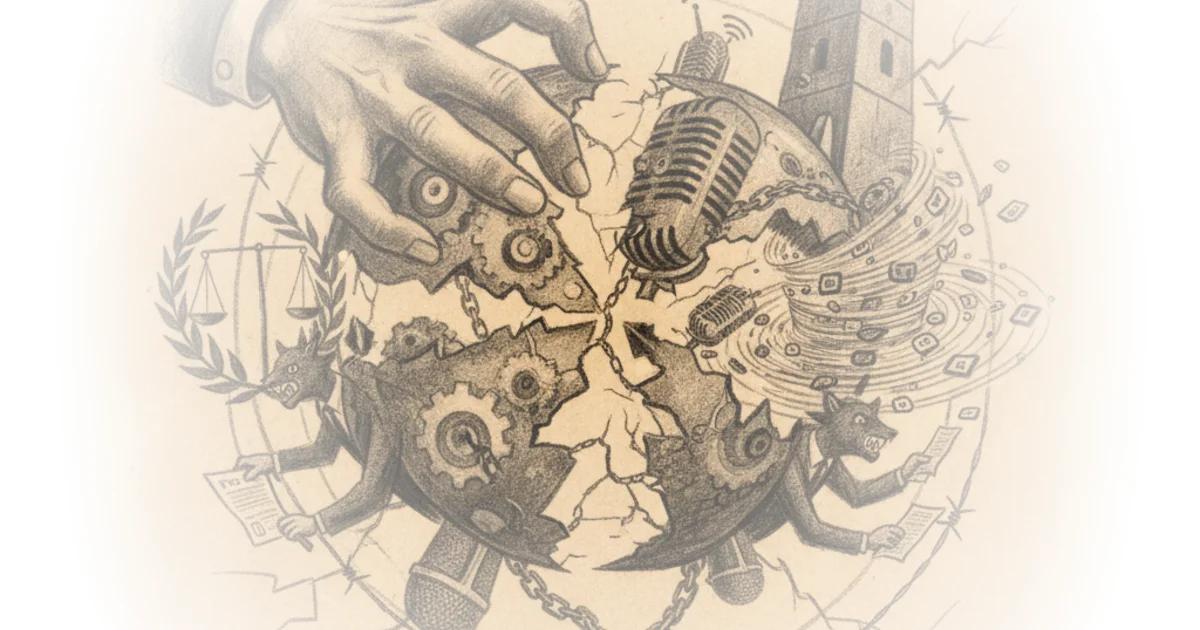
This transactional corruption is the piece's most disturbing element. The companies effectively held the public's access to national news hostage to secure a monopoly. Stoller notes that while the Federal Communications Commission (FCC) and the Antitrust Division initially blocked the deal in the previous administration, the current executive branch approved it shortly after the companies complied with the demand to silence a comedian. The speed of the approval and the subsequent immediate closing of the deal suggest a coordinated effort to present the courts with a fait accompli. As Stoller observes, "They paid out golden parachutes to executives and began integrating the lines of business, so as to force any judge trying to oversee the deal to have to granularly manage an unwinding and, in the hopes that a judge would find that too annoying to deal with and simply let the merger happen."
The legal strategy employed here is not just aggressive; it is contemptuous of judicial authority. When Judge Troy Nunley issued an injunction to keep the companies separate pending trial, Nexstar responded by stacking TEGNA's board with its own executives, effectively ignoring the court order. Stoller highlights the audacity of this move: "Nexstar, instead of obeying the judge, stacked the board of TEGNA with its own and former executives. And then they tried to keep the names of the board members secret from plaintiffs."
"The goal of these companies is not just dismissive of enforcers, but of courts as well."
Critics might argue that corporations often test the boundaries of legal orders, and that this is merely an extreme example of aggressive litigation strategy rather than systemic corruption. However, Stoller's evidence of the board stacking and the explicit admission by the CEO that the subsidiary is operating as part of the parent company undermines the defense of mere procedural overreach. This is a direct challenge to the judiciary's authority.
The Elite Enablers
Perhaps the most unsettling aspect of Stoller's analysis is his focus on the lawyers facilitating these actions. He points out that the legal architects of the Nexstar-TEGNA deal are not fringe figures but prestigious, Democratic-leaning litigators. Beth Wilkinson, a high-profile lawyer at Wilkinson Stekloff, is described as a donor to Democratic causes who has previously criticized firms for cutting deals with the administration. Yet, Stoller notes the hypocrisy: "It's a fascinating moment, to watch Wilkinson advise on how to get a deeply corrupt merger closed by flouting the law, while she talks about her professional responsibility of 'fighting for the rule of law.'"
Stoller argues that for these elites, "fighting the government" has become a code for dismantling regulatory constraints, regardless of the political affiliation of the administration in power. He lists Wilkinson's other clients, including Microsoft in the Activision deal and Visa in its antitrust battles, to illustrate a pattern of defending powerful entities against public interest regulations. The moral dissonance is sharp, especially given her role in the confirmation of Supreme Court Justice Brett Kavanaugh. Stoller writes, "Two years into her new venture, she represented then US Supreme Court nominee Brett Kavanaugh during confirmation hearings when he faced sexual misconduct allegations that he's denied."
This connection between corporate legal strategy and the composition of the Supreme Court is a recurring theme. Stoller suggests that the legal elite are not just representing clients but are actively shaping the judicial landscape to favor their interests. The implication is that the rule of law is being eroded from within by the very people sworn to uphold it.
The Paramount-Warner Gamble
The second case study, the proposed $110 billion merger between Paramount and WarnerMedia, escalates the stakes from local corruption to a potential global media monopoly backed by foreign sovereign wealth and billionaire influence. Stoller frames this deal as a direct result of political bribery, where billionaire Larry Ellison is alleged to have promised the White House control over CNN in exchange for regulatory approval. "That would be outrageous in most eras, but today it's a snoozer, a sort of 'did you expect anything else you rube' moment," Stoller writes, capturing the numbing effect of repeated scandals.
The involvement of foreign powers adds a layer of national security concern that is being ignored. Stoller points out that half the funding comes from Middle Eastern sovereign wealth funds, specifically the United Arab Emirates and Saudi Arabia, nations that rely heavily on U.S. military protection. He questions the enforcement of rules regarding foreign ownership of media: "Are there rules prohibiting or discouraging foreign governments from buying major U.S. media outlets? Yes, except Trump enforces those rules, so it's another 'did you expect anything else you rube' moment."
The legal strategy here is even more daring. Stoller explains that if lower courts block the merger, the plan is to appeal directly to the Supreme Court, potentially using the "shadow docket" to bypass normal judicial review. This tactic relies on the assumption that the current court will overturn established antitrust precedents. Stoller notes the connection between the deal's general counsel, Makan Delrahim, and the Supreme Court, highlighting Delrahim's role in the confirmation of Justice Neil Gorsuch. "Delrahim uses corrupt connections with the Supreme Court to break merger law so as to close a merger putting media assets in the hands of a close Trump ally and Middle East countries dependent on U.S. military assets," Stoller argues.
"State attorneys general are trying to uphold the rule of law, but oligarchs are bullying not only them, but even judges, with an implicit threat that the Supreme Court will ensure the outcome they want."
A counterargument worth considering is that the financial risks for Ellison and the potential for geopolitical instability make the deal unlikely to succeed regardless of legal maneuvering. Stoller acknowledges Ellison's collapsing net worth and the risks associated with the AI bubble, suggesting the deal might fail on economic grounds. However, he maintains that the intent and the method of the attempt reveal a deeper rot in the system.
The Role of History and Context
Stoller weaves in historical context to show that the current situation is a perversion of the American state's design. He references the architecture of the state, where power was split to prevent exactly this kind of consolidation. The fact that state-level enforcers are now the primary line of defense against federal inaction is a testament to the failure of federal institutions. He draws a parallel to the history of media cross-ownership, noting how regulations like "must-carry" rules were designed to protect local broadcasters, only to be exploited by them to raise prices and consolidate power. The reference to the WarnerMedia deep dive adds depth, reminding readers that the separation of national and local content was a deliberate policy choice that is now being dismantled.
Bottom Line
Matt Stoller's argument is a powerful, if unsettling, diagnosis of a legal system in crisis, where the distinction between high-stakes corporate strategy and criminal enterprise has blurred. The strongest part of his case is the detailed exposure of how legal elites are weaponizing the law to bypass judicial orders and regulatory frameworks. The biggest vulnerability is the reliance on the assumption that the Supreme Court will act on these corrupt impulses, a prediction that remains unproven but highly plausible given recent trends. Readers should watch for the upcoming preliminary injunction hearing and the potential for the Supreme Court to intervene, as these will be the true tests of whether the rule of law can withstand the pressure of oligarchic consolidation.