Then & Now reframes the modern obsession with shopping not as a moral failing of the individual, but as a centuries-long engineering project that rewired human desire itself. While most coverage of consumerism focuses on the guilt of buying fast fashion, this piece traces the architecture of our cravings back to Renaissance Italy and the birth of the modern salesman, revealing that the "conscious consumer" is fighting a battle against a system designed over 500 years ago.
The Architecture of Desire
The piece begins by dismantling the idea that consumerism is merely about acquiring useless trinkets. Then & Now writes, "we've always consumed and while we now do consume the latest frivolous fashion and want the latest pointless gadgets we also consume meaningful things new foods and books travel and art." This distinction is crucial; it separates the biological act of consumption from the cultural phenomenon of consumerism. The author argues that the latter is a specific historical development where acquisition became the primary metric for happiness and social standing.
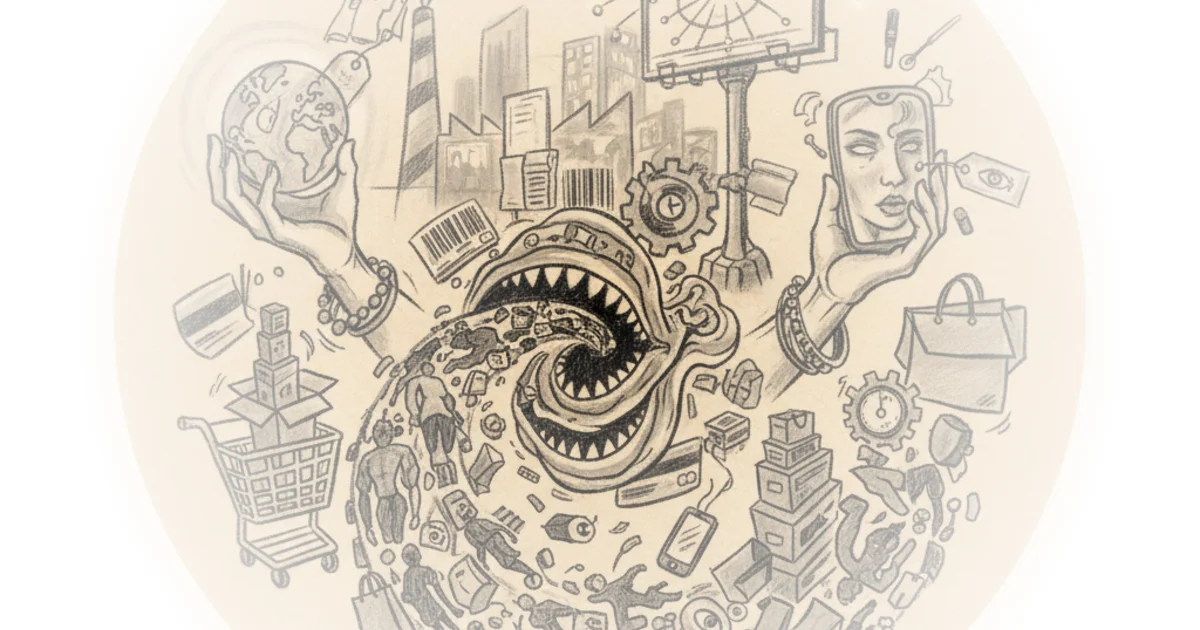
To understand the scale of this shift, the text turns to historian William Leach. Then & Now cites Leach's observation that "the cardinal features of this culture were acquisition and consumption as the means of achieving happiness, the cult of the new, the democratization of desire and money value as the predominant measure of all value in society." This framing is powerful because it moves the conversation from individual willpower to systemic values. It suggests that the pressure to buy isn't a personal weakness but a cultural mandate where money has replaced virtue as the ultimate measure of worth.
The consumer society is different from previous forms of consumption; we have a wider variety of goods, shops, and services, and everything is commercialized and exchanged.
From Virtue to Vice
The most compelling section of the commentary explores the historical resistance to this culture. Then & Now details how Renaissance merchants in Florence and Venice faced intense moral scrutiny, with figures like Aristotle and Plato arguing that "brash undirected luxury was immoral" and led to "laziness, corruption and an inward drive for ever increasing selfish desires." The piece vividly describes the "bonfire of vanities" in 1497, where citizens burned cosmetics and fine clothes, illustrating a time when society actively policed consumption.
This historical context is vital because it proves that our current relationship with goods is not inevitable. The author notes that ancient Stoics and the Christian Church viewed attachment to material things as a path to frustration, a stark contrast to the modern view. However, the narrative shifts in the 18th century with the rise of global trade and the industrial revolution. Then & Now highlights the role of Josiah Wedgwood, who "invented the modern salesman" by utilizing "inertia selling campaigns, product differentiation, market segmentation, [and] detailed market research." This is where the machinery of modern desire was assembled, turning the purchase of pottery into a psychological game.
Critics might argue that this historical determinism downplays the agency of modern consumers who actively choose ethical brands. Yet, the piece counters this by noting that even "ethical consumption" operates within the same commercialized framework, where moral choices are often just another product category to be marketed and sold.
The Cathedral of Commerce
The commentary then moves to the physical transformation of the landscape in the 20th century, specifically the rise of the shopping mall. The author describes these spaces as "new cathedrals of commerce," designed by architects like Victor Gruen to be self-contained cities. Gruen's vision was to create a "spiritual communal core" for suburban life, replacing the ancient Greek agora. Yet, the outcome was a betrayal of that vision. Then & Now quotes Gruen's later disillusionment, where he lamented that these spaces became "bastard developments" that failed to provide the "place and opportunity for participation in modern community life."
This section effectively illustrates the gap between the intent of consumer infrastructure and its reality. The piece argues that the invention of the glass shop window "democratized desire even as it democratized access to goods," creating a visual culture where everything is on display but nothing is truly shared. The shift from local markets to massive, enclosed malls fundamentally altered how people interact with their communities, replacing social exchange with transactional isolation.
The modern world created adventurers, explorers, dandies and flâneurs, moving through the streets, through the countryside, moving through the world just to collate and to understand the new.
The Psychology of the New
Finally, the piece tackles the psychological engine driving this system: the production of new desires. Then & Now draws on sociologist Colin Campbell to explain that modern consumers "withdraw from reality as fast as he encounters it, ever casting his daydreams forward in time, attaching them to objects of desire." This insight reframes shopping not as a response to need, but as a form of daydreaming where the object is merely a placeholder for an imagined future self.
The author connects this to the 19th-century concept of the "flâneur," the person who wanders aimlessly to experience the new, and the hedonism of Oscar Wilde's Dorian Gray, who "exchanges his moral self for the unbound liberty of the new." This psychological analysis suggests that the endless cycle of consumption is driven by a deep-seated human desire for novelty and self-reinvention, which the market has learned to exploit with surgical precision. The piece concludes by questioning whether there is any "way out" of this ocean of consumer power, leaving the reader with the sobering realization that the system is not just an economic model but a fundamental reordering of human consciousness.
Bottom Line
Then & Now's strongest contribution is its historical scope, proving that our current consumer culture is a constructed reality with a beginning, not a natural state of human existence. Its biggest vulnerability lies in its somewhat fatalistic tone, which offers little concrete path forward beyond recognizing the trap. Readers should watch for how this historical understanding might inform future regulatory approaches to marketing and the design of public spaces, rather than just individual lifestyle changes.