Richard Hanania makes a provocative claim that cuts against the grain of modern relationship advice: society is actively trying to force heterosexual dynamics to mimic lesbian ones, and in doing so, it is dismantling the very foundation of heterosexual attraction. He argues that the cultural obsession with eliminating power differentials and prioritizing "personality compatibility" over physical or status-based traits is not just idealistic, but biologically and economically disastrous for a nation already facing a fertility crisis. This is not a standard dating column; it is a controversial intervention that treats romantic preferences as immutable market forces rather than social constructs to be engineered.
The Myth of the "Equal" Partner
Hanania begins by dismantling the conventional wisdom that successful relationships require partners to be fundamentally similar. He recalls his own early confusion, noting, "If commonality was the basis for forming relationships, then my situation was truly hopeless." Instead, he found success by leaning into traits often stigmatized as "masculine," such as "willingness to break taboos" and "arrogance and defiance in the face of social pressure to conform." The author suggests that mainstream discourse has fallen into a trap of "social desirability bias," where people say they want partners who are like-minded, but their actual behavior reveals a preference for complementarity.
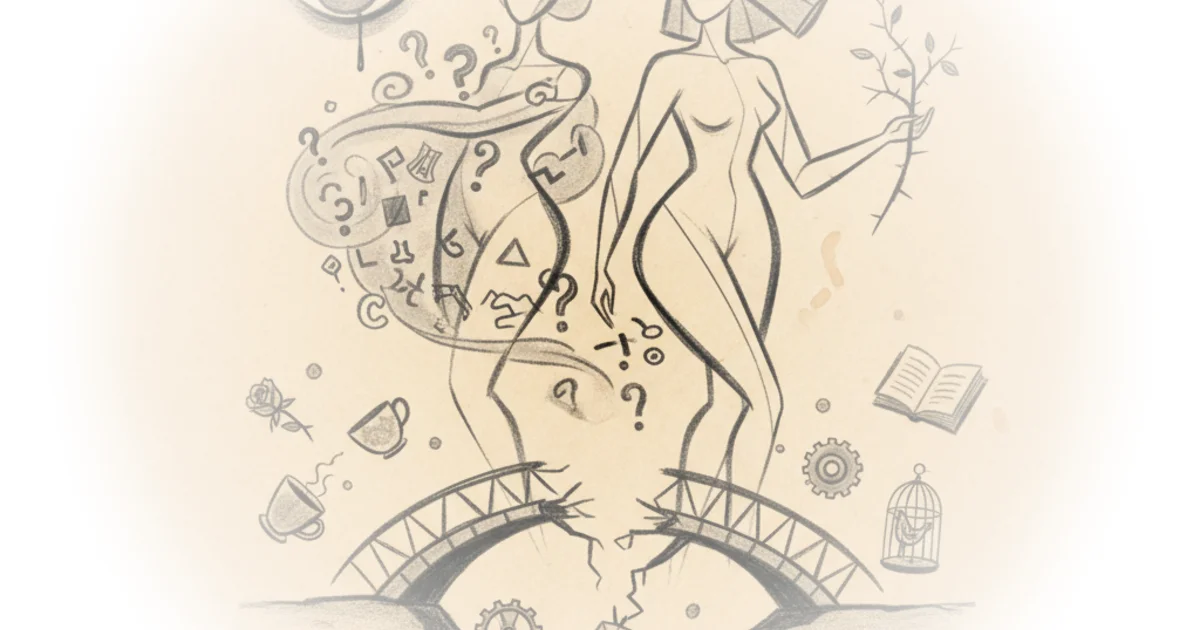
This framing is striking because it flips the script on the "red pill" movement. While Hanania admits he distrusts the broader red pill mindset, he argues that in this specific instance, "mainstream discourse is actively misleading." He posits that society is trying to make heterosexuals into lesbians by enforcing a model of romance based on "holistic appreciation" rather than the distinct preferences men and women have evolved to hold. As he puts it, "The culture of lesbianization involves taking the female-female model of romance and, through cultural pressure and sometimes legal persecution, forcing it onto heterosexuals."
Society is trying to make heterosexuals into lesbians.
The evidence Hanania marshals relies on the idea that even within same-sex relationships, gendered preferences persist. He cites a 2023 study by Klümper et al. which found that among homosexuals, men still cared more about looks than women, while lesbians valued being "like-minded" more than their heterosexual counterparts. He argues that this proves attraction is not a blank slate. "Gay men still have the same kinds of preferences as other men, and lesbians still have the preferences of women," he writes. This data point is crucial to his argument: if even gay men and lesbians retain their gendered preferences, then trying to impose a "lesbian" model of equality on straight couples is fighting human nature.
Critics might argue that Hanania overstates the rigidity of these preferences, ignoring how cultural shifts have successfully altered dating norms in the past. However, his reliance on "revealed preferences"—what people actually do rather than what they say they do—gives his argument a stubborn, empirical weight that is hard to dismiss.
Power, Status, and the "Transactional" Reality
The most controversial section of Hanania's piece tackles the taboo of power differentials. He draws a sharp parallel between economics and romance, arguing that just as socialism fails because it ignores the reality of market incentives, modern relationship norms fail because they ignore the reality of sexual attraction. "Trying to remove power disparities in heterosexual relationships is as misguided as working to eliminate them in the economy," he asserts. He suggests that for many women, attraction is inextricably linked to a man's status, wealth, or authority.
Hanania does not shy away from the uncomfortable examples often used to demonize this dynamic. He notes that men who prioritize youth and beauty are often labeled as "Donald Trump and Jeffrey Epstein types," while those who seek intellectual equality are seen as more refined. Yet, he argues this is a false dichotomy. "Society does not have an interest in all heterosexual relationships living up to lesbian norms," he writes. Instead, he contends that the "transactional" nature of many relationships—where a young woman trades beauty for a man's resources—is a rational, mutually beneficial exchange that has been unfairly stigmatized.
He points to the "Clavicular phenomenon" and "looksmaxxing" as the male response to this cultural pressure, where men, realizing that personality advice is no longer effective in a digital dating world, have shifted to obsessing over physical appearance. This creates a feedback loop where men and women, socialized in gender-segregated spaces, develop distorted views of each other. "Men and women stopped understanding each other and began to theorize about relationships in gender-segregated spaces," Hanania observes. This echoes the historical context of the "male gaze," where women were often viewed as performers for male attention, but Hanania argues the pendulum has swung too far, creating a "pedo hysteria" and age-gap taboos that prevent natural pairings.
The quest to remove power differentials in sex is even worse than trying to do the same in the economy.
Hanania's analogy to the economy is his strongest rhetorical move. He argues that just as we don't ban Amazon for having too much power, we shouldn't ban relationships where one partner has more status. "Power is simply a byproduct of Amazon's success," he writes, suggesting that in romance, power is often the very source of attraction. This perspective challenges the feminist narrative that all power imbalances are inherently exploitative. He acknowledges the danger of abuse but insists that "we need some realism too," noting that "men will like younger women, and women will like older men who have power over them."
The Demographic Imperative
Ultimately, Hanania's argument is driven by a demographic anxiety. He warns that for nations with "sub-replacement fertility," stigmatizing traditional heterosexual pairings is akin to "a country experiencing a generation-long depression doubling down on going to war with the profit motive." The "lesbianization" of heterosexuality, he argues, leads to fewer relationships and fewer children because it demands a level of egalitarian perfection that most people cannot achieve.
He suggests that the solution is not to force everyone into a single mold of "enlightened" romance, but to accept the diversity of human desire. "We just shouldn't be stigmatizing relationships in either direction," he concludes. Whether it is a man seeking a younger partner or a woman seeking a powerful one, these arrangements serve a social function. The author implies that the current cultural crusade against age gaps and status differences is not just a moral overreach, but a practical error that threatens the future of the family unit.
Bottom Line
Richard Hanania's piece is a bold, if polarizing, defense of biological realism in an era of social engineering. His strongest argument lies in the data showing that gendered preferences persist even in same-sex relationships, suggesting that "lesbian norms" are not a universal ideal but a specific female preference. However, the piece's biggest vulnerability is its tendency to conflate consensual transactional relationships with exploitative ones, potentially glossing over the real harms of power imbalances. Readers should watch for how this "realist" framework intersects with ongoing debates about consent and age gaps, as Hanania's call for non-judgmentalism could be interpreted as a defense of practices that many find deeply troubling.