This piece tackles one of the most counterintuitive ideas in physics: that according to Einstein's own equations, you can never actually watch something fall into a black hole. Derek Muller makes this visceral by imagining a nemesis trapped in a rocket ship — and from your perspective, he'd appear to slow down, freeze, and fade away at the very moment he should cross the horizon. This isn't science fiction; it's what Einstein's field equations predict when you actually solve them.
The View From Nowhere
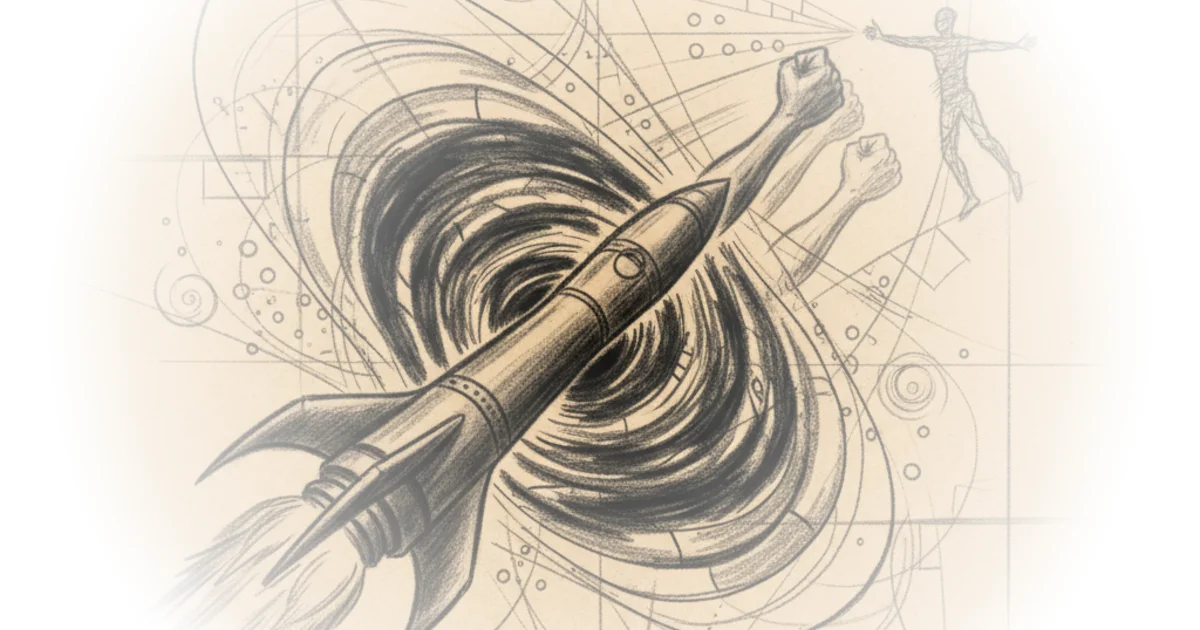
The article opens with this striking claim: "you can never see anything enter a black hole imagine you trap your Nemesis in a rocket ship and blast him off towards a black hole he looks back at you shaking his fist at a constant rate as he Zooms in gravity gets stronger so You' expect him to speed up but that is not what you see instead the rocket ship appeared to be slowing down." This is Muller at his best — taking an abstract mathematical result and dramatizing it through a vivid scenario. The reader isn't just learning about physics; they're watching a person get swallowed by gravity itself.
What makes this piece work is how Muller builds from Newton's problem to Einstein's solution. He quotes Newton's own unease: "one body may act upon another at a distance through a vacuum without the mediation of anything else is to me so great an absurdity that I believe no man who has a competent faculty of thinking could ever fall in it." This isn't just history — it's showing how even the greatest minds wrestled with what would become gravity's deepest mystery. Newton understood the problem but couldn't solve it.
Muller then introduces Einstein's breakthrough: "a mass like the sun curves the SpaceTime in its immediate vicinity this then curves the SpaceTime around it and so on all the way to the Earth so the Earth orbits the sun because the SpaceTime Earth is passing through is curved masses are affected by the local curvature of SpaceTime so no action at a distance is required mathematically this is described by Einstein's field equations." This is the core of general relativity explained in plain language — and it works. The author makes a complex idea feel intuitive without dumbing it down.
Solving the Unsolvable
The piece pivots to how Schwarzschild found the first exact solution to Einstein's equations during World War I. Muller describes this with almost cinematic detail: "Schwar Shield sent his solution to Einstein concluding with the war treated me kindly enough in spite of the heavy gunfire to allow me to get away from it all and take this walk in the land of your ideas." The historical framing makes the math feel human.
What Schwarzschild found was troubling. At R equals zero, one term "is divided by zero so it blows up to infinity" — a singularity where physics breaks down. But also at the Schwarzschild radius, another term "blows up so there is a second Singularity." Muller explains: "at the SW Shield Radius the SpaceTime curvature becomes so steep that the escape Velocity the speed that anything would need to leave there is the speed of light and that would mean that inside the short Shield radius nothing not even light would be able to escape so you'd have this dark object that swallows up matter and light a black hole if you will." The casual phrasing ("a black hole if you will") gives the piece personality — this isn't a textbook, it's someone genuinely wrestling with what the math reveals.
The article then traces how astronomers resisted what the equations implied. Muller recounts: "most scientists doubted that such an object could exist because it would require a lot of Mass to collapse down into a tiny space how could that possibly ever happen." This is key — the scientific community didn't believe in black holes not because of evidence, but because they seemed preposterous. The story of Oppenheimer and Hartland Snider showing "for the heaviest Stars there is nothing left to save them when their fuel runs out" feels like a turning point where theory outpaced intuition.
The Coordinate Illusion
The piece's most sophisticated moment comes when Muller explains why these singularities might not be real. He writes: "there is no real physical Singularity at the Event Horizon it just resulted from a poor choice of coordinate system." This deserves unpacking — what feels like a boundary in one coordinate system disappears entirely in another. It's a reminder that math describes reality, but the way we describe the math can distort what we're actually seeing.
Muller uses a clever analogy: "this diagram is a projection it's basically a 2d map of four-dimensional curved SpaceTime it's just like projecting the 3D Earth onto a 2d map when you do that you always get distortions there is no perfectly accurate way to map the Earth onto a 2d surface." The Mercator projection distorts sizes; the Gall Peters projection distorts shapes. Neither is wrong — they're just useful for different purposes. Similarly, Schwarzschild coordinates are one choice among many, and sometimes that choice makes things look like barriers when they're really just coordinate artifacts.
Nothing can cross this sort of boundary then how could there be black holes how could black holes even form form
This is the heart of the piece — if coordinate choices create apparent barriers, then what we think is happening might actually be an illusion of perspective. The article shows that Einstein's equations predicted not just black holes but their opposites: white holes and potentially wormholes connecting parallel universes. What started as a theory about gravity revealed something far stranger.
Where Critics Push Back
A counterargument worth considering: the piece leans heavily on visual metaphors ("space flowing in towards the black hole like a waterfall") which are useful but can oversimplify what actually happens to light and time near the event horizon. Physicists working on quantum gravity would note that the singularities Schwarzschild found may not be coordinate artifacts at all — they might represent real physical boundaries where our theory breaks down, not just poor coordinate choices. The piece acknowledges this tension indirectly by showing how different projections reveal different truths.
Bottom Line
Muller's strongest move is transforming an abstract mathematical result into a visceral story about watching someone you care about get swallowed by gravity itself. His weakest move is not fully acknowledging that the "resolution" he describes — changing coordinate systems — doesn't actually resolve whether black holes have singularities inside them; it just moves where those singularities appear. The piece's real value is showing how Einstein's equations predicted things even Einstein found difficult to accept: that time freezes at horizons, that nothing crosses in from our perspective, and that the universe contains structures we still don't fully understand. It's a reminder that sometimes the math reveals more than the intuition can handle.