Fred Mills doesn't just report on a new stadium; he exposes how a single architectural decision—a roof—can determine whether a city captures a billion-dollar economic windfall or watches it pass by. While most coverage focuses on the spectacle of the Super Bowl, Mills argues that the game is now less about athletic prowess and more about the "glorious combination of sporting excellence and engineering mastery" required to host it. He presents a stark reality: without a domed structure, Nashville's historic venue was mathematically disqualified from the NFL's biggest stage, forcing a choice between expensive renovation or a complete rebuild.
The Engineering of Exclusion
Mills frames the narrative around a simple, unforgiving metric: temperature. He notes that "the main factor getting in the way of the Nissan Stadium's ability to host the Super Bowl is the weather," citing a February low of -4° C, which falls well below the league's 10° C threshold for outdoor games. This is not merely a complaint about the cold; it is a critique of infrastructure planning that failed to anticipate the economic stakes. By comparing the aging facility to modern venues like SoFi or Allegiant, Mills illustrates how quickly "age really does start to show" when the criteria shift from simple seating capacity to climate-controlled luxury.
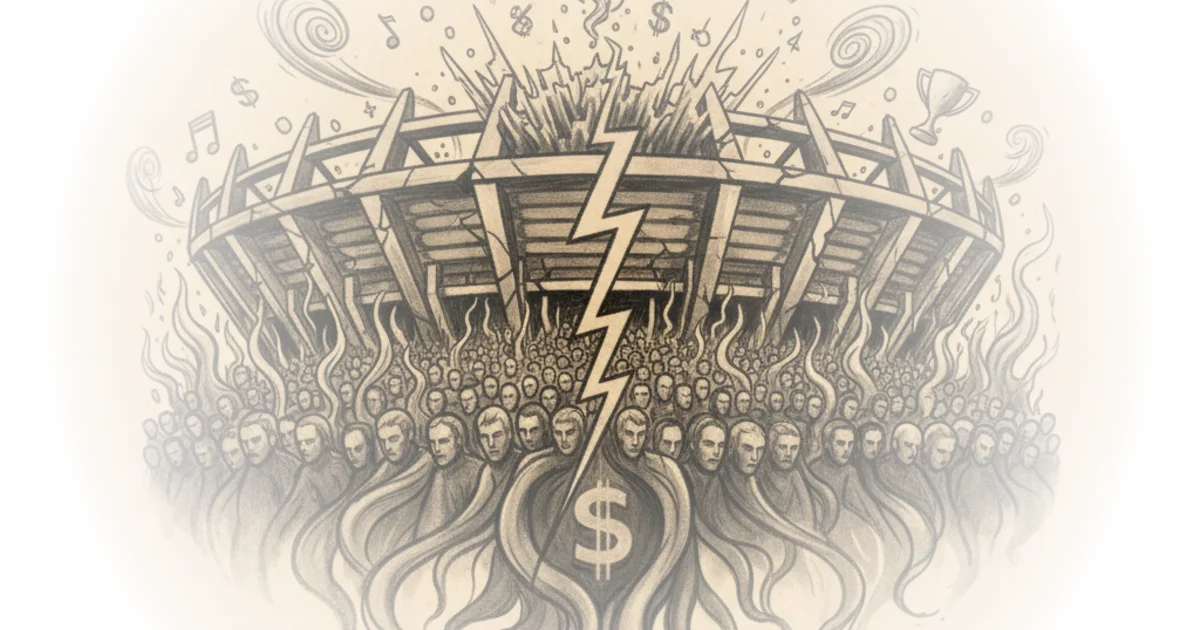
The author's analysis of the financial calculus is particularly sharp. He points out that while renovating the old structure was an option, the costs were "astronomical," making a new build the only logical path forward. This decision underscores a broader trend in American sports: the public is footing the bill for private entertainment because the return on investment—"as much as a billion dollars in visitor spending and employment"—is too lucrative for cities to ignore. Critics might argue that spending $2.1 billion of public money on a facility for a single team is an inefficient allocation of resources, yet Mills suggests the city is simply playing the hand the NFL dealt them.
"Hosting the Super Bowl can earn your city crazy money. We're talking as much as a billion dollars in visitor spending and employment."
A New Blueprint for Intimacy
Perhaps the most counterintuitive element of Mills' coverage is the revelation that the new stadium will actually hold fewer people. The old Nissan Stadium seated 70,000; the new one caps at 60,000. Mills explains this paradox by highlighting a shift in philosophy: "fewer seats means a more intimate experience." He details how the design team rotated the building 90 degrees and chopped off the ends to create a "unique square shape," ensuring that "each ticket in the new Nissan Stadium is going to be 38% closer to the field than the previous arena."
This move away from maximizing capacity toward maximizing proximity is a direct response to the modern fan's demand for engagement. Mills describes the elimination of "nosebleed seats" where fans can barely see the players, replacing them with a layout where "there won't be a bad ticket in the entire house." The engineering behind this includes a massive cable-stayed roof supported by 19,000 tons of steel and 660 feet of translucent ETF (ethylene tetrafluoroethylene) panels. These panels are highlighted not just for their weather protection, but for their ability to "maximize daylighting" while remaining incredibly lightweight, a feat of material science that allows for long spans without the structural burden of glass or metal.
"We ended up rotating the building 90° and on the ends, we basically chopped off a lot of the length of the building and made it more square."
The Economics of Luxury and the Fate of the Past
Mills acknowledges that the reduction in general admission seats is offset by a massive increase in high-revenue luxury spaces. The new facility will feature 130 suites and 126 studio boxes, transforming the stadium into a year-round revenue engine capable of hosting concerts, festivals, and community events even when the Titans are not playing. He paints a picture of a "frictionless" future where AI and sensors allow fans to grab refreshments without waiting in lines, and where upper concourses open up to "glass walls with garage doors" that reveal panoramic city views.
The most somber part of the narrative, however, is the fate of the old stadium. Mills describes a demolition plan that is as unique as the construction: because the new arena is only 90 feet away, a controlled implosion is impossible. Instead, the 26-year-old venue will be "completely flattened" by a massive mechanical excavator arm. This mechanical destruction of a venue that hosted legends like Steve McNair and Eddie George serves as a metaphor for the relentless churn of modern sports infrastructure. The memories are not preserved; they are recycled into the foundation of the next generation's profit center.
"Once the new arena opens for business, the 1999 venue, along with 26 Years of Memories, is going to be demolished."
Bottom Line
Fred Mills successfully argues that the new Nissan Stadium is less a monument to football and more a high-stakes economic vehicle designed to capture a billion-dollar prize. His strongest insight lies in the deliberate reduction of seating capacity to prioritize intimacy and luxury, a move that challenges the traditional "bigger is better" ethos of stadium construction. However, the piece's greatest vulnerability is its acceptance of the public funding model as an inevitable necessity, glossing over the contentious debate over whether such massive subsidies truly benefit the broader community or merely the franchise owners.