Kings and Generals reframes the chaotic aftermath of Julius Caesar's assassination not as a sudden explosion of violence, but as a slow-burning crisis of institutional legitimacy where legal maneuvering was just as deadly as the sword. The piece distinguishes itself by tracing how the Roman Senate, desperate to avoid civil war, inadvertently armed its own executioners by pitting rival Caesarean factions against one another. This is not merely a recounting of battles; it is a study in how political desperation can dismantle the very laws meant to preserve the state.
The Illusion of Legal Order
The narrative begins by dismantling the myth of a clean break between the assassination and the next war. Kings and Generals writes, "unlike caesar's civil war that began with a clear act of war the crossing of the rubicon the civil war that would later be called the war of mutineer began slowly with a number of events slowly pushing the relevant parties closer and closer to bloodshed." This framing is crucial because it highlights the ambiguity that allowed the conflict to metastasize. The author argues that the initial phase was defined by bureaucratic jockeying rather than open combat, as figures like Mark Antony and Octavian vied for provincial commands to secure legal immunity.
The coverage details how Antony, facing public backlash and lacking an army, exploited a rumor of a Getic invasion to seize command of veteran legions. Kings and Generals notes, "anthony immediately requested that the parthian army be put under his command to defend the province the senate was initially reluctant but not wanting to risk the province relented." This moment illustrates the Senate's fatal flaw: their fear of external threats blinded them to the internal threat of a general consolidating power. By the time the rumor was debunked, the damage was done. The author points out that Antony's subsequent demand to swap provinces with Decimus Brutus was a move to bypass the Senate entirely, forcing the issue to the public assembly.
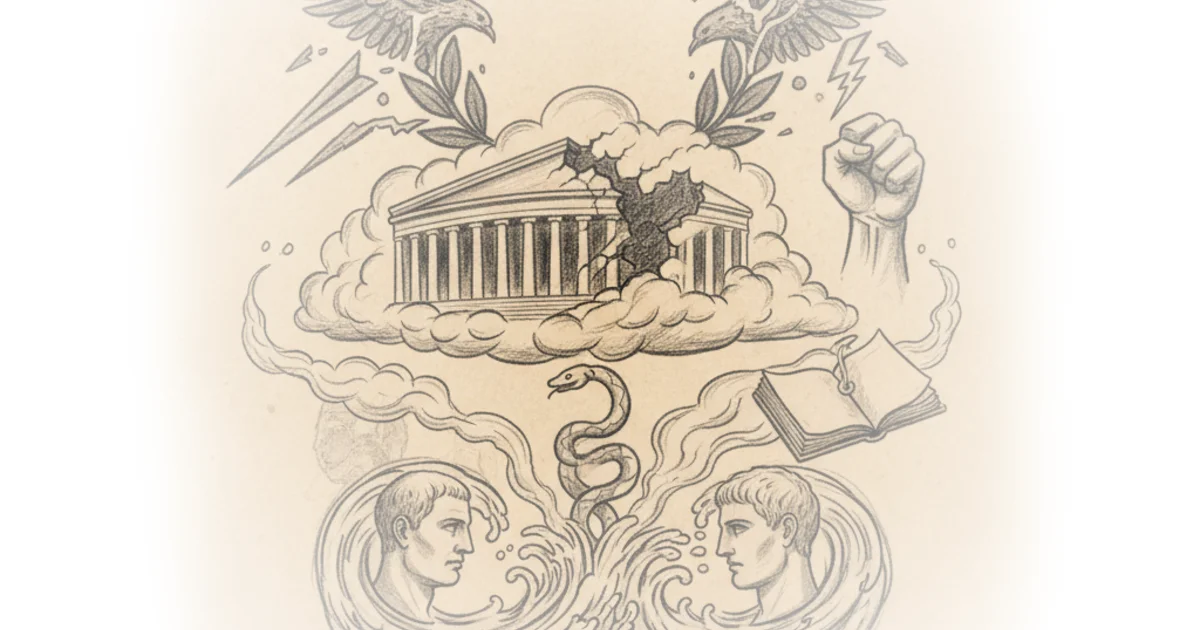
The Senate, desperate to avoid civil war, inadvertently armed its own executioners by pitting rival Caesarean factions against one another.
Critics might argue that the Senate had no viable alternative, as refusing Antony could have sparked an immediate revolt. However, the text suggests their hesitation was less about strategy and more about a paralysis born of conflicting loyalties. The narrative shows how Octavian, initially dismissed as too young, became the pivotal swing vote, leveraging his popularity to pass Antony's law in exchange for future favors—a transaction that would soon turn deadly.
The Fracture of the Caesarean Faction
As the year 43 BC approached, the fragile alliance between Antony and Octavian shattered, revealing the deep personal and political fissures within the Caesarean camp. Kings and Generals describes the tension: "the two men had constantly been at loggerheads but anthony circle had been advising him to reconcile finally seeing the benefit in this anthony and octavian made a temporary alliance." This temporary truce was a marriage of convenience, not ideology. When Antony annulled Octavian's election as a tribune, the betrayal was personal and political, driving Octavian to raise his own private army of veterans under the guise of "bodyguards."
The commentary highlights the brutality of the power struggle, noting that when Octavian's agents sowed discontent among Antony's legions at Brundisium, Antony responded with extreme force. "infuriated anthony rounded up the ringleaders and decimated them this brutal action combined with a larger offered reward was enough to temporarily win the legions back to his side." This detail underscores the precarious nature of loyalty in the late Republic; soldiers were bought and sold, and discipline was maintained through a mix of terror and gold. The author effectively uses this to show that the "war of Mutina" was less about high ideals and more about the survival of warlords.
Meanwhile, the Senate, led by Cicero, played a masterful game of divide and conquer. Kings and Generals writes, "cicero was doubling down on his attacks against anthony and in an impassioned speech in the senate called fantoni to be declared an enemy of the people." By declaring Antony an enemy of the state, the Senate legally empowered Octavian, Hirtius, and Pansa to raise armies, effectively using the young Octavian as a proxy to destroy Antony. The author notes the irony: "the senate which hoped that the two caesareans would wear each other down." This strategy temporarily restored the Senate's authority but ultimately empowered a new dictator.
The Battle of Mutina and the Cost of Ambiguity
The climax of the piece focuses on the Battle of Mutina, where the theoretical legal maneuvering turned into a bloody reality. Kings and Generals sets the scene: "anthony arrived shortly besieging the city and encircling it with walls just as caesar had done at alicia." The siege of Mutina became the focal point where the Senate's new coalition finally confronted Antony's veterans. The narrative emphasizes the psychological weight of the conflict, quoting Appian's description of the battle: "the battle was fought in near silence only broken by groans of pain and the clash of weapons there were no war cries the veterans on both sides knowing that this would do little to." This silence speaks volumes about the tragedy of Romans killing Romans, united by a shared past but divided by a fractured future.
The author details the tactical brilliance and the tragic waste of life, noting how the Martian Legion and Octavian's bodyguards engaged in a fierce struggle against Antony's elite forces. The outcome was a tactical victory for the Senate's coalition, but a strategic disaster. Hirtius was killed, and Octavian, realizing the Senate could now discard him, began to consolidate his own power. The text implies that the victory at Mutina was hollow: "with the senate having assigned all eastern governors to assist him and brutus cassius had managed to gather a huge force of 12 legions." The Liberators had won the battle, but the war for the soul of Rome was far from over.
Bottom Line
Kings and Generals delivers a compelling analysis of how the Roman Republic's institutions collapsed not from a single blow, but from a series of legalistic compromises that empowered warlords. The piece's strongest element is its refusal to romanticize the conflict, instead focusing on the cold calculus of power that drove the Senate to arm Octavian against Antony. The biggest vulnerability in the narrative is the rapid pacing, which occasionally glosses over the complex motivations of the eastern governors and the Pompeian remnants. Readers should watch for how this temporary Senate victory sets the stage for the Second Triumvirate, proving that the war of Mutina was merely a pause in the Republic's death throes.