Rohin Francis reframes exercise not as a chore for vanity, but as the most potent, side-effect-free pharmaceutical intervention available, backed by cellular mechanics that rival the most complex medical technologies. While the medical establishment often focuses on the pathology of heart failure, Francis uses the lens of elite performance to reveal the staggering biological potential hidden within the average human body.
The Free Drug with No Side Effects
Francis opens with a provocative comparison that cuts through the noise of modern pharmacology. "Most medications on the market actually offer a fairly modest benefit and often come with a long list of side effects yet there is one drug that is readily available and offers the following list of benefits," he writes. He lists the outcomes—increased lifespan, reduced cancer risk, improved mood—before revealing the obvious but often ignored source: exercise. This framing is effective because it strips away the mystique of medical intervention, grounding health in a biological imperative that predates modern medicine.
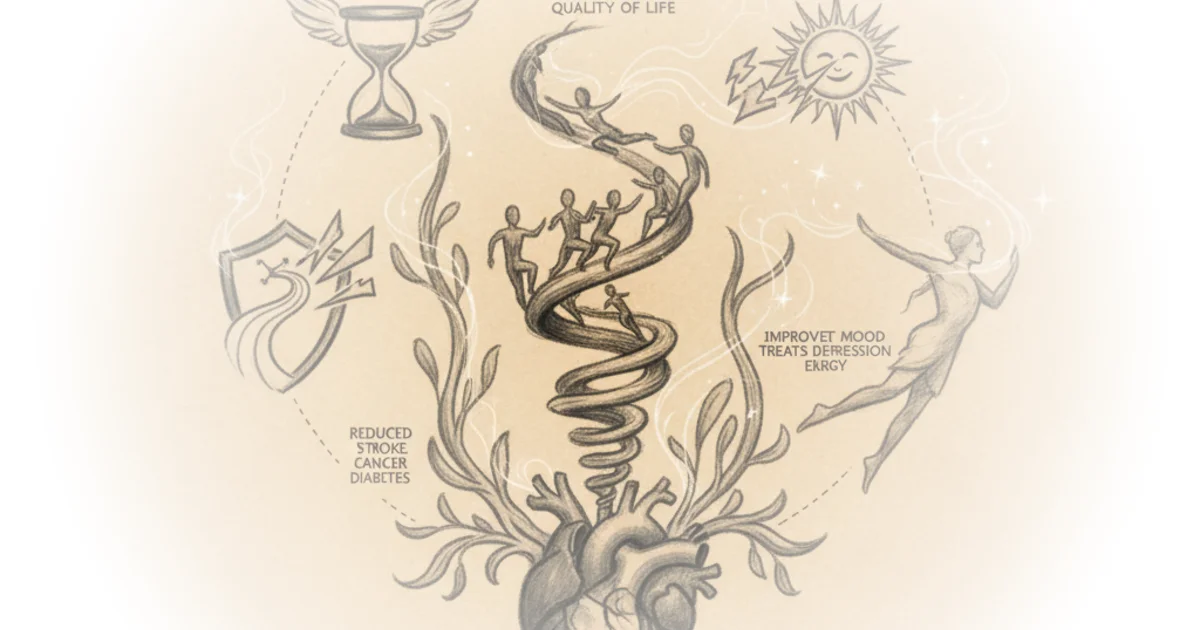
The author argues that while we obsess over DNA inheritance, we overlook the daily agency we have over our physiology. "Aside from maybe choosing what dna to inherit which i trust you all did in between incarnations," Francis quips, acknowledging the limits of our genetic lottery before pivoting to what we can control. The core of his argument is that the cardiovascular benefits are not merely about weight loss or aesthetics, but about a sophisticated, evolutionary process that transforms oxygen into energy at a cellular level.
"Millions of years of evolution have produced an incredibly sophisticated process with a multitude of changes... we refer to having an impaired heart as heart failure, a term that sometimes comes with emotional baggage or implies the wrong thing."
This reframing of "heart failure" is crucial. By shifting the focus from a static diagnosis to a dynamic functional test, Francis highlights how modern medicine often misses the mark by testing patients at rest. He notes that most patients only exhibit symptoms when exerting themselves, making resting tests insufficient for understanding true cardiac capacity.
The Science of Oxygen and Prognosis
To illustrate the depth of this biological machinery, Francis visits Royal Papworth Hospital to observe a cardiopulmonary exercise test (CPET). He explains that this test measures the precise amount of oxygen a person can consume and convert into work, a metric known as peak VO2. The data presented is stark and undeniable. "A vo2 max of greater than 20 translates as only a 5 1-year mortality but a vo2 max of less than 14 predicts an 80 percent one-year mortality," Francis reports.
This statistical chasm underscores the prognostic power of exercise capacity. The author contrasts the typical human range of 30 to 40 with the elite capabilities of sled dogs (150) and thoroughbred horses (190), noting that "human pathetic in cardiology" is a fair assessment of our species' average output compared to nature's other athletes. However, the takeaway isn't to despair over human limitations, but to recognize the massive gap between a failing heart and a healthy one that can be bridged by movement.
Critics might argue that comparing human physiology to sled dogs is a rhetorical flourish that distracts from the clinical reality of heart failure patients. Yet, Francis uses this comparison to drive home a point: the human body is capable of far more than we assume, and the ceiling is often determined by activity levels, not just genetics.
Visualizing the Heart in Motion
Moving beyond gas exchange, Francis introduces exercise echocardiography, an ultrasound performed while the patient pedals a bike. This technology allows doctors to see the heart's pumping function under stress, revealing issues that remain invisible at rest. "You can scan someone's heart at rest it can look quite normal even if they have severe cardiac impairment which is why exercise tests are so useful," he explains.
The commentary details how a healthy heart triples its cardiac output during exercise, a feat driven by both heart rate and stroke volume. In contrast, patients with heart failure often have a "blunted" response, unable to expand the heart's filling phase (diastole) or squeeze effectively (systole). Francis highlights the elegance of this system: "In a healthy heart you will see heart rate go up along with the stroke volume... being able to increase your stroke volume adequately relies on expanding your heart in diastole to get lots of blood in then squeezing it small in systole ejecting lots of blood out."
"The 80 is the level above which pyruvate which is a breakdown product of anaerobic metabolism is produced faster than it can be used aerobically... and that is the burn that personal trainers like to torture you with."
By explaining the anaerobic threshold and the resulting acidosis, Francis demystifies the physical sensation of "the burn." He frames this not as pain to be avoided, but as a signal of metabolic intensity. This is a vital distinction for busy readers who might otherwise view discomfort as a sign to stop, rather than a sign that the body is engaging its deepest energy systems.
The Myth of the Elite Athlete
Perhaps the most empowering section of the piece is the dismantling of the idea that one must be an Olympian to reap these benefits. Francis explicitly rejects the culture of extreme fitness. "I want to send is that exercise doesn't have to be triathlons or iron man or woman events or marathons," he states. He advocates for walking the dog, dancing, or playing with kids as valid, potent forms of medicine.
He warns against the paralysis of perfectionism: "You don't need to collapse in a sweaty heap attempting to do a bad impression of david goggins... any exercise is better than no exercise." This advice is particularly relevant for the busy professional who might feel that unless they can dedicate an hour to high-intensity training, they are wasting their time. The evidence suggests that the biological machinery Francis described is triggered by any movement that elevates the heart rate, regardless of intensity.
Bottom Line
Francis's strongest argument is the recontextualization of exercise from a lifestyle choice to a fundamental physiological necessity, supported by hard data on mortality and cardiac output. The piece's biggest vulnerability is its reliance on the reader accepting that they can consistently integrate this "drug" into a busy life, a hurdle that is behavioral rather than biological. The reader should watch for emerging research on the specific signaling networks between exercise, bone, and fat, which Francis hints at as the next frontier in understanding this "magic."
"Any exercise is better than no exercise. Don't be put off by the idea it has to be intense."
The ultimate verdict is clear: the most advanced medical technology in the world cannot replicate the systemic benefits of moving the body, yet we often treat it as an optional extra rather than the cornerstone of health.