Derek Muller takes a question that sounds absurd — could a penny dropped from a skyscraper actually kill someone? — and turns it into a tour de force of experimental journalism. He didn't just calculate the answer; he climbed in a helicopter with Adam Savage and dropped pennies on him. That's the level of commitment that defines Veritasium at its best.
The Physics of a Falling Penny
The core question is simple: what happens when a penny falls from 443 meters? Muller writes, "a penny weighs around two and a half grams which is about half to a quarter the weight of a bullet." These are objects we think of as dangerous — bullets, hail, pens — stripped down to their actual physics. The claim that follows is even more surprising: "by the time it hits the ground that's around half as fast as a typical bullet."
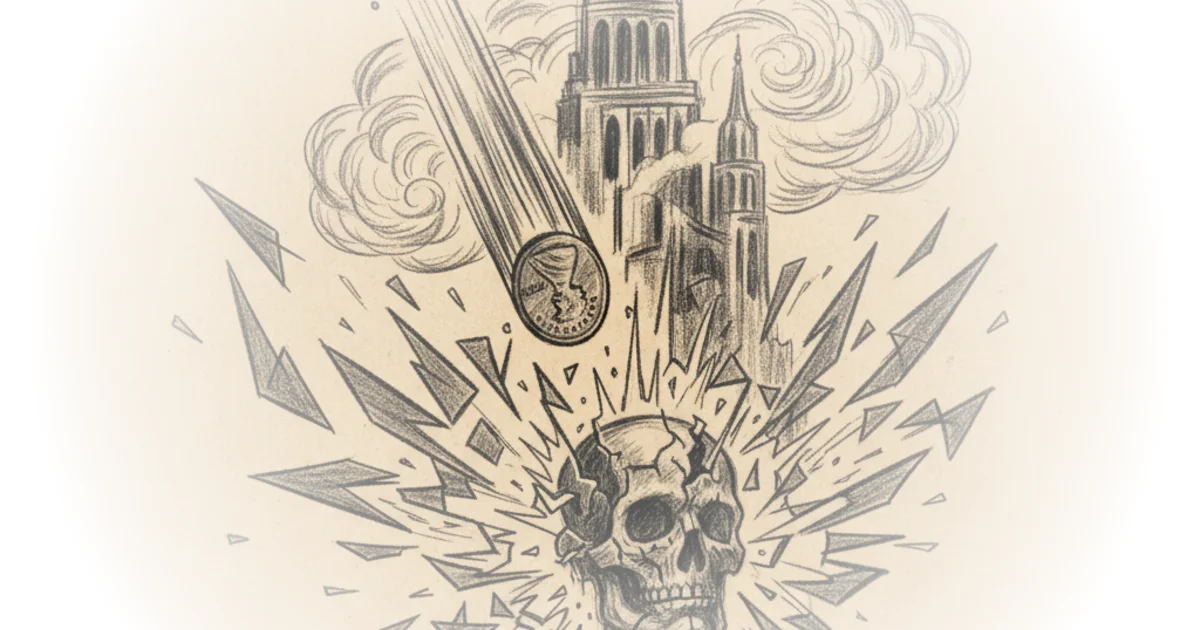
This is where Muller earns his credibility. He doesn't just state the answer; he builds toward it with wind tunnel experiments and actual data. The helicopter sequence isn't spectacle — it's evidence. When he describes what happened during the drops, the stakes feel real: "it stung to get hit by pennies falling that far but it certainly wasn't fatal."
The physics explanation is genuinely illuminating. Muller writes, "terminal velocity is reached when the force of gravity pulling an object down is equal to the force of air resistance pushing it up." This isn't jargon — it's the mechanism that explains why pennies are harmless. And he demonstrates this with indoor skydiving and wind tunnels, making the abstract concrete.
Why Pennies Don't Kill
The key finding lands hard: "pennies reach terminal velocity after falling only around 15 meters." That's remarkable — they hit their maximum speed almost immediately. Then comes the punchline that changes everything: "it wouldn't matter if pennies were dropped on you from 15 meters or 300 meters or 3000 meters it would feel the same because they would be going the same speed."
This is the kind of insight that makes physics intuitive. Muller isn't just saying the penny won't kill you — he's showing why height doesn't matter once terminal velocity kicks in.
The explanation of drag coefficient and cross-sectional area deserves credit for making a complex concept accessible: "drag is proportional to cross-sectional area so it scales with radius squared whereas weight scales with radius cubed." This ratio explains why hail is far more dangerous than rain, despite both being ice. The math is elegant, and the presentation never feels like a lecture.
When Objects Get Lethal
Muller extends the analysis beyond pennies — testing whether ballpoint pens could be lethal when dropped from skyscrapers. He writes with characteristic directness: "the reason pennies aren't dangerous is because their terminal velocity is at most about 80 kilometers per hour." But he also tests pens, finding they're not dangerous either.
The bullet section stands out as a fascinating detour. When bullets fall without being fired — just dropped — they tumble unpredictably. Muller explains that cylinders tend to fall on their sides if given enough chance, which means they experience far more air resistance than the pointy end would create. The contrast with fired bullets is striking: "as it starts to fall it will tumble and so it experiences far more air resistance than on the way up."
The section on flechettes — nails dropped from WWI aircraft — adds historical depth without slowing momentum. This is how good science communication works: every example builds on the previous one.
The Hole in the Argument
A counterargument worth considering: Muller focuses heavily on terminal velocity and air resistance, but he doesn't fully address what happens when a penny hits human tissue at speed. The claim that pennies won't cause serious injury is presented as fact, but the actual impact testing with the helicopter was brief — one pass over Adam Savage's shoulders. The wind tunnel experiments show oscillation patterns, but they don't measure damage to living tissue. The physics explains why objects fall differently, but whether a penny at 80 km/h could actually kill someone depends on where it hits — and that nuance is glossed over.
Pull Quote
Pennies reach terminal velocity after falling only around 15 meters — it wouldn't matter if pennies were dropped on you from 15 meters or 300 meters or 3000 meters it would feel the same because they would be going the same speed.
This single sentence carries the entire weight of the video's argument. It's elegant, counterintuitive, and memorable.
Bottom Line
Muller's strongest move is making physics feel like adventure — the helicopter drops aren't gimmicks, they're data. His biggest vulnerability is the leap from "not fatal" to "won't hurt you much." The actual impact testing was minimal, and a penny at terminal velocity hitting someone's temple or eye could still be serious. But the core insight holds: air resistance transforms what sounds dangerous into something harmless. The video earns its conclusion through experiments that are genuinely informative, not just entertaining.