Mark Koyama delivers a rare treat for the busy intellectual: a review that treats economic history not as a dusty archive, but as a living laboratory for understanding why the modern state exists. While most analyses obsess over how the Industrial Revolution started, Koyama highlights how Walker Hanlon's new book flips the script to ask why the era of limited government inevitably collapsed under the weight of its own success. This is not just a history lesson; it is a forensic audit of the trade-offs between market freedom and human welfare that remains startlingly relevant today.
The Paradox of Success
Koyama immediately establishes that Hanlon's work is an anomaly in a field increasingly dominated by applied econometrics. He notes, "Economic history is distinct as perhaps the only subfield in economics where publishing a book is still somewhat normal or perhaps even expected for a senior scholar." This distinction matters because Hanlon's narrative relies on deep archival immersion rather than just data scraping. The core thesis is deceptively simple: the mid-19th century British experiment in laissez-faire was a brilliant solution to the wrong problem. As Koyama summarizes, "Hanlon suggests that laissez-faire was an appropriate economic philosophy in this context: 'across the first half of the nineteenth century, Britain's laissez-faire system was successful. Economic growth was booming, and the benefits were accruing not only for the rich but also for average workers.'"
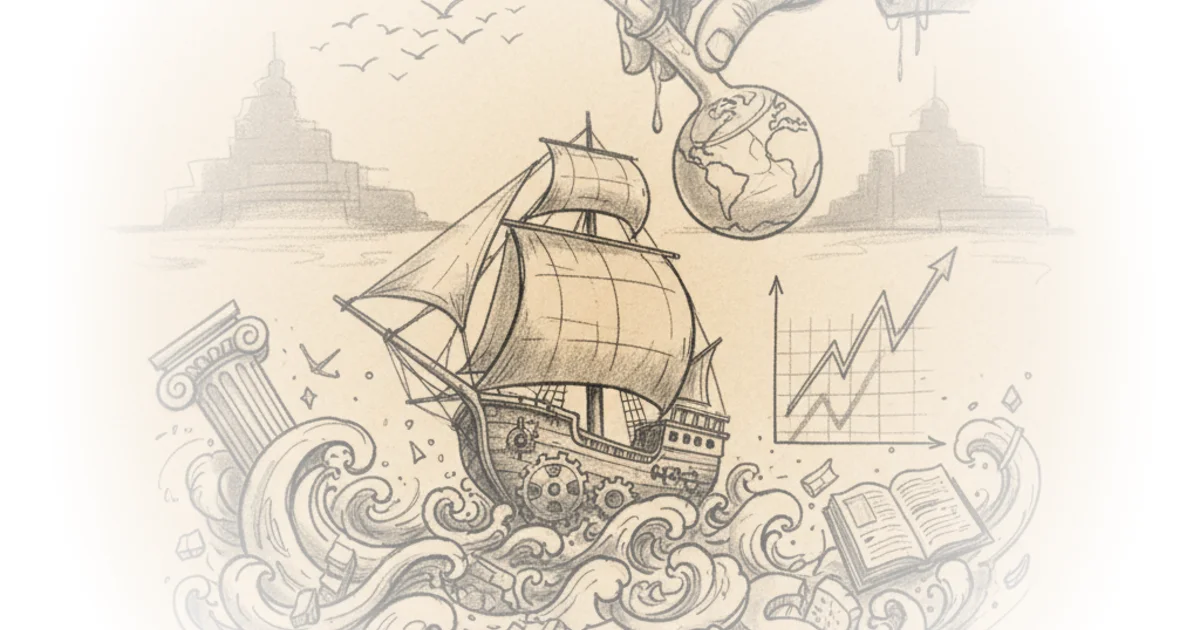
The brilliance of this framing is that it grants the classical liberals their due. They weren't wrong about the 1820s; they were right to dismantle the archaic protections of the fiscal-military state. However, Koyama points out that the very success of this system created new, unmanageable pathologies. The rapid urbanization that drove growth also generated a "large health penalty to urban living in the 19th century," turning cities into death traps due to overcrowding and pollution. The market, left to its own devices, could not solve these externalities.
Rapid urbanization brought new problems of overcrowding, sanitation, disease control, and pollution. The market, left to its own devices, could not solve these externalities.
Critics might argue that Hanlon overstates the inevitability of state intervention, but the evidence of market failure is overwhelming. Koyama writes, "Increasingly severe market failures in the form of externalities from pollution, asymmetric information in a range of markets made government intervention potentially welfare enhancing." The book effectively demonstrates that the shift away from non-interference wasn't an ideological betrayal, but a pragmatic necessity forced by the changing nature of the economy.
The Collapse of Private Safety Nets
Perhaps the most compelling section of Koyama's commentary addresses the failure of private charity and mutual aid. Before the modern welfare state, workers relied on "friendly societies" and local parish relief. Koyama explains that these systems worked fine for localized, idiosyncratic shocks. But the industrial economy created systemic risks that no private group could absorb. He illustrates this with the Lancashire Cotton Famine, a crisis triggered by the American Civil War that devastated the region's single-industry economy.
The scale of the disaster was staggering. Koyama notes, "In towns like Blackburn and Preston between 30-50 percent of the population were on poor relief by late 1862." Local parishes, the traditional unit of relief, were financially bankrupted by the sheer concentration of need. The existing infrastructure of voluntary aid, while generous, was "widespread recourse to charity and voluntary aid but this, though generously provided, was often unreliable and difficult to coordinate." Hanlon's data shows that the old model of localized insurance simply could not handle a geographically concentrated exogenous shock. The state had to step in, not because politicians wanted more power, but because the alternative was mass starvation.
Koyama draws a sharp parallel to another historical tragedy to underscore the point: "The most tragic example of a highly concentrated exogenous shock in the mid-19th century was the Irish potato famine, for which existing forms of relief were entirely inadequate." The lesson is clear: when the economy becomes too complex and interconnected, the risk pooling required to protect citizens exceeds the capacity of private institutions. This is a powerful argument for the necessity of the modern administrative state, grounded in hard data rather than ideology.
The Myth of the Laissez-Faire Consensus
While praising Hanlon's economic rigor, Koyama offers a sharp critique of the book's political economy. He argues that Hanlon treats "laissez-faire" as a monolithic philosophy that was gradually abandoned, when in reality, it was never a coherent doctrine to begin with. Koyama writes, "Classical liberalism has never been identical to laissez-faire because classical liberal thinkers have always recognized areas where government intervention is required." He points to figures like Edwin Chadwick, a utilitarian who was instrumental in building the modern public health system, as evidence that the intellectual landscape was far more nuanced.
The review suggests that Hanlon's framing oversimplifies the intellectual history. "Hanlon's narrative is of liberal, laissez-faire inclined policymakers and thinkers confronting the reality of widespread market failure and gradually adapting their policies," Koyama observes. But this ignores the fact that many of these thinkers were already predisposed to technocratic intervention. Koyama cites the historian Brebner to make the point: "Jeremy Bentham and John Stuart Mill, who have been commonly represented as typical, almost fundamental, formulators of laissez faire, were in fact the exact opposite, that is, the formulator collectivist ends and his devout apostle."
This is a crucial distinction. If the shift to the welfare state was driven by people who were already comfortable with state power, then the narrative of a sudden ideological conversion is flawed. Koyama pushes back, suggesting that "a deeper investigation of the ideas and writings of the classical economists and associates like Chadwick will reveal a more forthright commitment to policies of amelioration and improvement rather than what is conventionally meant by the term laissez-faire." By glossing over these internal debates, Hanlon misses the rich texture of the political struggle that actually shaped the modern state.
Hanlon's narrative is of liberal, laissez-faire inclined policymakers and thinkers confronting the reality of widespread market failure and gradually adapting their policies and intellectual principles.
Furthermore, Koyama notes that the book underplays the role of conflict between interest groups. The rise of the state wasn't just a rational response to market failure; it was also a political battleground. "Political economy is about heterogenous preferences and Hanlon's framing in terms of an unmet nascent demand for education or for regulations abstracts from these conflicting preferences," Koyama argues. The failure to tackle coal pollution, for instance, wasn't just a technical oversight; it was the result of powerful coal interests blocking regulation. By focusing so heavily on the efficiency of policy, Hanlon risks presenting the rise of the state as a technocratic inevitability rather than a contested political victory.
Bottom Line
Mark Koyama's review of The Laissez-Faire Experiment is a masterclass in economic history, successfully arguing that the modern welfare state was a necessary adaptation to the systemic failures of industrial capitalism. Hanlon's data on the collapse of local relief systems during the Cotton Famine provides an irrefutable case for why private charity could not scale to meet industrial risks. However, the argument's greatest vulnerability lies in its treatment of political ideology; by smoothing over the complex, often contradictory beliefs of 19th-century thinkers, the book risks presenting the rise of the state as a purely rational evolution rather than a messy political contest. For the busy reader, this is a vital reminder: the institutions we take for granted were forged in the fires of genuine crisis, not abstract theory.