Brad DeLong amplifies a crucial warning: the next wave of election denialism won't just be about stolen votes; it will be about mistaking algorithmic hype for democratic reality. By dissecting the 2026 Los Angeles mayoral primary, the piece exposes how "viral" momentum can create a false consensus that collapses under the weight of actual ballot counting, providing a blueprint for future fraud narratives. This is not merely about one candidate's loss; it is an analysis of how the executive branch and state institutions must prepare for a specific type of cognitive dissonance where online engagement is weaponized to delegitimize standard administrative procedures.
The Majority Illusion and the Feed
DeLong argues that we are witnessing a dangerous conflation of social media metrics with electoral viability, a phenomenon scientists call the "majority illusion." He writes, "Your social media feed is dominated by the loudest, best-connected nodes. Their opinions can feel like the majority consensus even when it's not." This framing is essential because it shifts the blame from malicious actors alone to the structural design of platforms that amplify extreme voices. The author illustrates this with the case of Spencer Pratt, a reality TV figure whose campaign was fueled by clips and memes rather than traditional ground game.
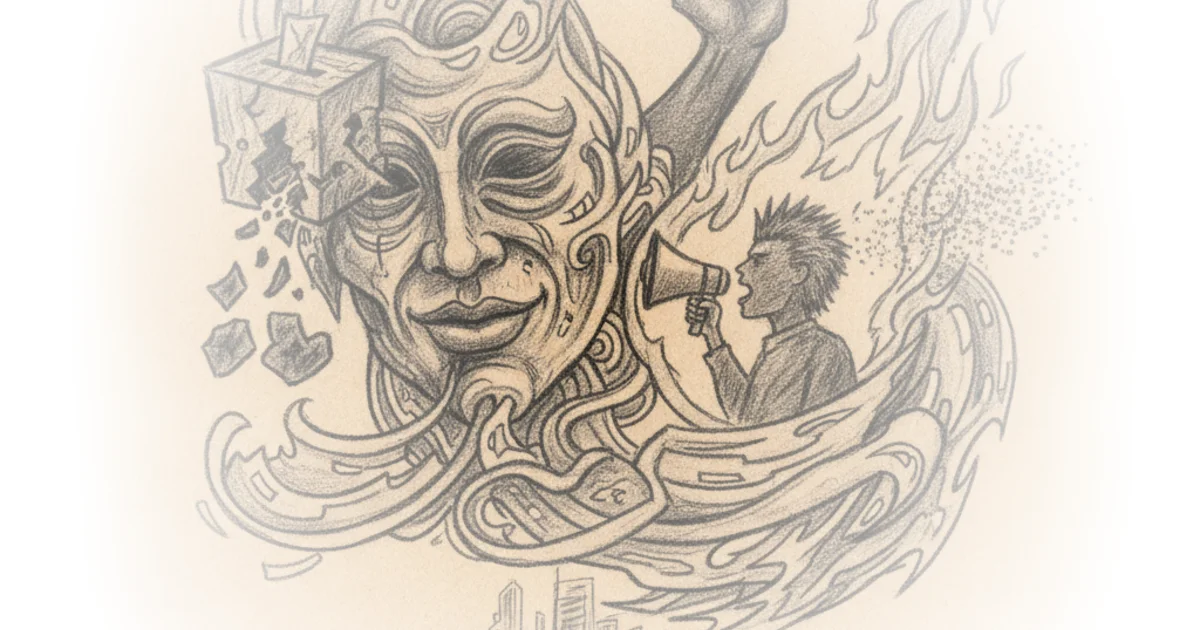
The commentary suggests that this dynamic creates a self-reinforcing loop where supporters believe their curated feed represents the entire electorate. DeLong notes, "When your feed is wall-to-wall Pratt — clips, endorsements, memes, weird AI propaganda — it is easy to slide from 'Pratt is popular online' to 'Pratt is popular.'" This observation lands with particular force when contrasted with actual polling data, which showed Pratt trailing significantly despite his digital dominance. The piece effectively highlights a vulnerability in modern democracy: the gap between perceived public opinion and measured voter intent.
Critics might argue that focusing on "online cope" lets actual bad actors off the hook for deliberately sowing confusion. However, DeLong's point is precisely that the ecosystem relies on this psychological bridge; without the genuine belief of supporters who think their feed is real, the conspiracy theories lack traction. The distinction between a manufactured narrative and a genuinely held delusion born of algorithmic distortion is subtle but critical for understanding how to counter it.
"A clip with three million views just tells you the clip did numbers online, and presumably a lot of people who liked it are nowhere near Los Angeles."
The Mechanics of the Red Mirage
The piece then pivots to the technical reality that fuels these conspiracy theories: the predictable timeline of mail-in ballot processing. DeLong explains that this is not a plot but a feature of systems with high mail-voting usage, where early in-person votes (often Republican) are counted before later-arriving mail ballots (often Democratic). He writes, "Republican voters are more likely to vote in person. Democratic voters are more likely to vote by mail... As those later ballots are added, a Republican lead can shrink."
This section is vital for readers trying to distinguish between legitimate administrative delays and manufactured crises. DeLong points out that election deniers have learned to use this "red mirage, blue shift" dynamic as a "fraud-accusation template whenever their preferred candidate's early lead shrinks." The author draws on historical context, noting that in November 2022, Republican Rick Caruso led Karen Bass by over 12,000 votes before mail ballots were fully processed, only for her to eventually win by nine points. This precedent underscores that the current panic is a repeat of a known pattern, not an unprecedented anomaly.
The commentary emphasizes that officials like Governor Ron DeSantis are leveraging this predictable shift to imply fraud without evidence. As Brad DeLong puts it, "DeSantis, who is a governor, gets to gesture at fraud without having to produce any evidence of it." This highlights the institutional challenge: when high-ranking officials validate baseless claims, they erode public trust in the very mechanisms designed to ensure fair elections. The piece suggests that the solution lies not just in faster counting, but in better public education about how vote tabulation works.
Prediction Markets and the Coping Mechanism
Finally, DeLong addresses the bizarre role of prediction markets in this ecosystem. He observes that some observers are interpreting market corrections against a candidate as proof of rigging, rather than as rational updates based on new data. "The whole premise is that the market updates as new information comes in," he writes, noting that prices should theoretically cut through the noise. Instead, these markets have become another tool for "cope," allowing supporters to maintain their delusion that the feed's narrative must be true.
This analysis of prediction markets adds a sophisticated layer to the argument, showing how even financial tools are being repurposed to support conspiracy theories. The author notes, "Prices should cut through the cope." Yet, in an environment where emotional investment outweighs rational analysis, these markets fail to correct the narrative. This failure is symptomatic of a broader issue where truth is secondary to identity and tribal signaling.
"A fraud narrative can be a comforting bridge between those two things: it lets supporters continue to trust their perception."
Bottom Line
DeLong's most compelling contribution is the identification of "online cope" as a driver for election denialism, linking the psychological need to validate one's digital reality with the political weaponization of vote-counting timelines. The argument's greatest strength lies in its use of concrete historical precedents, like the 2022 LA mayoral race, to demystify current events. However, the piece faces a challenge in reaching the very audience it seeks to correct: those who have already accepted the "majority illusion" as truth. The reader should watch for how the administration and state election officials adapt their communication strategies to pre-empt these predictable narratives before they gain traction in 2026.