Chris Chappell delivers a startling assessment of American military readiness: the United States could lose a kinetic conflict with China in just thirty days. This isn't a hypothetical scenario drawn from a wargame simulation alone, but a conclusion backed by a massive data-driven study that the Pentagon itself deemed sensitive enough to demand redactions. For a busy reader tracking global stability, this piece cuts through the noise of political posturing to expose a terrifying logistical reality: the US military is running on fumes and empty magazines.
The Logistics of Defeat
Chappell anchors his argument in the Heritage Foundation's "Title 10" study, which utilized artificial intelligence to synthesize over 7,000 data sources. The findings are stark regarding the two pillars of modern warfare: fuel and munitions. "When it comes to fuel, the study shows that the US is absolutely screwed," Chappell writes, noting that the Navy relies on a tiny fleet of aging oilers to meet the entire Indo-Pacific demand. This is not a minor supply chain hiccup; it is a cascading failure waiting to happen. The author points out that the US faces a critical shortage of cargo capacity, leaving above-ground storage tanks dangerously exposed to potential strikes.
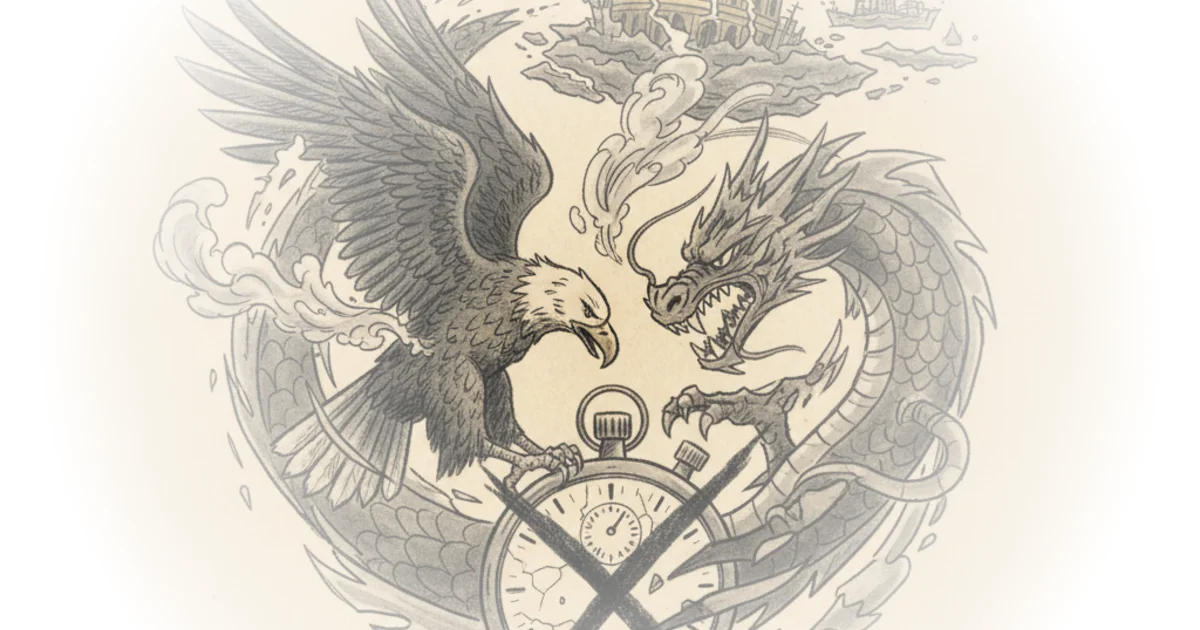
The situation regarding ammunition is even more precarious. Chappell highlights that precision-guided munitions, specifically long-range anti-ship missiles, could be depleted in about one week. "Precision guided missiles like long range anti-ship missiles are depleted in about one week," he notes, a timeline that leaves no room for a prolonged campaign of attrition. The core of the argument is that the US has hollowed out its manufacturing base and logistical tail, creating a force that is powerful but fragile. Critics might note that war is inherently unpredictable and that enemy capabilities are often overestimated in such models, but the sheer scale of the inventory gap described here is difficult to dismiss.
The US looks like it would lose platforms, ammunition, and/or fuel more than two times faster than China, meaning that it may reach the point where it can no longer continue operations fast.
The Mutual Vulnerability
However, Chappell refuses to paint a one-sided picture of American weakness. He pivots to China's own Achilles' heel: its desperate dependence on imported oil. "Imports made up over 70% of China's total oil consumption in 2023," he explains, with the vast majority funneling through the narrow choke point of the Strait of Malacca. This creates a scenario of mutually assured logistical destruction. If the US cannot sustain its fleet, China cannot sustain its economy or its military machine if its oil lines are severed.
The commentary effectively reframes the conflict from a simple clash of firepower to a battle of supply lines. Chappell argues that the US could exploit China's unhardened refineries and fixed pipeline networks, which lack redundancy. "Rebuilding them wouldn't be easy either," he writes, emphasizing that these facilities are so complex they cannot simply be turned off and on again without catastrophic complications. This section is particularly compelling because it identifies specific, high-value targets that are often overlooked in favor of discussing aircraft carriers and stealth bombers.
Yet, the argument also acknowledges China's counter-strength: its ability to mass-produce missiles. "China knows that it likely cannot beat the US head-on, which is why it's put so much emphasis on building up the ability to produce missiles at a much faster rate than the US," Chappell observes. While the US struggles with production capacity, China leverages state-owned conglomerates to flood the market with projectiles. This asymmetry suggests that while the US might win the initial engagement through quality, it risks losing the war of attrition through quantity.
The Bottom Line
The strongest part of Chappell's coverage is its refusal to rely on political rhetoric, instead focusing on the hard math of fuel tankers and missile inventory. The biggest vulnerability in the argument, however, is the assumption that a conflict would play out exactly as the model predicts without diplomatic de-escalation or unforeseen technological breakthroughs. Readers should watch for how the administration addresses these specific logistical gaps, as the gap between current readiness and the demands of a great power conflict is now a matter of public record.
Unless you're running a vintage axe and long ship campaign, no one expects Vikings.
Bottom Line
Chappell's analysis serves as a crucial reality check, stripping away the illusion of American invincibility to reveal a military stretched thin by decades of underinvestment in logistics and manufacturing. While China faces its own severe vulnerabilities regarding energy security, the window for the US to correct its course is rapidly closing. The most urgent takeaway is not that war is inevitable, but that the current trajectory makes a decisive victory for the US unlikely without a massive, immediate overhaul of its supply chains.