Most coverage of Sudan reduces the world's largest displacement crisis to a statistic of 150,000 dead and 12 million displaced, treating the conflict as a distant tragedy. Kahlil Greene, writing for History Can't Hide, refuses this erasure by centering the narrative on the diaspora's creative resistance and the specific cultural lineage of the Sudanese people. This piece is notable because it shifts the gaze from the violence of the Rapid Support Forces to the quiet, persistent labor of those rebuilding identity in exile.
The Architecture of Loss
Greene sets the stage by contextualizing the current war not as an isolated event, but as the latest chapter in a century of interrupted sovereignty. He notes that the paramilitary group at the heart of the violence, the Rapid Support Forces, "traces its lineage directly to the Janjaweed, the militia responsible for the Darfur genocide that began in 2003." By linking the current atrocities to the historical precedent of the Janjaweed, Greene forces the reader to confront a pattern of international inaction that has persisted for two decades. This framing is essential; without it, the current suffering appears as a random outbreak rather than a systemic failure of global accountability.
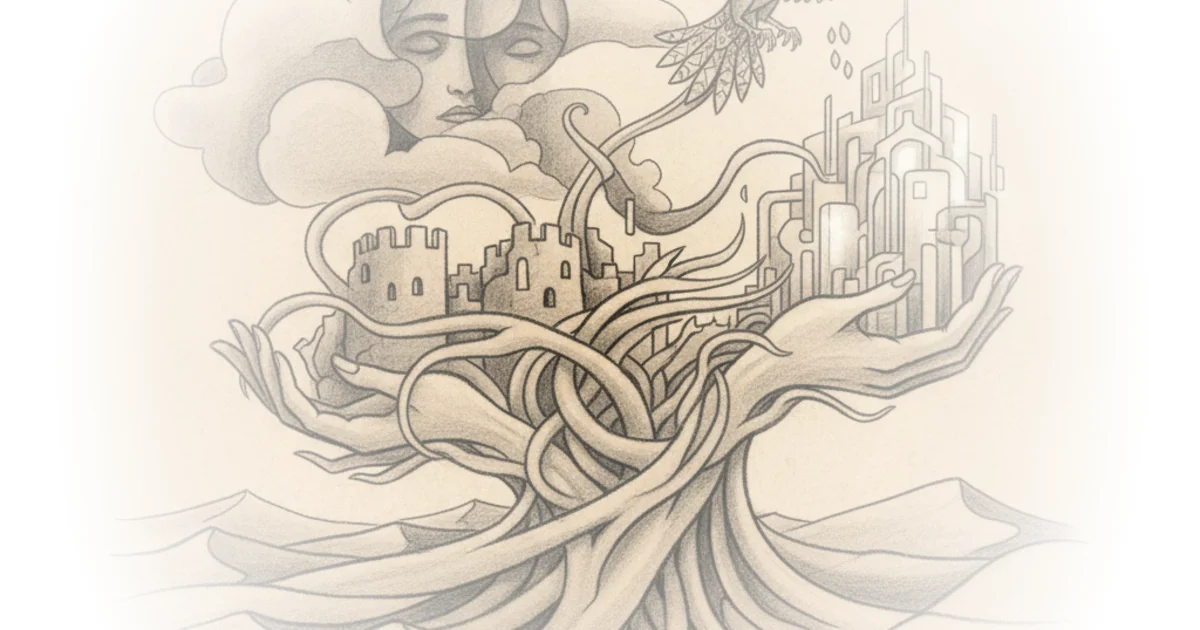
The author highlights how the 2019 revolution, which ousted the thirty-year dictatorship of Omar al-Bashir, was powered by a specific cultural memory. "Sudanese women, students, and labor organizers filled the streets demanding civilian rule, invoking what Marwa describes as the legacy of the Kandakas, the revolutionary matriarchs of Nubian history." This reference to the Kandakas is not merely decorative; it grounds the modern political struggle in a deep, pre-colonial history of female leadership, countering the narrative that Sudan is simply a failed state. Critics might argue that focusing on historical matriarchs risks romanticizing a struggle that is currently being met with brutal force, but Greene uses this history to explain the resilience of the protesters rather than to minimize their current suffering.
"Sudan has been in crisis for the last three years, but really for much longer. Modern Sudanese history has been shaped by interruption."
The Diaspora as a Site of Resistance
The commentary then pivots to the personal essay by Marwa Eltahir, which Greene introduces as a reflection on what the war has taken and what is being built in its wake. Greene argues that the diaspora is not just a collection of refugees, but a dynamic cultural force. "The ability to escape became its own kind of privilege, shaped by access to visas, money, and networks," Greene writes, acknowledging the harsh realities of migration while celebrating the community that forms from it. This distinction is crucial; it avoids the trap of viewing the diaspora solely as victims, instead presenting them as agents of cultural preservation.
Eltahir's narrative, as curated by Greene, describes the tension of living in an "in-between space." Greene paraphrases her experience of the diaspora as a place where "the tension between my life as a Black American girl and my identity as a Muslim Sudanese daughter became more pronounced." Yet, he notes that this fragmentation has transformed into a unique strength. "What once felt like fragmentation now reveals itself as range," Greene observes, highlighting how the collision of cultures has produced new forms of art and organizing. This is a powerful reframing: the displacement that the administration and international bodies view as a humanitarian disaster is, for the community, a catalyst for innovation.
The piece details the creation of "Our Political Home," an incubator for trans and queer African storytellers. Greene emphasizes that this work is about more than just art; it is about survival. "With the support of organizations such as RIVET, I am able to continue building the platform of OPH as a safe space that fills the gap in connecting trans & queer storytellers across the diaspora to explore how identity, migration, and memory shape the way we understand power, home, and politics." This quote underscores the intersectional nature of the diaspora's work, challenging the monolithic view of Sudanese identity often presented in Western media.
"To belong to multiple worlds at once, to navigate the West and the East, to translate, reinterpret, and carry forward."
The Cost of Erasure
Despite the focus on resilience, Greene does not shy away from the devastation. He lists the tangible losses: "Homes abandoned in haste. Family heirlooms left behind. Museums looted. Archives buried under rubble." The mention of looted museums is particularly poignant given Sudan's status as home to more pyramids than Egypt; the destruction of these sites represents an attack on human history itself. Greene writes, "Entire histories interrupted," a phrase that carries the weight of centuries of Meroitic script and cultural heritage being erased by modern warfare.
A counterargument worth considering is whether focusing on cultural production might inadvertently distract from the urgent need for military intervention or diplomatic pressure to stop the fighting. However, Greene anticipates this by framing the cultural work as a form of resistance that refuses to let the world look away. "The challenge is rarely a lack of impact. It's a lack of visibility," he concludes, suggesting that the diaspora's primary battle is to ensure their story is told before it is silenced forever.
Bottom Line
Greene's commentary succeeds by refusing to let the genocide in Sudan become a footnote in global news, instead weaving a narrative that honors the depth of the loss and the sophistication of the response. The strongest part of this argument is its refusal to separate the cultural from the political, showing how art and memory are vital tools for a people under siege. The biggest vulnerability lies in the sheer scale of the tragedy, which no amount of cultural preservation can fully mitigate, but Greene's focus on the diaspora's agency offers a necessary counter-narrative to the despair that often defines coverage of the region.