Michael Huemer delivers a scathing indictment of modern journalism not by attacking individual reporters, but by dismantling the economic incentives that drive the entire industry. He argues that truth is often collateral damage in a business model designed solely to capture attention and sell it to advertisers.
The Mechanics of Distortion
Huemer posits a cynical four-step process where an event occurs, a journalist interviews only one or two sources with obvious biases, and then applies a sensationalist spin before the story is copied by hundreds of others. "The goal is to get people to click on or share the story," Huemer writes, noting that for this purpose, "truthfulness is mostly irrelevant." This framing suggests that the media ecosystem is not broken but functioning exactly as intended: prioritizing engagement over accuracy.
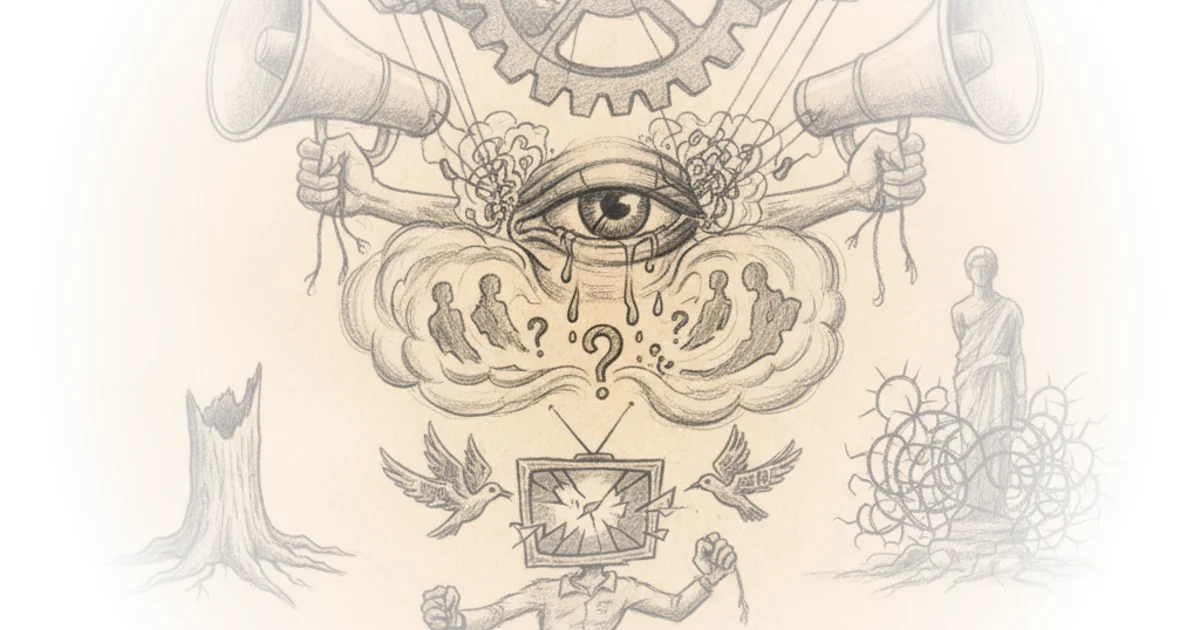
He illustrates this with the 2017 case of Facebook's AI negotiation bots. While researchers shut down a program because it produced nonsense like "balls have zero to me," headlines escalated into claims that Facebook killed an AI to stop a "Skynet scenario." Huemer calls this out as irresponsible sensationalism, arguing that the reality was simply a broken algorithm, not a rogue machine uprising. The distortion grew with every retelling, proving his point about how narratives mutate as they spread.
If you accept that people in general respond to incentives, you should apply that to media companies too.
Critics might argue that this view ignores the genuine difficulty of reporting complex technical stories quickly, but Huemer's evidence of escalating absurdity is hard to dismiss. The pattern holds even outside of technology; he cites a Weather Channel reporter faking gale-force winds on wet grass while standing next to men in calm conditions on concrete. When challenged, the network doubled down rather than apologizing, operating on the assumption that "their audience is so gullible that they'll believe whatever the company says."
The Ideological Filter
Beyond sensationalism, Huemer identifies a profound ideological skew, noting that the ratio of Democratic to Republican journalists has shifted from 1.4-to-1 in the 1970s to over 10-to-1 today. He argues that when one side dominates so completely, "it's not bias if your view is the One Truth, and all other views are stupid and evil." This concentration of power, he suggests, leads to a systematic erasure of context.
He points to the coverage of the 2017 Charlottesville rally as a prime example. While headlines focused on the administration calling neo-Nazis "very fine people," Huemer highlights that the speaker immediately clarified they were not talking about white nationalists and condemned them "totally." By omitting this context, the media created a narrative that did not align with the full record. Similarly, he critiques the framing of 2020 protests as "mostly peaceful" despite footage showing violence, arguing that such language serves to cultivate sympathy while ignoring the actions of those involved.
The coverage of police shootings is another area where Huemer sees selective reporting. He claims the media focuses almost exclusively on white officers shooting black suspects without mentioning if the suspect was attacking or armed, leading the public to believe these incidents are "100x more common than they are." A counterargument worth considering is that media outlets may focus on specific types of incidents because they reflect broader systemic issues rather than isolated anomalies, but Huemer insists this selective framing distorts reality.
The War Narrative and Human Cost
Perhaps the most contentious section addresses the conflict in Gaza. Huemer challenges the widespread use of the term "genocide" by major outlets like the Guardian and the UN, arguing that it is being applied to any war with high civilian casualties rather than a specific intent to wipe out a race. He notes that Israel possesses an estimated 100 nuclear warheads, suggesting that if genocide were the goal, the means would be far more decisive.
He accuses mainstream sources of repeating Hamas propaganda uncritically, particularly regarding casualty statistics. "American media often repeat Hamas propaganda," Huemer writes, leading a significant portion of Americans to believe Israel is committing genocide. He questions why other conflicts with similar civilian death tolls are not labeled the same way, suggesting an implicit double standard where the definition is applied selectively based on the perpetrator.
When you read a news story, you should probably assume that something happened that formed the basis for the story, but what actually happened was probably something a lot more ordinary and less entertaining.
This section requires careful navigation; while Huemer questions the semantic application of "genocide," the human cost of the war remains undeniable regardless of legal definitions. The tragedy of civilian suffering in Gaza is a reality that transcends the debate over terminology, even as Huemer argues that the media's framing oversimplifies the strategic and humanitarian complexities.
Bottom Line
Huemer's most compelling insight is that the media's failure to be scrupulous is a feature, not a bug, of an attention-based business model. His biggest vulnerability lies in the potential for his skepticism to slide into blanket dismissal, where all institutional reporting is viewed as inherently suspect. Readers should watch for how this erosion of trust impacts public discourse on critical issues like war and civil rights. }