Where Mysticism Meets the Toolbox
This essay from Wayfare Magazine attempts something genuinely ambitious: it tries to bridge the Spanish mystical poetic tradition, the epistemology of sacred knowledge, and the Book of Mormon into a single coherent argument about what it means to "know" anything at all. The author, writing as both poet and convert, argues that experiential knowledge -- the kind that reshapes a person from the inside -- is fundamentally different from, and superior to, rational or informational knowledge. Whether the essay succeeds in that ambitious synthesis is another question entirely.
The Writer as Instrument-Maker
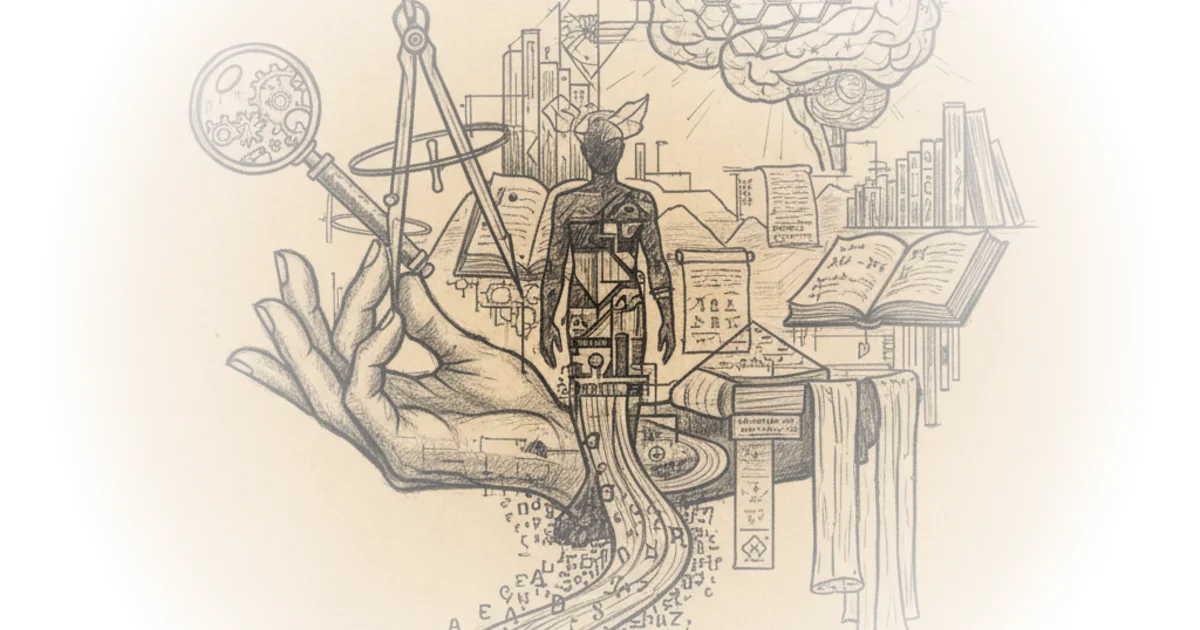
The essay opens with a striking metaphor. A writer, over time, becomes a builder of perceptual instruments -- "sharp tools for reading the world." This is not mere craft talk. The author positions the writer's vocation as something closer to what a contemplative does: constructing an interior architecture capable of receiving meaning that rational discourse alone cannot deliver.
"Knowing" is the accumulation of human experience and expertise -- a toolbox of instruments that manages the delicate perception of our inner garden and projects the description of the petals of our flowers: the garden spoken of by artists and mystics.
The metaphor of the "inner garden" draws explicitly from the Spanish mystics -- Saint John of the Cross and Saint Teresa of Avila -- and their tradition of describing the soul's interior landscape through botanical and architectural imagery. It is a rich lineage, and the author clearly feels at home in it. But there is a tension here that the essay does not fully resolve: is the writer's toolbox something built through craft and discipline, or is it a gift received through spiritual surrender? The essay seems to want it to be both, but never quite explains how those two modes of knowing cooperate rather than compete.
Blood, Genetics, and Religious Ritual
One of the essay's more unexpected moves is an analogy between the Jewish ritualization of blood and modern genetics. The argument runs roughly as follows: Jewish tradition protected blood from "trivial manipulation" for five thousand years, encoding an intuitive understanding of hereditary importance. Modern genetics, arriving in the nineteenth century, reached a parallel conclusion through scientific method. Therefore, religious knowledge and scientific knowledge are not opposed but rather different channels for the same truths.
This is an interesting argument, but it rests on a shaky foundation. The Jewish dietary and sacrificial laws concerning blood were rooted in theological convictions about the blood as the seat of life -- a concept from Leviticus 17:11 -- not in proto-genetic reasoning about hereditary traits. Drawing a straight line from kosher laws to Mendelian genetics requires ignoring the entirely different purposes these knowledge systems served. The analogy flatters both sides but explains neither.
Eliade, Myth, and Sacred Concentration
The essay invokes Mircea Eliade's work on myth and sacred experience, arguing that myth functions as a "synthetic source" through which transcendental experience travels across time. This is a reasonable, if compressed, reading of Eliade. But the author quickly moves from Eliade's phenomenological approach -- which deliberately brackets questions of truth in favor of describing structures of religious experience -- to a confessional claim that the Holy Spirit's testimony requires "delicate awareness, focused wonder and reverence."
Sacred knowledge is not ideology or dogma. It is an active principle of integration into a cosmos perceived through individual resources.
Eliade himself would likely have resisted this move. His project was descriptive, not prescriptive. He wanted to understand how sacred experience functions across cultures, not to advocate for any particular tradition's claims. The essay conscripts Eliade into a Latter-day Saint theological framework in a way that, while intellectually creative, risks misrepresenting the scholar's actual position.
Simone Weil and the Paradox of Incarnation
The essay's most compelling intellectual moment comes through Simone Weil. The author quotes her on the paradox of saintly incarnation:
After tearing the soul from the body and passing through death toward God, the saint must re-incarnate in order to radiate divine light in the world. Conversion must become concrete; otherwise, it remains only a dream. The perfect imitator of God first disembodies, then incarnates.
This is vintage Weil: paradoxical, severe, and luminous. The saint must first undergo a kind of death -- a stripping away of ego, comfort, and worldly attachment -- before returning to the body and the world as a vessel for something beyond the self. It is a pattern that echoes Christ's own death and resurrection, and Weil means it to be taken with full seriousness.
What makes this quotation's placement interesting is that Weil herself was famously resistant to institutional religion. She attended Mass but refused baptism. She was drawn to Catholicism but also to Greek philosophy, Hindu scripture, and the Cathars. Placing her alongside Book of Mormon scripture and Latter-day Saint conversion narratives creates an unusual theological constellation. Weil would almost certainly have been uncomfortable in that company -- but the author's willingness to draw from such disparate sources suggests a mind genuinely hungry for truth wherever it appears, even at the cost of intellectual tidiness.
Concha Urquiza and the Poetry of Longing
The inclusion of Concha Urquiza's sonnet "To Jesus Called Christ" is one of the essay's strongest decisions. Urquiza, a Mexican poet who drowned at thirty-five under mysterious circumstances, wrote devotional poetry charged with erotic intensity and spiritual anguish. Her sonnet captures the paradox of loving God while feeling unworthy of that love:
I only want to live to seek you / I only fear dying before finding you / I only feel alive when I call you; / And although I live burning in living fire, / Since I deny you my entire will / I do not dare to tell you that I love you.
These lines carry the emotional weight that the essay's more discursive passages sometimes lack. Urquiza does in fourteen lines what the surrounding prose attempts across several pages: she makes sacred longing feel real, bodily, and costly. The poem also quietly undermines the essay's occasional tendency toward triumphalism about sacred knowledge. Urquiza's speaker does not possess certainty. She possesses desire -- burning, self-doubting, unresolved desire. That is a far more honest description of most people's spiritual experience than confident talk of "testimony" and "confirmation."
The Conversion Narrative
The essay's final sections shift into personal testimony. The author describes encountering the Book of Mormon, finding it initially incomprehensible, and then gradually sensing something beneath the text -- not rational understanding but aesthetic and spiritual resonance. Logic fell silent. Silence became beauty. The story culminates in an encounter with the Book of Ether's narrative of the brother of Jared, whose illuminated stones and transported bees become, for the author, images of divine guidance and sweetness.
As conversion narratives go, this one is refreshingly honest about the confusion and resistance that preceded acceptance. The author does not pretend that the Book of Mormon made immediate rational sense. Instead, the text worked on a different register -- poetic, intuitive, felt rather than argued. For readers who share the author's faith commitments, this will resonate deeply. For those who do not, it raises a question the essay never addresses: how does one distinguish genuine spiritual perception from the powerful human tendency to find meaning in what one wishes to be true?
Bottom Line
This essay is the work of a poet-theologian writing at the intersection of Spanish mysticism, Latter-day Saint scripture, and Continental philosophy. Its strengths are its intellectual ambition, its genuine love of language across traditions, and its inclusion of Concha Urquiza's devastating sonnet. Its weaknesses are structural: the argument meanders, the analogies sometimes strain, and the shift from scholarly analysis to personal testimony happens without adequate signposting. Readers drawn to mystical literature and cross-traditional theology will find much to chew on. Those looking for a tightly reasoned argument will find the essay's associative, poetic logic either liberating or frustrating -- and possibly both at once.