Fred Mills doesn't just report on a construction project; he frames the completion of the Rogun Dam as the resurrection of a Soviet "fever dream" that could fundamentally rewrite the energy map of Central Asia. While many outlets focus on the geopolitical friction between Tajikistan and its neighbors, Mills digs into the sheer engineering audacity required to build a structure taller than the Eiffel Tower in one of the world's most seismically active zones. This is a story about how a half-century-old ambition is finally colliding with modern reality, for better or worse.
The Ghost of Soviet Ambition
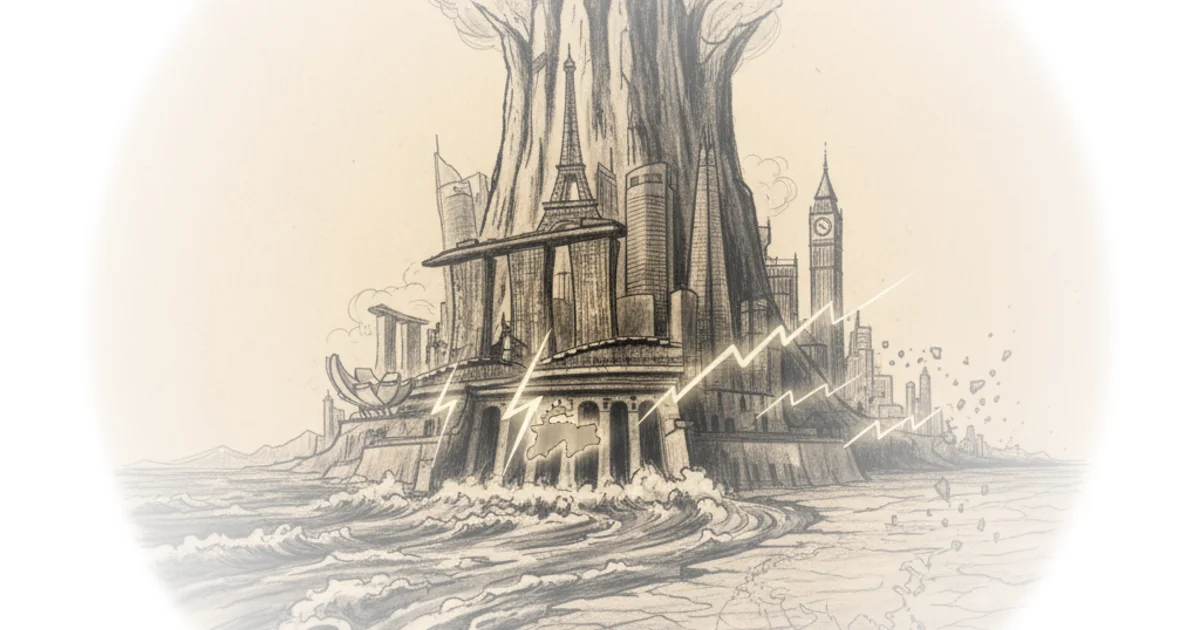
Mills anchors his narrative in the sheer scale of the undertaking, asking readers to visualize a dam so massive it would "overshadow Paris, Singapore, and well, actually, most cities." This hyperbole serves a purpose: it immediately establishes that we are not talking about a standard hydroelectric project, but a monument to human will. He traces the lineage of this ambition back to the Soviet era, noting that the USSR was "famous for launching absolutely enormous construction schemes, often in extreme conditions and at immense human and financial costs."
The author effectively uses the Bratsk Dam in Siberia as a historical precedent, describing it as a structure where "the horizontal pressure of the reservoir physically can't push it over or slide it downream." By explaining the mechanics of a gravity dam through the analogy of a "giant wedge of concrete anchored into rock," Mills makes complex engineering accessible without dumbing it down. He highlights the brutal conditions of the original Soviet efforts, where workers faced temperatures plunging below -40°C and had to heat concrete just to stop it from freezing. This historical context is crucial; it suggests that the current project is not just about electricity, but about finishing a legacy that was abandoned due to political and economic collapse rather than technical impossibility.
"The Rogan Dam would never have been possible without the innovation and engineering might that these other dams had brought."
Critics might argue that Mills glosses over the human cost of these Soviet "legends," particularly the resettlement of 30,000 people for the Bratsk reservoir and the environmental devastation linked to the Aral Sea disaster. While he mentions the "water mismanagement in Central Asia," the focus remains heavily on the engineering triumph rather than the ecological or social scars left by such massive interventions.
A Century of Stalled Dreams
The narrative takes a sharp turn when Mills details the project's long stagnation. He notes that construction began in 1976, only to be derailed by the "ongoing Afghanistan war, the arms race, and the Chernobyl cleanup." The collapse of the Soviet Union left the unfinished dam as a "giant project" that the newly independent Tajikistan lacked the money or expertise to finish. Mills paints a grim picture of the 1990s, where the site was "looted, equipment was destroyed, and many engineers and workers fled."
This section is vital because it explains why the project is so contentious today. The dam was never just a local issue; it was a Soviet-era plan designed to create an "integrated central Asian grid." As Mills points out, downstream republics like Uzbekistan feared the dam would give Tajikistan "too much control over water flows critical for cotton irrigation." This geopolitical tension is the elephant in the room that has kept the dam unfinished for decades. Mills argues that the project was "far too ambitious for its own good" during the Soviet era, citing "unstable geology" and "massive amounts of expensive tunneling" as the primary hurdles.
"By the 1980s, under Brezhnev and then Gorbachev, the USSR faced stagnation and limited resources for giant infrastructure projects like this."
The author's coverage of the financial struggles is particularly sharp. He notes that even when the project was revived in the 2000s, the costs spiraled into the "tens of billions of dollars," and a national campaign to have citizens buy shares "failed to generate enough funding." This highlights a recurring theme in mega-projects: the gap between the vision and the wallet. The eventual takeover by the Italian firm Salini Impregilo (now Webuild) marks a new chapter, but the shadow of the past looms large.
Engineering Against the Earth
Perhaps the most compelling part of Mills' analysis is his breakdown of the seismic challenges. He draws a fascinating parallel between the dam and "super tall skyscrapers" like the JPMorgan Tower in Tokyo, which use base isolation and mass dampers to survive earthquakes. However, he quickly pivots to the unique difficulty of dam construction: "A dam can't be separated from its base. It has to be firm and solid and hold back thousands of liters of water, an almost unimaginable weight."
Mills explains the solution with clarity: the Rogun Dam is designed as a "rockfill embankment dam with a central clay core." Unlike rigid concrete structures, this design allows the dam to be "flexible," meaning it can "move in an earthquake without cracking." He describes the material as behaving "somewhat like a cushion," capable of settling and compressing without catastrophic failure. This technical detail is essential for understanding why the project is finally feasible now, decades after it was deemed too dangerous.
"They really can't overprepare for this situation. Rogan dams in a zone where quakes of magnitude 7 or even 8 are possible."
The author also details the massive diversion tunnels required to dry out the riverbed, noting that four tunnels, each up to 1.5 km long, were necessary to channel the river around the site. This engineering feat, combined with the reinforcement of foundations to prevent liquefaction, underscores the immense risk involved. While Mills presents these solutions as triumphs of modern engineering, a counterargument worth considering is whether any structure, no matter how well-designed, can truly withstand a magnitude 8 earthquake in such a volatile region. The stakes of failure are simply too high to ignore.
Bottom Line
Fred Mills delivers a masterclass in contextualizing a mega-project, successfully weaving together Soviet history, geopolitical tension, and cutting-edge engineering to explain why the Rogun Dam matters now. His strongest argument lies in the comparison between the dam's flexible design and the rigid failures of the past, offering a plausible path forward where others have seen only dead ends. However, the piece's biggest vulnerability is its relative silence on the long-term environmental and diplomatic fallout; while the engineering may hold, the political and ecological tensions it exacerbates remain unresolved.
"The Rogan Dam would never have been possible without the innovation and engineering might that these other dams had brought."
Readers should watch for how the dam's completion shifts the balance of power in Central Asia, as the technical success of the structure may well trigger a new wave of regional conflict over water rights.