This analysis cuts through the usual geopolitical noise to reveal a startling economic paradox: Hong Kong's prosperity was built not on open markets, but on a deliberate, state-enforced scarcity of land. PolyMatter argues that the city's unique model—artificially restricting supply to fund world-class services while maintaining low taxes—was a fragile equilibrium that has now shattered. For busy leaders tracking global capital flows, understanding this structural collapse is essential, as it signals a fundamental shift in where the world's safest capital can reside.
The Architecture of Scarcity
The piece begins by dismantling the myth of land shortage, a common misconception in crowded metropolises. PolyMatter writes, "Clearly there's no shortage of land; in fact, 75% of the city's entire surface is completely empty, occupied only by wild boars, snakes and monkeys." This visual contrast between the dense urban core and the untouched wilderness sets the stage for the central thesis: the crisis is political, not geographical. The government, holding a monopoly on land, intentionally releases a "tiny sliver" of available acreage to the highest bidder, effectively creating billions in revenue "out of thin air."
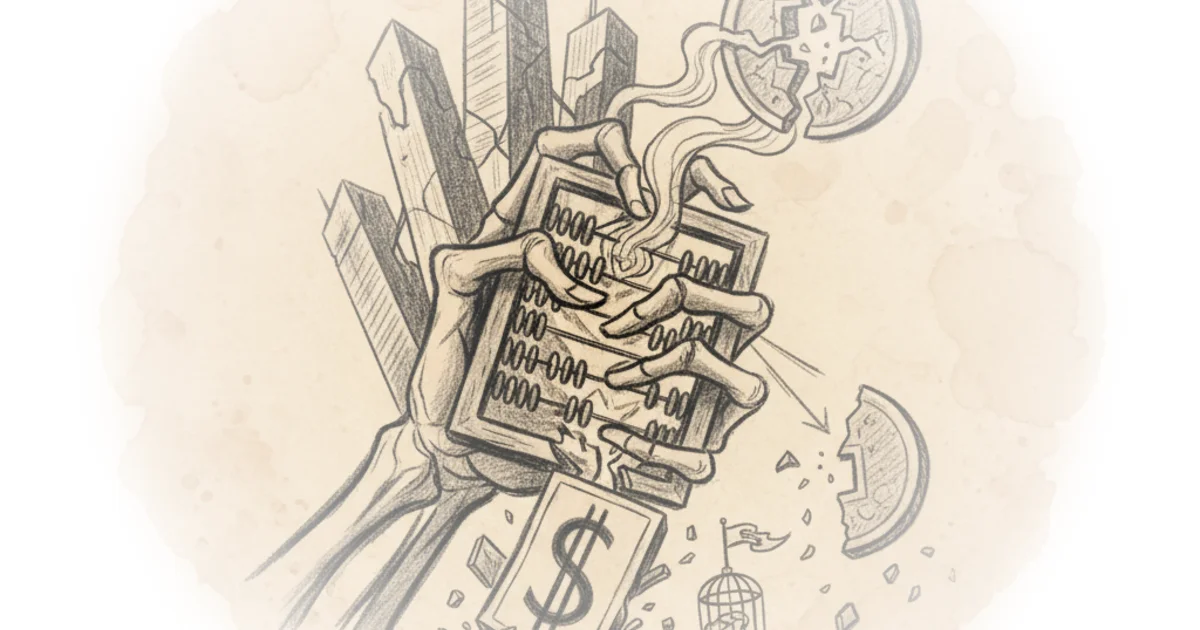
This strategy allowed the administration to maintain some of the lowest tax rates on the planet. As PolyMatter notes, "The average Hong Konger pays far, far less... about 2%," with no sales or capital gains tax. The argument here is compelling because it reframes the city's low taxes not as a gift, but as a direct subsidy from the inflated real estate market. However, this model had a critical flaw: it required a constant influx of wealthy buyers to sustain the bubble. Locals were priced out, and expats were too few. The solution, PolyMatter suggests, was a "bottomless source of demand right next door called China."
"The goal is to inflate prices by artificially reducing the supply of land... each year the government puts a tiny... sliver of the other 75% up for auction which it sells to the highest bidder."
The Flight of Capital and the Illusion of Safety
The commentary then pivots to the psychological drivers behind this capital flight. The narrative posits that Chinese elites, despite their wealth, lived in a state of perpetual anxiety regarding the rule of law on the mainland. PolyMatter illustrates this volatility: "In 2021 the 100 billion private tutoring industry was wiped off the Earth with a stroke of a pen." The argument is that Hong Kong served as a unique "safe haven" where money could escape the arbitrary reach of the executive branch in Beijing.
This dynamic relied on a specific political condition: "freedom without democracy." PolyMatter explains that the lack of democratic accountability prevented voters from demanding more housing, which would have collapsed the land-revenue model. Simultaneously, the presence of independent courts and free movement of capital made the city attractive to those fleeing mainland uncertainty. The author writes, "Hong Kong uniquely was stuck somewhere in between... it had freedom without democracy." This framing is sharp, identifying the precise institutional balance that made the city's economy work. Critics might argue that this ignores the deep social resentment caused by such extreme inequality, but the piece correctly identifies that the system was designed to prioritize capital efficiency over social equity.
The Unraveling of the Paradox
The turning point of the analysis is the imposition of the National Security Law, which PolyMatter argues destroyed the very mechanism that made Hong Kong valuable. The law created a "second parallel court system" that is "most certainly not fair or independent." The consequence is immediate and severe: if the legal system can no longer guarantee the safety of assets, the primary reason for moving money to Hong Kong evaporates.
PolyMatter puts it bluntly: "Why should you, a Chinese supermarket or property mogul, take your money to Hong Kong if it isn't any safer?" The result is a collapse in demand, with land sales hitting their lowest levels since the Great Recession and the city running persistent deficits. The author notes that "two of the five auctions had to be cancelled after no one offered more than the minimum bid." This evidence strongly supports the claim that the economic model is no longer viable. The city now faces a brutal choice: raise taxes and lose its competitive edge, or cut spending and degrade its world-class public services.
"Now that alone would be bad enough but it gets worse: Hong Kong is also caught in the middle of the US-China trade war... the city's best and brightest, its future workforce, is fleeing."
The Erosion of Human Capital
Beyond the financial metrics, the commentary highlights a more insidious threat: the loss of human capital. The piece describes how the government replaced critical thinking in schools with "patriotic rote memorization," a move that alienates the very talent pool needed for a modern economy. PolyMatter observes that "thousands of highly educated, high earning, often English-speaking families have escaped... for all these reasons demand for property has plummeted." This brain drain is perhaps the most irreversible damage, as it strips the city of its future innovators and professionals.
The analysis suggests that Hong Kong is becoming indistinguishable from the mainland, losing its unique selling proposition. The author warns that the city is "slowly lose the very things that make it special," transforming from a global hub into just another Chinese city with high costs and low freedom. This trajectory poses a significant risk to the global financial architecture that has long relied on Hong Kong as a bridge between East and West.
Bottom Line
PolyMatter's strongest contribution is the clear linkage between land policy, political autonomy, and economic viability, demonstrating that the three were inextricably linked. The argument's vulnerability lies in its assumption that the mainland elite have no other options; while Singapore and London are alternatives, the cultural and logistical proximity of Hong Kong may still offer a residual advantage. The critical takeaway is that the era of Hong Kong as a unique, semi-autonomous financial fortress is over, and the global economy must adjust to a new reality where capital safety is no longer guaranteed in the region's most prominent hub.
"Without freedom and democracy, Hong Kong begins to look more and more like mainland China, and the more it looks like China, the less advantage it has over China."