The Franklin's Tale: Where Medieval Romance Meets Modern Marriage Ideals
Chaucer's "The Franklin's Tale" stands as a unique intersection point in the evolution of romantic literature—a Breton lay that emerged from centuries of French storytelling tradition yet arrives at something startlingly modern. The tale, embedded within The Canterbury Tales, proposes a marriage built on mutual respect rather than subjugation, and it does so by playing with the conventions of courtly love in ways that still feel radical today.
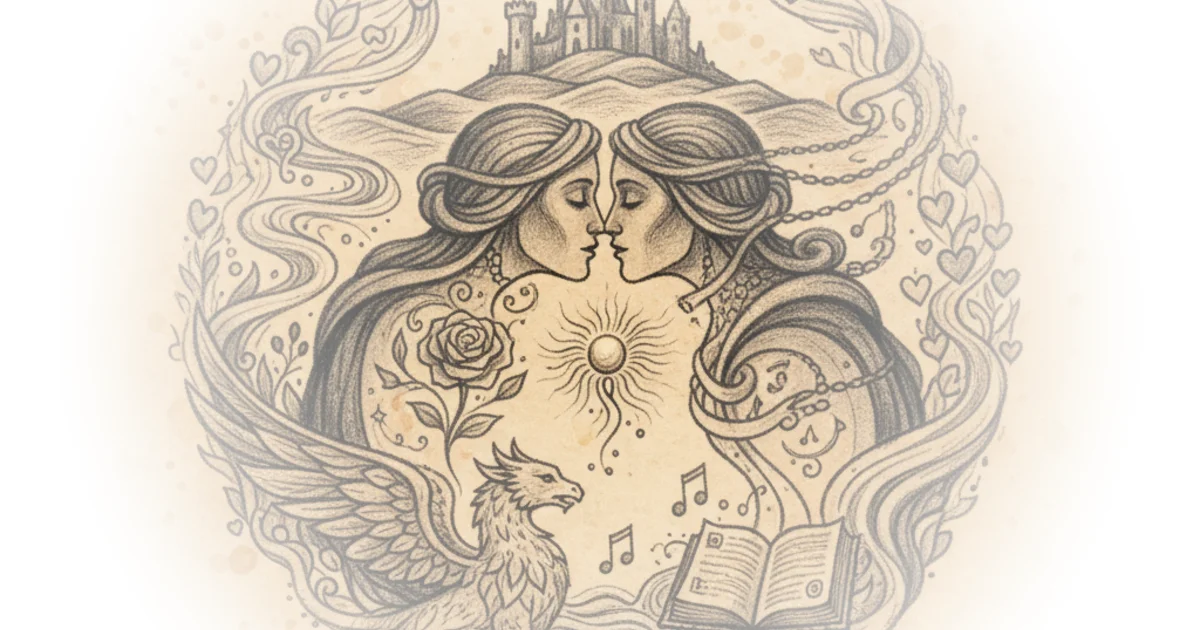
The Lays: A Cross-Channel Tradition
The Breton lays trace their roots to the French storytelling tradition. Marie de France wrote in Anglo-Norman French—the dialect of Norman French that developed in Britain after William the Conqueror's 1066 invasion—while Chaucer composed in Middle English, a blend of Old English and the French inheritance.
This shift reflects a profound transformation in the English language itself. After 1204, when King John lost Normandy and political separation from France occurred, English began reclaiming prominence in the court. By Chaucer's era in the late 14th century, Middle English had become dominant—a linguistic evolution that mirrors the social changes occurring across medieval England.
The Franklin's Tale specifically draws from this long tradition of Breton lays: stories of magic, romance, folklore, and the pains of erotic love. But Chaucer adapts these elements into something distinctly innovative for his time.
Who Is the Franklin?
The Franklin in The Canterbury Tales represents something new: a wealthy freeborn landowner, symbol of the rising middle class. He served as sheriff and member of parliament—respected but not noble. His character is defined by generosity, honor, and an almost obsessive dedication to hospitality. Chaucer describes him as an older man with a white beard, riding his horse, worthy in the epic tradition.
The Franklin embodies what would become the most representative English figure: the everyman of the late Middle Ages. He's morally invested in comfort, food, and hospitality—interested in freedom and liberty. It's fitting that he tells this particular tale, as it was inspired by the native Breton lay form while imagining new concepts of gentility.
The Tale's Core: Mastery Versus Gentleness
The story centers on Arveragus and Dorin—their marriage defined by a distinct separation between mastery and gentleness. This dynamic mirrors what Marie de France explored in her own lays, where she placed these two forms of love at odds: control versus freedom.
In Laustik, the jealous husband slays the lady; in Guimar, the hero's love is imprisoned within a walled garden because her husband fears she might love another. These are tales of mastery—control exercised over women. But in Lanval, redemption comes when the lady generously overlooks transgression and rescues him.
Chaucer's Franklin's Tale proposes something different: mutual trust and honor between both parties. Neither partner holds sway over the other through obligation or subjugation.
The Birth of Romantic Love
The concept of romantic love as we understand it today was invented in this period—emerging from the troubadour tradition of southern France in the 12th century. C.S. Lewis noted in his work on courtly love that explaining romantic love to Augustine or Paul would be nearly impossible. The classical and early medieval worlds simply lacked a conception of it.
The rules of dating, ideals of compatibility, marriage based on mutual affection—all of these modern relationship conventions trace back to this literary moment. When the Franklin's Tale describes its vision of marriage—"Love is a thing as any spirit faith; women of kind desire and liberty, and not been constrained as a thrall"—it's revolutionary.
Love is a thing of freedom, not constraint.
This definition explicitly contrasts with the conventional marriages of the period, where wives were subject to husbands much like vassals to feudal lords. Arveragus swears of his own free will never to exercise any mastery over her in practice—though he must keep up appearances of sovereignty for society.
The Courtly Love Triangle
When Arveragus departs for adventures, Aurelius enters the narrative as the perfect courtier who sees Dorin dancing and becomes consumed with love. He's not a villain—he's courteous and honorable—and when he courts Dorin directly, she rejects him firmly. "No, I will stay true to who I am."
But then comes the rash vow—the moment of crisis that defines medieval romance narratives. Dorin promises to be true to Aurelius if he can remove those rocks from the coast. This rash promise becomes the catalyst for everything that follows.
A Counterargument Worth Considering
Some scholars might argue that framing this tale as proto-modern marriage idealizes the specific historical context. The Franklin's Tale still operates within feudal structures—Arveragus maintains sovereignty in appearance, and Dorin's promise emerges from a position of power imbalance. We shouldn't mistake Chaucer's nuanced exploration for genuine equality.
Bottom Line
The Franklin's Tale matters because it captures a pivotal shift in how Western literature conceptualizes love. Chaucer takes the Breton lay form—already centuries old—and transforms it into something that looks forward to modern relationship ideals: mutual respect, voluntary commitment, freedom within marriage rather than subjugation. The tale's biggest strength is this radical reimagining of what marriage could be. Its vulnerability lies in how much further the actual practice of equality still had to go.